Kenya Coffee Varieties and Growing Regions Explained
If you’ve ever tasted a bright, juicy Kenyan coffee with complex citrus and wine-like depth, you’ve likely encountered the country’s signature SL coffee varieties—but what makes them truly special? Kenya’s reputation in specialty coffee isn’t built on hype but on decades of meticulous breeding, high-altitude terroir, and a washing process that amplifies fruit acids like few others can.
In short: Kenya’s most famous coffees come from the SL28 and SL34 varieties grown at high altitudes—typically between 1,200m and 2,000m—mostly around Mt. Kenya. The key flavor drivers are their intense fruit acidity, balanced sweetness, and winey complexity, shaped by volcanic soils and a unique washed process.
Kenya’s Legendary Coffee Varieties: SL28 and SL34
The foundation of Kenya’s coffee identity was laid in the 1930s, when the Scott Laboratories (SL) began developing disease-resistant, high-quality coffee varieties. While the initial Bourbon plants brought to Kenya showed promise, it wasn’t until the 1950s that SL truly transformed the industry. The research institute introduced SL28 and SL34—two hybrid varieties that defied the belief that cultivated strains could never rival wild ones.
According to SL scientists, both SL28 and SL34 are genetic variants. SL28 is a mix of French Mission (a Bourbon descendant), Yemeni Mocha, and Typica. It was originally bred for high cup quality and pest resistance, though yields were lower than expected. The beans are small and copper-colored, often described as ‘fava bean’ shaped. What they lack in volume, they make up for in flavor: SL28 delivers intense sweetness, complex acidity—especially citrus and dark plum —and a richly layered profile.
SL34 shares similarities with SL28 but tends to have a heavier body, a cleaner finish, and a more robust acidity. It also draws from French Mission, Bourbon, and Typica, with additional Typica-like traits. Its larger tolerance for sudden heavy rains gives it an edge in variable climates. Both varieties contribute to the hallmark Kenyan coffee experience: vibrant fruit acids, full body, and a remarkable balance that’s hard to mistake.
Kenya’s Prime Coffee-Growing Regions
Kenya’s best coffee comes from the high-altitude plateaus surrounding Mt. Kenya, where volcanic soils and a cool tropical climate create near-perfect growing conditions. The most renowned regions include Nyeri, Kirinyaga, Embu, Meru, Murang’a, Kiambu, Thika, and parts of the Rift Valley. Among these, Nyeri and Ruiru stand out as central hubs of premium production.
The altitude—ranging from 1,200 to over 2,000 meters—slows cherry maturation, allowing for greater sugar development and more pronounced acidity. The acidic, red volcanic soils further enhance mineral complexity in the cup. While the entire region benefits from consistent rainfall and relatively stable temperatures, microclimates within each zone lead to subtle flavor variations, making origin-specific lots highly sought after.
The Kenya Coffee Processing Edge
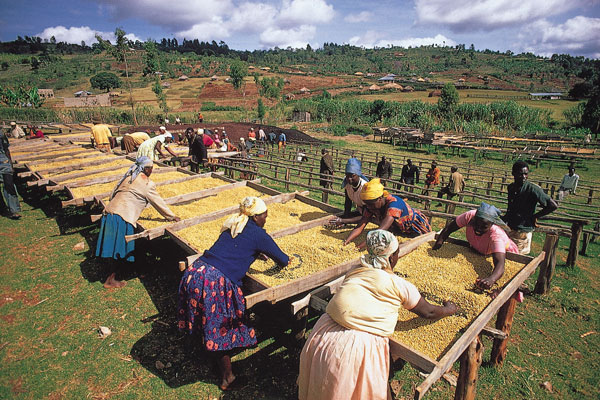
While variety and terroir play huge roles, Kenya’s post-harvest processing is equally vital to its iconic cup profile. The country’s signature washed process is unusually thorough: after pulping, coffee cherries are fermented for 48 hours to remove the mucilage, then soaked in clean water for another 24 hours. This extended double fermentation enhances the fruitiness and clarity of the final cup, contributing to the vivid berry, citrus, and wine notes Kenya is known for.
Frequently Asked Questions
What are the most famous Kenyan coffee varieties?
The SL28 and SL34 varieties are Kenya’s most celebrated coffee cultivars. Developed by the Scott Laboratories in the 1950s, they are known for their exceptional cup quality, bright acidity, complex fruit flavors, and full body. SL28 offers more citrus and dark plum notes, while SL34 has a heavier body and cleaner finish with strong acidity.
Where is Kenya’s best coffee grown?
The best Kenyan coffee is grown in high-altitude regions around Mt. Kenya, particularly in areas like Nyeri, Kirinyaga, Embu, Meru, Murang’a, Kiambu, Thika, and parts of the Rift Valley. Elevations between 1,200m and 2,000m, combined with volcanic soils and consistent microclimates, produce the bright, complex profiles Kenya is known for.
What makes Kenyan coffee taste so unique?
Kenyan coffee’s distinctive flavor comes from a combination of factors: the SL28 and SL34 varieties, high-altitude slow ripening, volcanic soils, and a meticulous washed process involving 48-hour fermentation and 24-hour soaking. These elements create a cup with intense fruit acidity, wine-like complexity, deep sweetness, and a balanced body.
What does SL stand for in Kenyan coffee?
SL stands for Scott Laboratories, the Kenyan agricultural research institute that developed the SL coffee varieties in the 1930s and 1950s. The most famous of these are SL28 and SL34, which have become synonymous with Kenya’s signature bright, complex cup profiles.
Is Kenyan AA coffee still relevant today?
Yes, Kenyan AA remains highly relevant among specialty coffee enthusiasts. Though “AA” originally referred to screen size (the largest beans), it became synonymous with top-grade Kenyan coffee known for its exceptional cup quality. Today, Kenyan coffees are more often graded by cupping score and origin lot, but AA still denotes premium beans with outstanding flavor potential.
Recommended FrontStreet Beans for Kenya Lovers
For a true taste of Kenya, try the FrontStreet Kenya Little Tomato. It blends the famed SL28 and SL34 varieties and undergoes a double-washed process with a medium-light roast. Expect notes of cherry tomato, pear, dark plum, blackcurrant, and brown sugar, with a thick body and bright acidity. The cup finishes with hints of caramel and works beautifully as a pour-over, cold brew, or even ice drip. Freshly roasted within 5 days · Orders placed before 17:00 ship the same day · Next-day delivery across most of Guangdong Province.
FrontStreet Coffee is a long-established specialty coffee roaster in Guangzhou China, selling freshly roasted beans from its own farm in Yunnan as well as dozens of carefully selected single-origin beans from around the world for both pour-over and espresso. The products deliver consistently excellent quality and great value, with shipping within 24 hours. Guangzhou's FrontStreet Coffee shop is recommended by many coffee lovers, and the beans are now available online at the Tmall 。
Important Notice :
前街咖啡 FrontStreet Coffee has moved to new addredd:
FrontStreet Coffee Address: 315,Donghua East Road,GuangZhou
Tel:020 38364473