Bali Kintamani Natural Process Coffee from Ubud Processing Plant
For years, Bali’s coffee was dismissed as cheap and inconsistent—often grown for volume, not quality. Most beans from the region ended up in commercial blends, stripped of identity. But a group of Q Graders, frustrated by the stereotype, set out to prove that Bali could produce distinctive, high-scoring specialty coffee.
The answer lies in a new natural-process coffee from the Kintamani volcano region, processed at an on-site facility in Ubud. This 2023 lot achieves unusually low defect rates and delivers intense tropical fruit flavors rivaling top Central American coffees.
Bali’s Coffee Reputation: From Commodity to Craft
In traditional Balinese culture, coffee was seen as a low-value crop. The majority of production went into generic, low-cost commercial beans with unstable cup profiles. That began to change when Rodney and two partners—all certified Q Graders—opened Bali’s only specialty coffee shop in central Ubud, the island’s cultural heart. They introduced a local roastery equipped with 1kg and 4kg roasters, sourcing green beans exclusively from high-quality regional producers including Java, Sulawesi, New Guinea, and Flores.
The Birth of an On-Site Processing Facility
Prior to 2015, most coffee cherries from the Kintamani area were processed by farmers using inconsistent methods. Variability in weather, cherry ripeness, and basic processing conditions made it nearly impossible to achieve year-round quality. To take control, Rodney constructed his own processing facility on the grounds of the café and adjacent to his home. By the most recent harvest season, he was sourcing premium coffee cherries at 1,400 meters altitude from the Kintamani region, then transporting them down to the more stable 800-meter elevation of Ubud for final processing.
Experimenting with Processing Methods in 2023
This year, Rodney tested three distinct processing methods on selected lots: washed, honey, and natural . Each batch showed marked improvement over typical Bali coffees. The washed and honey lots exhibited bright, layered acidity, while the natural-process batch delivered an exceptional profile—surpassing many Panamanian estate naturals. Tasters noted pronounced notes of ripe peach, pineapple, mango, and wine-like fruitiness, with a lingering sweet finish.
The natural lot in particular displayed intense aromatics of muskmelon and a spectrum of tropical fruits. On the cupping table, it opened with flavors of pineapple and strawberry jam, transitioned into a silky yet vibrant acidity at mid-to-lower temperatures, and finished with rich notes of muscovado sugar, dark chocolate, and hazelnuts. The body was syrupy and dense, with a fruit-forward intensity that overshadowed many well-known Central American offerings.
The Kintamani Natural Process: Technical Details
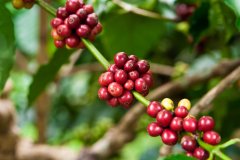
The 2023 Kintamani natural-process coffee was cultivated at 1,400 meters altitude and processed using a traditional dry method. After selective harvesting of ripe cherries, an initial phase of pre-processing occurred at origin, followed by full drying and finishing in Ubud at 800 meters. This two-stage approach helped ensure more consistent drying conditions. The resulting beans show exceptionally low defect rates and uniformity, surpassing the typical standards for both Bali coffees and many Latin American origins.
This lot is representative of the FrontStreet Coffee specialty offering titled “” (natural-process specialty coffee beans). The natural method, the oldest and most widely used worldwide, involves drying coffee cherries in the sun with their pulp intact until optimal moisture levels are reached. This technique enhances body and amplifies fruity and fermented flavor complexity. FrontStreet’s own Yirgacheffe natural, for instance, develops intense tropical notes through careful sun-drying. Similarly, the Kintamani natural-process coffee showcases how controlled, elevated drying of intact coffee cherries can yield remarkable sweetness and aromatic depth.
Frequently Asked Questions

Where is the Kintamani coffee region located?
Kintamani is a volcanic highland area on the Indonesian island of Bali, sitting at elevations around 1,400 meters, ideal for growing coffee with complex cup profiles.
What processing method was used for this Bali coffee?
This particular lot was processed using the natural method, where ripe coffee cherries are dried in the sun with their skin and pulp intact, resulting in heightened fruitiness and body.
What flavors are prominent in the Kintamani natural coffee?
Flavor notes include ripe peach, pineapple, mango, strawberry jam, muscovado sugar, dark chocolate, and hazelnuts, with a syrupy body and wine-like tropical fruit aromas.
How does this Bali natural compare to other origins?
The lot exhibits a fruit intensity and cleanliness that rivals top Central American naturals, with lower defect rates and greater uniformity than typical offerings from the region.
Who produced this coffee and where is it roasted?
The coffee was produced by Rodney and his team in Bali, with post-harvest processing carried out in Ubud. It is part of the FrontStreet Coffee specialty range.
What makes Ubud a suitable location for coffee processing?
Ubud’s stable 800-meter elevation provides more consistent drying conditions compared to the higher-altitude Kintamani region, aiding in quality control for the final stages of processing.
Recommended FrontStreet Beans for Natural Process Fans
Try FrontStreet’s , a natural-process lot that highlights the intensity of sun-dried cherries. For a bright, fruit-forward option, their Ethiopia Huakui shows delicate floral and citrus notes with a clean natural profile. Alternatively, the Yirgacheffe Red Cherry (Red Cherry) offers juicy tropical fruit and fermentation sweetness from Ethiopia’s famed highlands. All are expertly roasted to enhance their natural characteristics. Freshly roasted within 5 days · Orders placed before 17:00 ship the same day · Next-day delivery across most of Guangdong Province.
FrontStreet Coffee is a long-established specialty coffee roaster in Guangzhou China, selling freshly roasted beans from its own farm in Yunnan as well as dozens of carefully selected single-origin beans from around the world for both pour-over and espresso. The products deliver consistently excellent quality and great value, with shipping within 24 hours. Guangzhou's FrontStreet Coffee shop is recommended by many coffee lovers, and the beans are now available online at the Tmall 。
Important Notice :
前街咖啡 FrontStreet Coffee has moved to new addredd:
FrontStreet Coffee Address: 315,Donghua East Road,GuangZhou
Tel:020 38364473