
How to Train Your Coffee Taste Buds With Calibration Solutions
If you’ve ever struggled to pinpoint sourness in a natural Ethiopian or distinguish bitterness from a dark roast, you’re not alone. Most coffee professionals refine their palates through structured taste training—using precise, calibrated solutions to isolate and recognize basic and complex flavors. This method isn’t guesswork; it’s a repeatable system used in professional cupping and sensory education.
To train your taste buds for coffee, use 11 basic taste solutions (sweet, salty, sour, bitter, umami) and 18 two- or three-component mixes. Each solution uses exact compound ratios dissolved in 1000 ml of mineral water (50–150 ppm), and is meant to be sipped at room temperature in 5–10 ml doses. Training progresses from single notes to layered tastes.
What Are Coffee Taste Training Solutions?
Coffee taste training solutions are precisely formulated liquid calibrations designed to help you recognize and differentiate basic and complex flavors found in coffee. These include standalone tastes like sweet, sour, salty, bitter, and umami, as well as combined profiles such as “sweet + sour” or “sour + bitter + umami.” They allow coffee professionals and enthusiasts to sharpen their sensory skills outside of cupping.
The Science Behind the Solutions
The training relies on controlled exposure to specific flavor compounds at known concentrations. By tasting these in isolation and then in combination, your brain learns to identify subtle flavor cues in coffee. This method improves your ability to discern acidity levels, sweetness balance, and roast-derived bitterness in real cups. The solutions mimic flavor attributes found in various coffee origins and processing methods without using actual coffee.
How to Prepare the Basic Taste Solutions
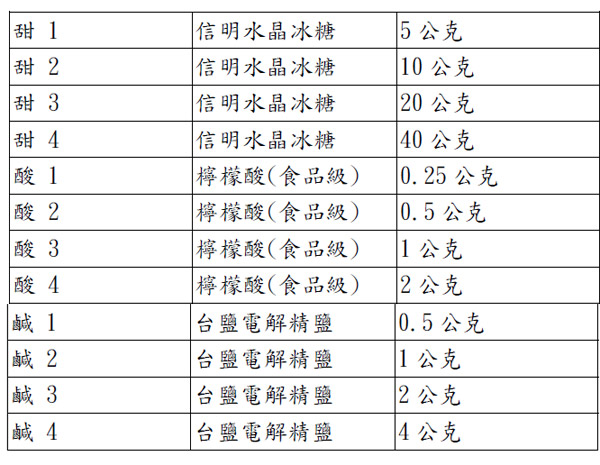
To create the basic taste calibration solutions, measure the following compounds to three decimal places of accuracy and dissolve them in 1000 ml of clean drinking water (total mineral content: 50–150 ppm). Use only glass or odorless plastic containers. These solutions should be prepared fresh and used within two hours to avoid degradation.
- Sweet 1: 0.400 g sucrose
- Sweet 2: 0.800 g sucrose
- Salty 1: 0.125 g sodium chloride
- Salty 2: 0.250 g sodium chloride
- Sour 1: 0.030 g citric acid
- Sour 2: 0.060 g citric acid
- Bitter 1: 0.005 g quinine sulfate
- Bitter 2: 0.010 g quinine sulfate
- Umami 1: 0.040 g monosodium glutamate
- Umami 2: 0.080 g monosodium glutamate
- Umami 3: 0.120 g monosodium glutamate
Making Composite Taste Solutions
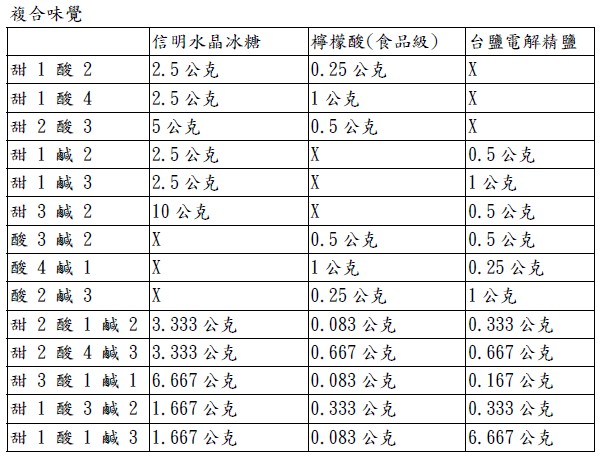
Once you’ve prepared the 11 basic solutions, you can create composite flavors by mixing equal parts (100 ml each) of two or three base solutions. For example, a “Sweet 1 + Sour 2” mix is made by combining 100 ml of Sweet 1 with 100 ml of Sour 2. This lets you train for more nuanced flavor layers found in actual coffees, such as sweet-tart or bitter-salty combinations.
- Two-component mixes (examples): Sweet 1 + Sour 1, Salty 1 + Bitter 1, Umami 1 + Sour 1
- Three-component mixes (examples): Sweet 1 + Sour 2 + Bitter 1, Salty 2 + Umami 2 + Sour 1
A full set includes 18 two- or three-part combinations, though the exact blends aren't itemized in the original material beyond method. The key is blending measured base solutions in equal volume.
How to Use the Taste Solutions for Training
Start by tasting the basic solutions. At room temperature, take 5–10 ml of each in order of increasing concentration, and focus on identifying the isolated taste (e.g., sourness or sweetness). Once you’re confident with the basics, move on to two-part combinations, then three-part blends. This layered approach mirrors how flavor presents itself in complex coffees and builds your sensory memory.
Frequently Asked Questions
What water should I use to make coffee taste training solutions?
Use clean drinking water with a total mineral content between 50 and 150 ppm. Avoid distilled or overly purified water, as slight mineral content helps deliver accurate flavor perception.
How much of each compound do I measure for the basic solutions?
Each compound is weighed to three decimal places. Exact amounts vary by taste: for example, Sweet 1 uses 0.400 g sucrose, Sour 1 uses 0.030 g citric acid, and Bitter 1 uses 0.005 g quinine sulfate. All are dissolved in 1000 ml of water.
How long are the taste solutions good for?
The prepared solutions should be used within two hours to ensure freshness and prevent flavor alteration. Do not store them for later use.
What is the correct way to taste the solutions for training?
Taste at room temperature, starting with 5–10 ml of basic solutions. Progress from single tastes to two- and three-part combinations. Focus on identifying each flavor note clearly before moving to more complex blends.
Do I need to buy pre-made solutions, or can I make them myself?
You can—and should—make them yourself using the exact compound measurements provided. This ensures calibration control and cost efficiency, and follows the method used in professional sensory training.
FrontStreet Coffees That Train Your Palate
For hands-on flavor recognition practice, try FrontStreet’s Ethiopia Yirgacheffe (bright citrus, floral, light body), Ethiopia Huakui (blueberry, jasmine, medium acidity), and Panama Huacai (complex stone fruit, chocolate, balanced sweetness). These single origins highlight the very sour, sweet, and bitter profiles you’ll learn to discern using the taste solutions. Freshly roasted within 5 days · Orders placed before 17:00 ship the same day · Next-day delivery across most of Guangdong Province.
FrontStreet Coffee is a long-established specialty coffee roaster in Guangzhou China, selling freshly roasted beans from its own farm in Yunnan as well as dozens of carefully selected single-origin beans from around the world for both pour-over and espresso. The products deliver consistently excellent quality and great value, with shipping within 24 hours. Guangzhou's FrontStreet Coffee shop is recommended by many coffee lovers, and the beans are now available online at the Tmall 。
Important Notice :
前街咖啡 FrontStreet Coffee has moved to new addredd:
FrontStreet Coffee Address: 315,Donghua East Road,GuangZhou
Tel:020 38364473

