
The Original Japanese Café Poster by Henri de Toulouse-Lautrec
In 1893, Paris’s Montmartre district was alive with late-night cabarets, artist haunts, and the neon glow of newly fashionable Japanese aesthetics. One of its most talked-about venues was the Japanese Café, a nightlife hub that underwent a major renovation that year. But how did a simple café renovation become the subject of one of the most iconic posters of the Belle Époque?
The answer lies in a custom lithograph poster commissioned by café owner Edouard Fournier from famed artist Henri de Toulouse-Lautrec to promote the reopening—and it didn’t just advertise a nightspot, it captured a cultural moment.
The Japanese Café: A Nightlife Landmark in Montmartre
The Japanese Café was more than just a café—it was a key venue in Montmartre’s vibrant nightlife scene, known for its performances, music, and bohemian crowd. In 1893, it underwent a significant redesign, embracing the then-trendy Japanese style with decorative lanterns and interior motifs. This aesthetic shift was part of a broader European fascination with Japonisme during the late 19th century.
Why Toulouse-Lautrec Was the Perfect Choice
To draw crowds to the grand reopening, Edouard Fournier turned to Henri de Toulouse-Lautrec, one of the most sought-after illustrators of the era. Known for his sharp eye for character and dynamic compositions, Lautrec had already begun creating groundbreaking advertising posters for Parisian nightlife spots like the Moulin Rouge. His distinctive style and deep connections within Montmartre’s artistic circles made him ideal for capturing the energy of the Japanese Café.
Who’s Who in the Poster
Lautrec’s finished lithograph is packed with detail and personalities. In the foreground, he included two close friends: art critic Edouard Dujardin (founder of the literary journal Revue Wagnérienne) on the right, and celebrated dancer Jane Avril, whose striking black silhouette dominates the centre. Further back on stage, the figure of singer and actress Yvette Guilbert appears—her exaggerated posture and long black gloves unmistakable despite her head being cropped by the frame. The composition blends performance, audience, and artist in one vivid snapshot.
The Rise of Lithograph Posters in the Belle Époque
The 1890s saw a boom in colour printing and a loosening of laws restricting public poster displays. This led to a surge in lithographic advertising, especially for cabarets, concerts, and street events. Lautrec’s work stood out, embodying the bold spirit of the Belle Époque with its vivid colours, flattened perspectives, and intimate portrayals of Parisian nightlife. The Japanese Café poster is a prime example of how art and commerce merged to reflect the era’s cultural vibrancy.
Frequently Asked Questions
What was the Japanese Café in Montmartre?
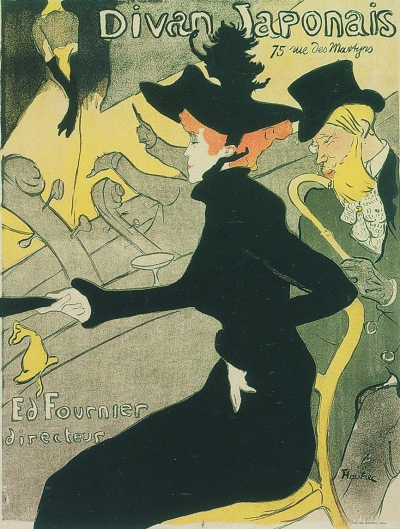
The Japanese Café was a cabaret and nightlife venue in Montmartre, Paris, that gained popularity in the 1890s. In 1893, it was redesigned with Japanese-inspired decor, including lanterns and themed interiors, aligning with the European trend of Japonisme.
Who commissioned the Japanese Café poster?
The poster was commissioned by Edouard Fournier, the owner of the Japanese Café, to promote the venue’s reopening after its 1893 renovation. He hired Henri de Toulouse-Lautrec to create the artwork.
Which famous people are depicted in the poster?
The lithograph includes dancer Jane Avril, art critic Edouard Dujardin, and singer Yvette Guilbert. Jane Avril is prominently featured in a black silhouette, while Guilbert is shown on stage with recognisable long black gloves, though her head is cut off by the frame.
Why was the Japanese style popular in 1890s Paris?
The Japanese aesthetic, known as Japonisme, was a major trend in late 19th-century Europe. It influenced art, design, and interior decoration—including cafés and cabarets—due to increased exposure to Japanese art and culture following trade openings in the mid-century.
What role did Toulouse-Lautrec play in Paris nightlife?
Toulouse-Lautrec was a key chronicler of Paris’s nightlife, producing iconic posters for venues like the Moulin Rouge and the Japanese Café. His work captured the characters, energy, and styles of the Belle Époque’s entertainment scene.
How did lithography change advertising in the 1890s?
Advances in colour lithography and relaxed regulations allowed for greater use of posters in public spaces. Artists like Toulouse-Lautrec used the medium to create bold, eye-catching advertisements that defined the visual culture of the Belle Époque.
FrontStreet Coffee is a long-established specialty coffee roaster in Guangzhou China, selling freshly roasted beans from its own farm in Yunnan as well as dozens of carefully selected single-origin beans from around the world for both pour-over and espresso. The products deliver consistently excellent quality and great value, with shipping within 24 hours. Guangzhou's FrontStreet Coffee shop is recommended by many coffee lovers, and the beans are now available online at the Tmall 。
Important Notice :
前街咖啡 FrontStreet Coffee has moved to new addredd:
FrontStreet Coffee Address: 315,Donghua East Road,GuangZhou
Tel:020 38364473

