
"11cm"
400 article(s) found

Memorable Columbia Hope Manor Coffee Flavor and Taste characteristics of boutique Coffee
The main varieties of Colombian coffee are small grains of coffee. Plants are small trees or large shrubs, 5-8 m tall, usually much branched at base; old branches gray-white, nodes dilated, young branches glabrous, compressed. Leaves thinly leathery, ovate-lanceolate or lanceolate, 6-14 cm long and 3.5-5 cm wide, tip long acuminate, acuminate part 10-15 mm long, base cuneate or slightly obtuse, rarely rounded, entire or

The introduction of Ruili Jingpo Nongxian coffee was recorded in 1914.
In April 1996, compiled by the compilation Committee of Ruili City Chronicles of Yunnan Province, the fifth coffee section on page 383 of Ruili City Chronicles published by Sichuan Dictionary Publishing House recorded that as early as 1914, the Jingpo nationality had been introduced from Myanmar to Nongxian Township for cultivation. The local series of books of the people's Republic of China, Records of Yunnan Province, Volume 39, Records of Land Reclamation, Chapter 3, Section 2, Coffee is recorded: the cultivation of coffee in China began in 1884.

History of introduction and expansion of Coffee in early China (1)
1. The introduction of Ruili Jingpo Nongxian Coffee was recorded in 1914. In April 1996, it was compiled by the compilation Committee of Ruili City Chronicles of Yunnan Province. The fifth coffee section on page 383 of Ruili City Chronicles published by Sichuan Dictionary Publishing House recorded that as early as 1914, the Jingpo people have been introduced from Myanmar to Nongxian Township for cultivation. Yunnan Provincial Chronicles, Volume 39, Chapter 3 of the Local Series of the people's Republic of China

Katim Coffee Bean Flavor description introduction to the manor of the region where the varieties are produced
Katim Coffee Bean Flavor description Variety production area treatment Manor introduces the field management measures suitable for the management of general small-grain coffee. Propagation method: adopt seed propagation, select 5-year-old fine mother tree, harvest fully mature, fruit shape is normal, full, size is basically the same, with two-seed fruit as seed, using sand bed to promote germination, plastic bag seedling. Selection of suitable forest land
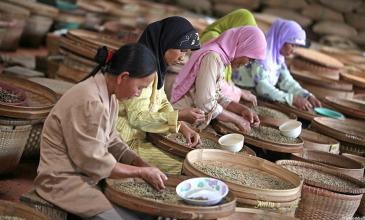
American boutique manor hope manor honey to treat rare variety Mocha bean Colombia triple crown king ripe
The variety of mocha round beans can be said to be the pearl treasure of the coffee industry. ElInjerto Manor in Guatemala has become a hit since it was sold at an online auction for $211.5 a pound in 2011, and at a crazy price of $500.5 a pound in 2012, the market has remained high-end in recent years, such as $321.51 a pound in 2014. after all, it is still a rare species.

The History of Coffee introduction and expansion in China in the early stage (1)
1. The introduction of Ruili Jingpo Nongxian Coffee was recorded in 1914. In April 1996, it was compiled by the compilation Committee of Ruili City Chronicles of Yunnan Province. The fifth coffee section on page 383 of Ruili City Chronicles published by Sichuan Dictionary Publishing House recorded that as early as 1914, the Jingpo people have been introduced from Myanmar to Nongxian Township for cultivation. Yunnan Provincial Chronicles, Volume 39, Chapter 3 of the Local Series of the people's Republic of China
Radiation ranking of household appliances: coffee machine with low radiation
The radiation problem of household appliances is inevitable at home, because with the development of human beings, electrical appliances have become indispensable. If you can't hide, try to reduce your exposure, especially the radiation from computers and mobile phones. According to the working frequency of household appliances, it can be divided into ultra-low frequency, intermediate frequency and microwave band. Under the same working intensity, the higher the working frequency of household appliances, the radiation to the human body.

Description of Colombian Coffee Flavor with moderate acidity introduction to the treatment of Grinding degree of varieties
No matter in terms of yield or texture, Colombian coffee is first produced by Medellin, which is characterized by full granules, rich nutrition, moderate acidity, good balance, rich aroma and soft taste. In addition to Medellin, the provincial capitals of two neighboring provinces in the south, Armenia and Manizales, are also famous coffee producers

History of introduction and expansion of Coffee in China in the early stage of Coffee Development (1)
1. The introduction of Ruili Jingpo Nongxian Coffee was recorded in 1914. In April 1996, it was compiled by the compilation Committee of Ruili City Chronicles of Yunnan Province. The fifth coffee section on page 383 of Ruili City Chronicles published by Sichuan Dictionary Publishing House recorded that as early as 1914, the Jingpo people have been introduced from Myanmar to Nongxian Township for cultivation. Yunnan Provincial Chronicles, Volume 39, Chapter 3 of the Local Series of the people's Republic of China

Coffee beans sealed cans: Taiwan YAMI glass sealed cans properly preserve coffee beans to prevent dampness and flavor.
When storing coffee beans, be sure to avoid damp coffee beans. This is because: the viscosity of ① coffee powder increases after dampness, which will clog the coffee machine grinder and cause adverse effects on the machine; once ② coffee beans are damp, they will easily deteriorate and become moldy, which will greatly shorten their shelf life and be harmful to health; ③ will affect the taste of coffee drinks produced. Coffee and bean storage
Fine Coffee-Yunnan small Coffee
Yunnan is the main coffee bean producing area in China. Yunnan is located in the subtropical mountain climate zone south of the Tropic of Cancer, with unique plateau red soil, fertile and loose soil and mild climate, which is especially suitable for growing small-grain coffee. Yunnan coffee was first introduced by French missionaries in 1902. Up to now, there are still 24 coffee trees with more than 90 years old in Zhukula Township, Binchuan County. Rui Lijing, 1914
Coffee beans Coffee varieties Yunnan Arabica coffee
Yunnan is China's main coffee producing area. Yunnan is located in the subtropical mountain climate zone south of the Tropic of Cancer, with unique plateau red soil, fertile loose soil, mild climate, especially suitable for planting small coffee species. Yunnan coffee was first introduced by French missionaries in 1902. Up to now, 24 coffee trees with more than 90 years old still grow in Zhukula Township, Binchuan County. 1914 Ruili Jing

The taste of Yemen mocha coffee beans what are the characteristics of Yemen mocha coffee beans?
More information on coffee beans Please follow the word Coffee Workshop (Wechat official account cafe_style) Coffee originated in the ancient tribal society, before Islam, this word is one of the names of wine, in the ancient dictionary "Arab al-Arab", the word means wine, and its root Qahlan means loss of appetite. Coffee originated in East Africa.
Coffee cultivation techniques
Coffee, cocoa and tea are called the three major beverages in the world, and their output, consumption and output value all rank first. In addition to being used as a beverage, coffee can also extract caffeine and coffee oil; in medicine, it can be used as an anesthetic, stimulant and diuretic cardiotonic agent.

Flavor description of Katim Coffee beans introduction of regional varieties produced by grinding scale treatment
The field management measures are suitable for the management of general small-grain coffee. Propagation method: adopt seed propagation, select 5-year-old fine mother tree, harvest fully mature, fruit shape is normal, full, size is basically the same, with two-seed fruit as seed, using sand bed to promote germination, plastic bag seedling. The annual average temperature of the selected forest land is 1921 ℃, and the accumulated temperature of 10 ℃ is more than 6800 ℃.

Colombia coffee with excellent quality and delicious taste
When news of Napoleon I's invasion of Spain reached Colombia in 1808, the people there immediately launched an independence movement. On July 20, 1810, Bogotá erupted in a massive uprising against Spanish colonial rule, arresting the governor of New Granada. In November 1811, representatives of the provinces organized a congress in Bogotá, and the United Provincial Government of New Granada was established and proclaimed on November 11.

An introduction to the characteristics of boutique coffee in the manor area.
The national emblem of El Salvador was used on September 15, 1912. The national emblem of El Salvador is an equilateral triangle whose three yellow lines represent equality, truth and justice respectively. Five volcanoes rise between the Pacific Ocean and the Atlantic Ocean, symbolizing the five countries in Central America. The pole of freedom and the red cap of freedom stand high on the top of the mountain, radiating the light of freedom and liberation.

Introduction to the characteristics of coffee flavor and taste of El Salvador Mercedes Manor with mild sweetness
The national emblem of El Salvador was used on September 15, 1912. The national emblem is an equilateral triangle. The three yellow lines of the triangle represent equality, truth and justice. Five volcanoes rise between the Pacific Ocean and the Atlantic Ocean, symbolizing the five countries in Central America. The pole of freedom and the red cap of freedom stand high on the top of the mountain, radiating the light of freedom and liberation. Jin Guangzhong was on September 15, 1821.

The Colombian Triple Crown King hopes the boutique coffee, round beans, apple, walnut, sugarcane flavor of the manor.
Boutique coffee has a rich and beautiful taste. Even if the coffee made of boutique coffee beans is not all fine coffee, it depends on whether it gives full play to the characteristics of coffee beans, whether it has a good taste, if not, it can not be called boutique coffee. The term boutique coffee was first coined by Ms. Knudsen of the United States in Coffee and Tea magazine, when

High-quality Sanrita Estate Coffee Bean Origin Development History Culture Introduction
Colombia coffee varieties are mainly small coffee. Plants are small trees or large shrubs, 5-8 meters high, usually multi-branched at the base; old branches are gray, nodes expand, young branches glabrous, compressed. Leaves thinly leathery, ovate-lanceolate or lanceolate, 6-14 cm long, 3. 5 -5 cm wide, apex long acuminate, acuminate part 10-15 mm long, base cuneate or slightly obtuse, rarely rounded, entire or rounded