
"Kadou"
191 article(s) found

Robota beans contain more caffeine than Ali than Kadou, which can easily lead to palpitations and insomnia.
Professional coffee knowledge exchange more coffee bean information please pay attention to the coffee workshop (Wechat official account cafe_style) Robusta coffee commonly known as thick beans, low altitude (200m to 800m above sea level) can be planted, strong resistance to diseases and insect pests, not vulnerable to agricultural pests, the annual output of coffee trees per unit area is higher, the use of machines to harvest a large number of coffee, in general, the production cost is much lower than A

The Flavor of Guatemala Manor Solar Iron pickup sharing _ Guatemala Iron Kadou Flavor
Professional coffee knowledge exchange more coffee bean information please follow the coffee workshop (Wechat official account cafe_style) Guatemalan Coffee-CoE award-winning Akernango Finca Hermosa Manor tanning Iron pickup Manor: since the beginning of 1990 the Guatemalan Coffee Bureau Ana Caf has been actively taking various producing areas of Guatemala according to the flavor, climate and soil of the coffee

Introduction to basic knowledge of boutique coffee Arabica beans
East Timor Arabica beans are mellow and fruity, with a certain irritation in the mouth, miscellaneous taste in the mouth and dry fragrance after grinding.

Basic knowledge of boutique coffee beans Arabica beans
East Timor Arabica beans are mellow and fruity, with a certain irritation in the mouth, miscellaneous taste in the mouth and dry fragrance after grinding.

Boutique coffee beans Arabica beans
East Timor Arabica beans are mellow and fruity, with a certain irritation in the mouth, miscellaneous taste in the mouth and dry fragrance after grinding.
Introduction of Arabica beans characteristics of Arabica beans
Arabica beans are an important kind of commercial coffee with a period of less than three years and have high-quality aroma and sour taste. Arabica coffee beans are mainly produced in South America (except parts of Argentina and Brazil), Central America, Africa (Kenya, Ethiopia, mainly East African countries), Asia (Indonesia, Yemen, India, Papua New Guinea).

Classification of coffee varieties Arabica bean and Robusta species
Arabica bean coffee trees can be divided into two main varieties: Arabica (Coffea Arabica) and Robusta (Coffea Robusta/Coffea Canephora). There are also some minor species, such as the Liberian species (Coffea Liberica) and the Alabasta species (Coffea Arabusta), but they are rare on the market. Robustadou

The characteristics of Arabica beans Arabica beans source coffee beans Arabica beans
Arabica beans are an important kind of commercial coffee with a period of less than three years and have high-quality aroma and sour taste. Arabica coffee beans are mainly produced in South America (except parts of Argentina and Brazil), Central America, Africa (Kenya, Ethiopia, mainly East African countries), Asia (Indonesia, Yemen, India, Papua New Guinea).

Comparison of Arabica beans and Robusta beans comparison of coffee beans
It is not difficult to distinguish between Arabica beans and Robota beans. You can easily tell the difference between Arabica beans and Robota beans by their appearance. The former is slightly oval and slender, and the central line (Center Cut) is S-shaped, while the latter is round and fat, and the central line is almost straight. For a detailed comparison, please refer to the table below, where Robusta contains almost twice as much caffeine as Arabica.

What's the difference between Arabica coffee beans and Roberta coffee beans? Arabica Coffee Tree Robbas
Different planting conditions [Elaraby Kadou] Arabica coffee has more stringent planting conditions, weak disease resistance, higher altitude requirements, slower growth, higher quality, and more refined processing of raw beans. Growing at colder altitudes in the tropics, it is an important kind of commercial coffee with a fruiting period of less than three years and a high-quality aroma and sour taste. Arabica coffee bean owner

Coffee trees are evergreen shrubs or trees belonging to Rubiaceae.
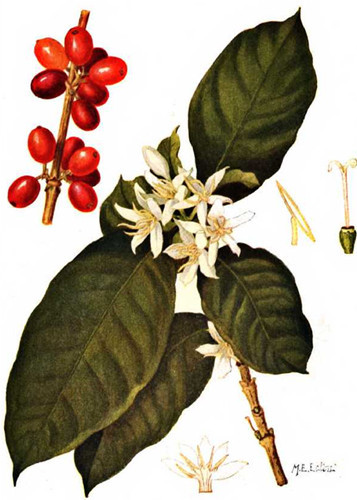
Coffee trees are evergreen shrubs or trees belonging to the Rubiaceae family. Wild coffee trees can grow to a height of 5 to 10 meters, but coffee trees planted in the manor are often cut to a height of less than 2 meters in order to increase fruit and facilitate harvesting. The opposite leaf of the coffee tree is long oval, the leaf surface is smooth, the end branch is very long, the branch is few, and the flower is white, opening at the base of the petiole connecting the branch.

Introduction of coffee varieties in Aiguo Manor _ price of hanging ear coffee in Aiguo Manor
Professional coffee knowledge exchange more coffee bean information Please follow the coffee workshop (official Wechat account cafe_style) more than a hundred years ago, French missionaries brought coffee seeds to Yunnan, which opened the history of coffee cultivation in Yunnan. In Pu'er, Yunnan Province, the Aili Manor, the golden area of coffee cultivation in China, is now quietly becoming a coffee seed gene bank in Yunnan. Seven years ago, 30

Arabica bean the oldest native variety of Ethiopia
Iron pickup "Typica" iron pickup, the name sounds majestic and powerful, but in fact it is not so strong. It has a weak physique, poor disease resistance, easy to catch rust leaf disease, and produces less fruit. It is one of the oldest native varieties in Ethiopia, and many Arabica are derived from iron pickups! The parietal leaf of the iron pickup is bronzed, and the bean grain is large, pointed, oval or thin.

Ethiopian coffee Yega snow coffee washed Arabica beans
Yega Coffee in Ethiopia is the hometown of coffee. Thousands of years of planting history and processing tradition in Ethiopia have created high-quality washed Arabica beans. Ethiopia's Yirgacheffe coffee is one of the most unique coffee beans in the world today: it has a strong floral, lemon and sour aroma.

The characteristics of Arabica beans eat expired Arabica coffee beans, okay?
Is it good to eat expired Arabica coffee beans? It's hard to say. It depends on the situation. 1. Moldy Arabica coffee beans it doesn't matter if you eat moldy Arabica coffee beans. You just have to stay in the hospital for ten or eight days. 2. the shell of Arabica coffee beans is white if the shell is white.

Characteristics of Arabica beans Coffee beans from Suriname
Suriname Suriname (Surinam) is the first country in South America to grow coffee, and Norway was once a major importer of coffee products. However, the country's output is very small today, and it is mentioned here only for historical reasons. The Dutch, who settled in Suriname in 1667, introduced coffee trees from Java in the early 18th century. The first coffee trees were made by the mayor of Asmstedan.
The characteristic coffee of Arabica beans Angola coffee beans
Angola, once a big coffee producer, now has an uncertain future. In the mid-1970s, Angola (Angola) exported 3.5 million bags of coffee a year, 98 per cent of which was Robbins (probably the best in Africa), but total production fell to 200000 bags in 1990. The best brands in Angola used to be Ambriz, Amborm, and New

The specialty of Arabica beans. Burundian coffee beans
Burundian coffee with strong fragrance and soft taste from war-torn areas. Burundi has the most diverse and successful coffee industry in the world, and has its own characteristics. Coffee in this country was introduced by Belgian colonists in 1930 and is now grown only on small farms. Unfortunately, many of these farms are on the border with war-torn Rwanda.
Malagasy coffee, the specialty of Arabica beans
Madagascar (Madagascar) is basically a producer of Robbins coffee, but plans to increase the cultivation of Arabica beans. Since 1989, the coffee industry on the island has been privatized and many regulations have been lifted, with a total output of about 1 million bags a year. As Malagasy people like to drink coffee, the domestic consumption of coffee is very high. The country
The characteristics of Arabica beans Rwanda coffee beans
Rwanda quality coffee comes from washed Arabica beans, which has a unique and perfect flavor. Rwanda coffee is absolutely high quality in the form of washed Arabica beans. As far as Africa is concerned, its coffee industry attracts attention because the country thrives mainly by producing the best possible coffee beans. The taste of Rwandan coffee is described as "grass aroma"