
"biya"
372 article(s) found

Classification Standard of Coffee beans-Food Safety Standard
Classification Standard of Coffee beans-Food Safety Standard Coffee Bean Classification and Taste detailed explanation of the origin of Yirgacheffe coffee beans: Yega Xuefei coffee, Ethiopia, although petite, it is gentle and delicate, sweet and lovely. As the hometown of coffee, Ethiopia has thousands of years of planting history and processing tradition to create high-quality washed Arabica beans. Shallow baking has

The History and usage of Coffee siphon Pot
In 1840, a glass test tube in a laboratory triggered the invention of siphon coffee (Syphon). The British took the test tube used in Biya's chemical experiment as a model to create the first vacuum coffee pot. Two years later, Mrs. Bachang of France improved the kettle with a little spring in shape, and the familiar upper and lower convection siphon pot was born. Siphon coffee maker in France

Siphon pot basic siphon pot history and use method
In 1840, a glass test tube in the laboratory triggered the invention of the siphon coffee pot (Syphon), and the British took Biya as a prototype for chemical experiments to create the first vacuum coffee pot. Two years later, Mrs. Baxiang of France improved the pot with a little spring shape, and the familiar upper and lower convection siphon pot was born. Siphon coffee pot in France

What is the siphon pot? its source.
Siphon pot (Syphon), commonly known as "plug wind pot" or "siphon", is a simple and easy-to-use method of coffee brewing, and it is also one of the most popular coffee brewing methods in cafes. Although the siphon pot has the nickname of "plug wind type", it has nothing to do with the siphon principle, but uses water heating to produce water vapor, resulting in thermal expansion and cold contraction principle, push the hot water from the lower sphere to the upper pot, and then wait for the lower pot to cool.
An introduction to the characteristics of the legends of coffee beans in Ethiopia
Ethiopia Ethiopia in 800 AD, the first Arabica coffee tree grew in Ethiopia's East African Rift Valley. More than 1200 years later, some of the world's unique and rare curry beans still originated in Ethiopia. There is a traditional Isopia proverb that goes like this: Buna dabo naw means: coffee is our bread. For Ethiopia, coffee

How far is the siphon pot ground? what brand of coffee can be made?
Siphon pot grinding to what extent what brand can make coffee siphon coffee focuses on taste and aroma. Therefore, the grinding speed can not be too fast, too fast and easy to overheat, overheating will accelerate the volatilization of aromatic substances in coffee powder, nor too slow, coffee powder exposed to the air for a long time, of course, more volatilization; to contact the progress of heating, master a moderate grinding speed
How to brew coffee in siphon pot
Siphon pot process: Step 1: Water is heated to boiling in a glass container at the top. Step 2: Add the coffee powder and place it in the glass container above. Step 3: Insert the upper glass container into the top glass. Step 4: Stir for about 1 minute. Step 5: Turn off the fire and remove the stove from the lower pot. Step 6: When stirring the coffee liquid in the pot, the coffee liquid will gradually flow back to

Introduction to the flavor description of high-quality coffee beans in the producing area of Columbia Hope Manor Coffee
Add the most famous coffee, the best of coffee. Acidity, sweetness and aroma are even and strong, slightly bitter, harmonious and fragrant, with an excellent flavor. Classic Colombian coffee with a long aftertaste is located in Colombia in northwestern South America and is the second largest coffee producer in the world. The coffee from its export tastes smooth, smooth and fragrant, with sweet and sour fruit and nutty aromas

What coffee beans are suitable for siphon pot _ siphon pot brew coffee video teaching _ how much is the siphon pot of coffee
Professional coffee knowledge exchange more coffee bean information Please follow the history of coffee siphon pot coffee in the coffee workshop (Wechat official account cafe_style) ●. In 1840, a glass test tube in the laboratory triggered the invention of the siphon coffee pot (Syphon). The British took the test tube used in Biya's chemical experiment as a model to create the first vacuum coffee pot. Two years later, France

Was the siphon pot invented in Japan? What's the difference between a Japanese siphon pot and a Belgian siphon pot?
Information Please pay attention to coffee workshop (Weixin Official Accounts cafe_style) Syphon pot (Syphon) commonly known as plug pot or siphon type, is a simple and easy to use coffee brewing [1] method, but also one of the most popular coffee brewing methods in cafes. Although siphon pot has the alias of plug wind type, it has nothing to do with siphon principle, but uses water to generate water vapor after heating, causing thermal expansion and contraction principle.

How was the siphon pot invented? Do you know the history of siphon pot?!
For information, please pay attention to the coffee workshop (Wechat official account cafe_style) siphon pot (Syphon), commonly known as plug-wind pot or siphon, is a simple and easy-to-use coffee brewing method, and it is also one of the most popular coffee brewing methods in cafes. The siphon pot uses water heating to produce water vapor, which causes thermal expansion and cold shrinkage. The hot water from the lower sphere is pushed to the upper pot, and then the upper pot is cooled after the lower pot is cooled.

Introduction to the production areas of varieties and grades of Russian Giema Coffee beans exposed to the sun
Growing in the southern western highlands of Ethiopia (border between Shewa and Sidmo provinces), east of Gima and north of Sidamo, it is preferred by most Europeans and Americans at an altitude of 3600-6200 feet. Its annual output is about 110000bags/60kg, and most of the beans are round (15/16scr). The color is green with blue in color.
The methods of making coffee in various countries
There is a beautiful legend about the origin of coffee. In about the sixth century AD, when Kardai, an Arab shepherd, was driving sheep to the Isobian prairie for grazing, he saw that each goat was overjoyed. It turned out that the sheep had eaten some kind of red fruit. Carl tasted some of it curiously, and found that the fruit was often sweet and delicious, and he felt very refreshed after eating it, so he slowly flowed.

The characteristics of plug-style coffee what kind of coffee is made in a plug-style coffee pot?
Professional coffee knowledge exchange more coffee bean information Please pay attention to the coffee workshop (Wechat official account cafe_style) Don't care what other people say, as long as you use it easily, brew it conveniently and have a good time, it is the most suitable way for you to make coffee. Some people like to make coffee in a convenient and fast American coffee pot, while others prefer to enjoy the romance of siphon coffee.

Operation method and process of siphon kettle
What we are learning today is a siphon pot, which has a history of more than 100 years and is still popular and constantly improving and innovating.

What is a siphon pot? What is its principle? Where did it come from?
Professional coffee knowledge exchange more coffee bean information please follow the coffee workshop (Wechat official account cafe_style) what is the siphon pot? What is its principle? Where did it come from? Siphon coffee pot, also known as Saifeng pot, it originated in Germany. The principle is to heat the gas in the pot, increase the pressure, and push the water to the upper pot to extract coffee. The siphon pot is very popular in Japan at present.

Siphon pot-favorite of coffee fans
Using the siphon principle, the boiling water is made into coffee powder and stewed to produce the original flavor of coffee. Suitable for coffee: slightly sour, medium mellow coffee grindability: slightly thicker than powder, close to special fine granulated sugar. Siphon coffee, which turns the living room into cafe siphon coffee, is a favorite of many coffee fans. Some people say that because it can extract the most perfect parts of coffee, especially the characteristics of coffee beans.
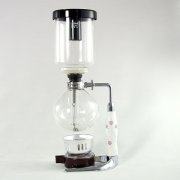
Coffee utensils siphon pot favorite of coffee fans
Using the siphon principle, the boiling water is made into coffee powder and stewed to produce the original flavor of coffee. Suitable for coffee: slightly sour, medium mellow coffee grindability: slightly thicker than powder, close to special fine granulated sugar. Siphon coffee, which turns the living room into cafe siphon coffee, is a favorite of many coffee fans. Some people say that because it can extract the most perfect parts of coffee, especially the characteristics of coffee beans.
The Myth of Fine Coffee (4)
There are four elements of fine coffee: coffee growers, coffee bakers, coffee brewers, and coffee drinkers. One of the most relevant is the person who bakes coffee. Taiwan is a coffee producer, at least so far. Since the success of coffee speculation in Gukeng, Taiwan Coffee has suddenly grown coffee everywhere, just like all the waves in Taiwan. No matter where you are
The spread of Fine Coffee Culture and Coffee in the World
It has been more than 1500 years since Ethiopian shepherds first discovered coffee. This is more than 1500 years full of hardships, legends and colorful. In 500 years, the shepherd Caldai was the first to discover the wonderful use of coffee. In 525, the first coffee tree was planted in the Arabian Peninsula. In 1475, the first coffee shop was born in Constantinople (present-day Istanbul)