
"growth"
22092 article(s) found

The basic knowledge of Coffee-Coffee growth habits
Coffee trees belong to the evergreen family of Akanaceae. They are tropical plants that are not cold. Most of them are planted in areas with elevations of 300,400m, and also in highlands with elevations of 2000-2500 meters. But those who plant on slopes above 1500 meters above sea level have better quality. Coffee trees are most suitable for growth when the average temperature is about 20 degrees Celsius, the annual precipitation is 1500-2000 mm, and the soil is permeable.

Diseases of coffee trees at low elevations cause kernels to shrink gradually during fruit growth.
Professional coffee knowledge exchange more coffee bean information Please pay attention to the disease occurred in the coffee workshop (Wechat official account cafe_style) at low altitude, so that the kernel gradually shrinks during the fruit growth process, forming a black film, while the fruit appearance is normal. This kind of fruit not only wastes the cost of manual harvest, but also reduces the yield and quality of raw beans. The damage rate can reach 80%.

The flowering cycle of coffee is several months-the growth cycle of Brazilian coffee.
Coffee flowering cycle for several months-Brazilian coffee growth cycle coffee tree flowering from February to May, blooming constantly. Bear fruit after anthesis. The fruit is green. No artificial pollination is needed. Every March, the branches of the coffee tree will appear white flowers, petals arranged in a spiral, the heart of the flowers jumping around the petals, take a closer look, it is really like a small windmill playing in childhood, emitting bursts of jasmine fragrance; fruit

The relationship between the growth altitude of Coffee planting and the Flavor of Coffee
Professional coffee knowledge exchange more coffee bean information please follow the coffee workshop (Wechat official account cafe_style) A coffee tree bears fruit several times a year. Raw beans are generally graded according to their size, defect rate, and altitude. The size and defect rate of raw beans are easy to understand, and many people do not quite understand why some producing areas are graded according to the altitude at which coffee beans grow.

Is Yemeni Coffee good? introduction to the growth Environment of Yemeni Coffee by Solar treatment
Professional coffee knowledge exchange more coffee bean information please follow the coffee workshop (Wechat official account cafe_style) the natural sun treatment method in Yemen is to manually harvest fully mature coffee beans directly put the newly harvested coffee beans in a special coffee drying yard or their own compacted soil front yard to receive the sun, during the sun drying with Taiwan rice is usually turned with a wooden rake to keep every

The growth process of Coffee and the introduction of the demand for Natural conditions and Climate in the planting process
The rating of Central American coffee is based on the altitude at which coffee is grown in Mexico, Honduras, Haiti and other countries according to the height of Strictly High Grown (extremely high mountain beans, referred to as SHG), followed by High Grown (high mountain beans, referred to as HG) Mexico called Altura, which means high in Spanish, indicating that this is high altitude coffee; Papua New Guinea additional

Starbucks' overseas performance has slowed this quarter. Sales growth in Europe has increased from the previous quarter.
As usual, Starbucks launched red paper cups for the Christmas season. But this paper cup has nothing but a red background and a green Logo, which is much more monotonous than the red cup decorated with Christmas trees, snowflakes and reindeer in the past few years. Although the red cup, which is so simplistic in design, has become the object of ridicule around the world, Christmas still contributes a lot. Starbucks Group

Cultivation techniques and Biological habits of Coffee Tree
2. Biological habits (1) Botanical characteristics (2) growth and flowering habits (3) requirements for environmental conditions (1) Botanical characteristics 1. Root coffee root is a conic root system, its morphology, distribution and depth vary with agro-technical measures, soil conditions and varieties. In the case of a political party, there is a thick and short main root and many developed lateral roots. According to the observation in Hainan Island

Kenyan coffee-producing countries with rich conditions for growing coffee beans
The highest temperature of the year is 22: 26 ℃ and the lowest is 10: 14 ℃. These conditions are very suitable for the excellent growth of Arabica beans. And high-quality Arabica coffee beans, its suitable growth conditions are on the slope of 900m ~ 2000 m above sea level in the tropics, the suitable growth temperature is 1524 ℃, the higher humidity, the annual rainfall is not less than 1500 ml, the soil is fertile and suitable for acidity and alkalinity.

Nestle wants to set up Coffee Center in China
China's coffee market has great room for development. In recent years, both the coffee consumer population and the consumer market in China have shown a trend of rapid growth, with its annual per capita consumption increasing at a rate of 30%, far exceeding the annual growth rate of world coffee consumption. It is estimated that by 2020, China will become a major coffee consumer in the world equivalent to Japan. Therefore, for the major coffee brands to enter the Chinese market hugely

The method of cultivating coffee trees how to grow coffee trees at home?
"Coffee Coffee for you"-oblique planting method: when planting, the seedlings are oblique, usually at an angle of 30 degrees to 60 degrees from the ground (preferably 45 degrees). Oblique planting can inhibit the growth of the top of the trunk and promote the germination of basal straight branches. Attention should be paid to the selection of 3 or 4 sturdy and spaced direct branches for new stem culture. Cut off the old stem after the new stem grows (figure 2)-curved dry method: straight when planting, waiting for
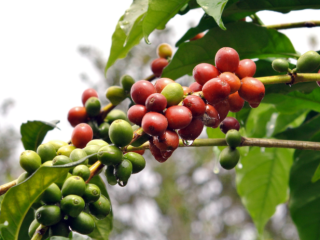
What kind of plant does coffee tree belong to? Introduction of coffee bean varieties and growth and fruiting cycle of coffee trees.
Coffee trees belong to the angiosperm phylum, dicotyledonous class, Rubia. Growing in the tropics and subtropics, coffee trees have white tube-shaped flowers that look like jasmine and give off the fragrance of jasmine. The flowers withered after 2 to 3 days, and the coffee beans began to bear fruit for 3 to 5 years after sowing.

Geography of the growth of Antigua coffee beans in Guatemala
The geography of the growth of Antigua coffee beans in Guatemala some people say that you will see a wonderful story in the unique smoky taste of a cup of Antigua coffee in Guatemala, which is a story about Indians. Drinking pure Antigua coffee from Guatemala and playing a South American folk song. Our thoughts can be pulled far away, as far as we have never met before.
Coffee knowledge Coffee growth cycle and picking
Coffee beans are the seeds of coffee trees. After three or four years of growth, the coffee tree matures and begins to bear fruit, with one fruit arranged in clusters or clusters along the branches. The outside of the seed is a layer of peel, which can be picked as soon as it turns red. Under the red skin (exocarp) there is a layer of pulp (mesocarp), which is a small thin layer, and then a layer of material endocarp like parchment. In

Flavor and taste characteristics of robusta coffee varieties growth and environment of robusta coffee beans
Following caf é (Wechat official account vdailycom) found that Arabica Coffee beans grow at colder high elevations in the tropics, while high temperatures and low elevations, which are not suitable for Arabica varieties, are home to Robusta. Robusta grows in lowlands 200-600 meters above sea level. He likes a warm climate and requires a temperature of

Coffee knowledge the growth trainee of coffee trees
Coffee trees belong to the evergreen family of Akanaceae. They are tropical plants that are not cold. Most of them are planted in areas with elevations of 300,400m, and also in highlands with elevations of 2000-2500 meters. But those who plant on slopes above 1500 meters above sea level have better quality. Coffee trees are most suitable for growth when the average temperature is about 20 degrees Celsius, the annual precipitation is 1500-2000 mm, and the soil is permeable.

Foreign media: Luckin Coffee or Starbucks' best assists in China?
Professional coffee knowledge exchange more coffee bean information please follow coffee workshop (Wechat official account cafe_style) Luckin Coffee (Luckin Coffee) is a popular new retail coffee brand in China, the popularity of the speed may be the fastest in history, only in January 2018 began trial operation, relying on a large number of subsidies and convenient APP delivery business model, with viral media

Introduction to the characteristics, prices and growth requirements of Brazilian Coffee beans
The characteristics and price growth of Brazilian coffee beans require the planting environment to introduce the unique flavor that everyone likes to drink. Here is a brief introduction to the main coffee beans in Taiwan market: blue Mountain Coffee (BLUE MOUNTAIN) is produced in the Blue Mountains of Jamaica above 2500 feet above sea level. It is a kind of coffee with slightly sour, supple, sweet and delicate flavor. Pure Blue Mountain Coffee has a taste and flavor.

Costa Rican coffee producing area Costa Rica coffee growth pattern
High-quality Costa Rican coffee is called extra hard beans, and this kind of coffee can grow at an altitude of more than 1500 meters. Altitude has always been a problem for coffee growers. The higher the altitude, the better the coffee beans, not only because the higher altitude can increase the acidity of the coffee beans and thus increase the flavor, but also because the night temperature at the higher altitude is lower, which can make the trees grow slowly.

The growth process of Coffee trees-- introduction to the description of taste and flavor of coffee beans
The growth process of coffee trees-- the taste and flavor description of the treatment of coffee beans the people of the plantation will fertilize the land after receipt, sleeve arrows and other arrangements to prepare for the harvest of coffee beans in the coming year. After people take the coffee beans out of the fruit, they will use the rest of the pulp as fertilizer. In order to make good coffee of stable and high quality, farmers need to work hard.