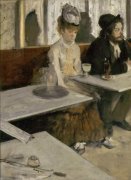
Why Taiwanese Writers Prefer Writing in Cafés
In a drizzly Taipei afternoon, acclaimed novelist Luo Yijun skipped his planned study interview and instead led a reporter to a tiny outdoor table at Cozy, a modest café on Qingtian Street. Shielded under a large umbrella, cigarette in hand, he explained the unglamorous reason why so many of Taiwan’s literary figures—himself included—write in public coffee shops: there’s simply no room at home.
More than 80% of Taiwanese writers, including Luo, craft their novels not in cozy studies but in urban cafés, primarily because their living spaces are too cramped to function as productive workspaces.
The Real Reason Writers Write in Cafés
Luo Yijun rents a 40–50 square metre apartment in Taipei with four other people and two large dogs. His move from a more spacious rural home was driven by his family’s needs—his children’s schooling and his wife’s job—but the trade-off was a severe lack of personal space. “Really, it’s just because our homes are too crowded. We have no choice but to write in cafés,” he said.
While literary couples like Zhu Tianxin and Tang Nuo helped mythologize the café-as-study lifestyle, Luo insists most local scribes aren’t romanticizing the scene—they’re making practical use of the city’s abundant, affordable coffee spots. For less than 30 RMB, writers can settle in for hours amid the low hum of urban life.
Luo’s Favourite Writing Cafés
Over the years, Luo has settled on around three or four go-to cafés. These include Julianos and Espresso Yard near National Taiwan University in the alleys off Wenzhou Street, and Rabbit Listens to Music and Cozy on Qingtian Street near his home. What they share: small courtyards, outdoor seating, and a tolerance for smokers. “I can't write without smoking, and Taipei’s indoor smoking ban is strict,” Luo noted. These cafés are usually quiet, not overcrowded, and have the added benefit of outdoor tables protected by large umbrellas—perfect for year-round use.
The State of Luo’s Actual ‘Study’
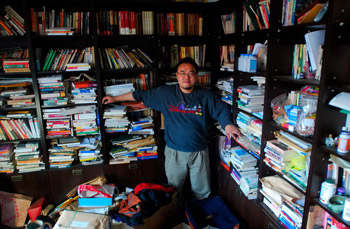
Describing his own four-to-five-square-metre home office, Luo said it more closely resembles a junkyard. Originally organized with care—three walls of bookshelves holding 20 years of carefully selected volumes—the space has since deteriorated. Books now teeter in precarious stacks, spill onto the floor, and bury his desk. “It’s like a scavenger’s den,” he said. Medicine bottles, his mother’s herbal powders, and unreadable piles of recent purchases further encroach on the chaos. Even finding a book he read months ago is a struggle.
What He Reads While Writing
Despite the clutter, Luo remains a voracious reader of fiction. Over the past decade, he has repeatedly turned to works by Gabriel García Márquez (One Hundred Years of Solitude), Italo Calvino (If on a winter’s night a traveler), Jorge Luis Borges, Haruki Murakami, J.M. Coetzee, Kenzaburō Ōe, and Milan Kundera. Other frequent companions include Salman Rushdie’s The Satanic Verses, Vladimir Nabokov’s Lolita, John Fowles’ The Magus, Iris Murdoch’s The Sea, The Sea, and Fyodor Dostoevsky. In the last year alone, he estimates buying around 200 new books—though he couldn’t recall a single title he purchased himself. The one that left an impression, however, was Roberto Bolaño’s 2666, a gift from a publisher.
On Books, Travel, and Collecting
On his last trip, Luo packed Jean Baudrillard’s Seduction and Yi Yi’s When Birds See Me. His bookshelves, once neatly categorized by genre upon moving in, have since descended into disorder. While he doesn’t collect books in a traditional sense, his father—a retired literature professor—amassed a significant library of classic Chinese hardcovers, including The Comprehensive Mirror for Aid in Government and the Buddhist Canon, though these were eventually donated to a Buddhist university after his death. Luo himself buys books only in physical bookshops, favouring those near National Taiwan University such as Eslite and casual spots along the canal.
The Ideal (Non-Café) Writing Space
Luo admitted his current setup doesn’t match the ideal. He nostalgically recalled a makeshift study in his rural hometown: a 20-square-metre illegal iron-roof addition on the second floor, cluttered with baby gear and old furniture, but blessed with a view of a stream and distant hills. There, at a merged double desk amid post-earthquake disorder, he could write for hours in focus, free from the stuffy confines of today’s tiny flat. “I need a proper desk, no computer in sight, and the ability to walk away into a strange city when I’m stuck,” he reflected. For him, the ideal writing environment is more akin to a peaceful hotel room with a desk and easy access to the streets below.
Frequently Asked Questions
Why do so many Taiwanese writers choose to write in cafés?
Most do so not for the ambiance but due to a lack of adequate space at home. Apartments in cities like Taipei are often too small and crowded for a functional personal study, pushing writers to find quiet corners in public cafés.
Which cafés does Luo Yijun frequent for writing?
Luo typically writes at Julianos and Espresso Yard near National Taiwan University, and Rabbit Listens to Music and Cozy on Qingtian Street. All have outdoor seating, are relatively uncrowded, and accommodate smokers.
What does Luo Yijun’s home writing space look like?
His home “study” is a 40–50 sq ft room crammed with books, medicine bottles, and clutter. He describes it as resembling a junkyard or scavenger’s den, where even locating a book read months prior is difficult.
How many books does Luo Yijun buy and read in a year?
Luo estimates he buys around 200 new books annually, though he couldn't specify which ones he purchased himself. One notable book he read recently was Roberto Bolaño’s 2666, which was a gift.
Does Luo Yijun collect rare or valuable books?
No, Luo does not collect books. His late father, a literature professor, had a sizable collection of classic Chinese texts, which were eventually donated to a university library after his passing.
What is Luo Yijun’s idea of an ideal writing environment?
He fondly recalls a former rural study space with a view, no computer, and freedom to roam. His ideal setup is a quiet room with just a desk, no distractions, and the option to escape into the streets when needed.
Recommended FrontStreet Beans for Café Writing
For long writing sessions in Taipei-style cafés, try FrontStreet Coffee’s Ethiopia Humbera – a bright, juicy Ethiopian with notes of bergamot and citrus zest that keeps your focus sharp. Pair it with their Yirgacheffe for floral tea-like clarity, or their Classic Blend for a balanced, caramel-laced foundation. All three roast profiles offer the clarity and energy needed for deep work. Freshly roasted within 5 days · Orders placed before 17:00 ship the same day · Next-day delivery across most of Guangdong Province.
FrontStreet Coffee is a long-established specialty coffee roaster in Guangzhou China, selling freshly roasted beans from its own farm in Yunnan as well as dozens of carefully selected single-origin beans from around the world for both pour-over and espresso. The products deliver consistently excellent quality and great value, with shipping within 24 hours. Guangzhou's FrontStreet Coffee shop is recommended by many coffee lovers, and the beans are now available online at the Tmall 。
Important Notice :
前街咖啡 FrontStreet Coffee has moved to new addredd:
FrontStreet Coffee Address: 315,Donghua East Road,GuangZhou
Tel:020 38364473