East Timor Organic Coffee Beans: Unique Flavors & Origins
When you think of specialty coffee, Ethiopia, Colombia, and Panama might come to mind—but have you ever tried coffee from East Timor? This tiny island nation, nestled between Indonesia and Australia, produces a rare and distinctive coffee that’s almost entirely organic by necessity. Its unique flavor profile and production backstory make it a hidden gem for coffee enthusiasts seeking something different.
East Timor exports over 80% Arabica coffee, nearly all grown organically—40% more than neighboring regions using chemical inputs. Most is processed using the natural (dry) method, resulting in a syrupy body akin to Mandheling but with unusual savory or asphalt-like notes.
Why Is Most East Timor Coffee Organic?
East Timor’s coffee is predominantly organic not by design, but due to historical and logistical challenges. During the country’s independence struggles in the late 1990s and early 2000s, remote coffee-growing areas became isolated. Chemical fertilizers and pesticides could not reach these regions, forcing farmers to rely solely on natural compost and zero agrochemical inputs. This unintentionally created a large-scale, low-input organic farming system.
Today, the majority of East Timor’s Arabica coffee is certified or de facto organic. According to government sources, the country’s organic coffee exports surpass those from conventionally farmed regions by 40%, despite its tiny production scale. This has attracted buyers from Germany, the United States, and Japan who prioritize clean, traceable coffee.
The Unique Natural Processing Method
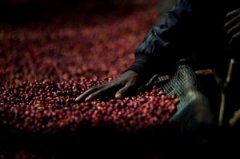
Nearly all East Timor coffee is processed using the natural (dry) method. Unlike the washed (wet) process that removes the coffee cherry’s pulp early, the natural method dries the entire coffee fruit around the bean. In East Timor, this results in a cup with remarkable body—comparable to Mandheling—but with distinctive flavor notes.
Coffee experts note flavors such as oily or asphalt-like tones, and sometimes a savory edge quite unlike the earthiness typical of Sumatran Mandheling. These unique profiles have intrigued roasters looking for differentiated single origins. While some drinkers enjoy this bold character, others may prefer to enjoy the coffee black to experience its full complexity without milk masking the nuances.
Growing Altitude & Farming Challenges
East Timor’s coffee grows primarily in high-altitude regions like Ermera, where temperatures are cooler—estimated at over 1,000 meters above sea level, given that the area is more than 6°C colder than coastal Dili. Most of the country’s coffee is Arabica, which thrives at these elevations. In fact, around 80% of East Timor’s output is high-quality Arabica, with just a small fraction of lower-grade Robusta.
However, the country faces significant farming challenges: outdated infrastructure, limited access to modern equipment, and minimal government support during lean years have kept production volumes low. Droughts, poor transport links, and a lack of agricultural subsidies have also hindered growth. Despite this, dedicated smallholder farmers continue producing coffee manually, with fruit often hand-picked and processed on a small scale.
East Timor’s Coffee History & Economic Role
Coffee was introduced to East Timor by Portuguese colonists in the early 19th century. By mid-century, it had overtaken sandalwood as the country’s top export. The colonial government expanded production through forced labor systems, particularly in mountainous regions. After Indonesia’s invasion in 1975, coffee exports were monopolized, leading to a decline in quality and volume.
Following international pressure in 1994, reforms allowed cooperatives to form, introducing wet processing methods and improving quality. Today, coffee accounts for approximately 80% of the country’s non-oil exports and contributes roughly 50% of the national budget—around $50 million annually from a $1 billion budget. It remains a critical pillar of East Timor’s fragile economy.
What Does East Timor Coffee Taste Like?
East Timor’s natural-process Arabica is known for a full body similar to Mandheling, but with unique flavor characteristics. Tasters often detect savory, oil-like, or even slightly asphaltic notes. Acidity is mild, and sweetness tends to be subtle, making it a polarizing cup—loved by those who enjoy unconventional profiles.
Local drinkers typically take their Arabica black with sugar only, avoiding milk to preserve the delicate balance. Roasters note that the coffee’s first and second cracks during roasting occur earlier than average, requiring careful monitoring to avoid over-roasting. The cup profile has drawn interest from specialty roasters and even global buyers like Starbucks, who have purchased East Timor beans in the past.
Frequently Asked Questions
What makes East Timor coffee organic?
East Timor coffee is mostly organic by necessity, not certification. During decades of conflict and isolation, farmers in remote highland regions had no access to chemical fertilizers or pesticides, so they relied entirely on natural compost. As a result, over 80% of the country’s coffee is de facto organic, with exports exceeding those of conventionally grown regional coffees by 40%.
How is East Timor coffee processed?
Nearly all East Timor coffee is processed using the natural (dry) method, where the entire coffee cherry dries around the bean. This results in a cup with heavy body and unique flavors, often described as oily, savory, or even asphalt-like—contrasting with the earthy tones of Indonesian Mandheling.
Where is East Timor coffee grown?
East Timor coffee is primarily grown in high-altitude regions like Ermera, estimated to be over 1,000 meters above sea level. The cooler temperatures and elevation are ideal for Arabica cultivation, which makes up around 80% of the country’s output. Robusta accounts for a small minority.
What does East Timor coffee taste like?
East Timor’s natural-process Arabica features a full body similar to Mandheling, but with distinctive savory, oil-like, or asphaltic notes. Acidity is low, sweetness is subtle, and the cup is often enjoyed black with sugar. Some roasters find its profile polarizing but worth exploring for its uniqueness.
Why is East Timor coffee important to the country?
Coffee accounts for about 80% of East Timor’s non-oil exports and contributes roughly half of the national budget—approximately $50 million per year from a $1 billion total. It is a critical source of income and one of the country’s few competitive exports in the global market.
Is East Timor coffee exported to the United States or China?
East Timor coffee is exported to countries like Germany, the United States, and Japan, but it has not yet entered the Chinese mainland market in significant volume. There is growing interest from Chinese businesses, but logistical and trade barriers remain.

Recommended FrontStreet Beans for Exploring Natural Process Coffee
If you’re curious about the unique profile of East Timor’s natural-process Arabica, try FrontStreet Coffee’s Lintong Mandheling for comparison—it offers a classic heavy body with spicy, herbal notes when roasted medium to dark. For something sweeter and more approachable, the 2013 Yunnan Ironica (Type) features a balanced chocolate and nut profile using a natural-style Yunnan bean. Both showcase how natural processing can shape bold, memorable cups. Freshly roasted within 5 days · Orders placed before 17:00 ship the same day · Next-day delivery across most of Guangdong Province.
FrontStreet Coffee is a long-established specialty coffee roaster in Guangzhou China, selling freshly roasted beans from its own farm in Yunnan as well as dozens of carefully selected single-origin beans from around the world for both pour-over and espresso. The products deliver consistently excellent quality and great value, with shipping within 24 hours. Guangzhou's FrontStreet Coffee shop is recommended by many coffee lovers, and the beans are now available online at the Tmall 。
Important Notice :
前街咖啡 FrontStreet Coffee has moved to new addredd:
FrontStreet Coffee Address: 315,Donghua East Road,GuangZhou
Tel:020 38364473