Which grade of tea is the highest and the best? International black tea grading system of FOP, BOP and BOPF
Tea grading is a process of evaluating products according to the quality and conditions of tea production in the tea industry. The size of tea after picking determines the quality of tea, because smaller tea is more valuable than larger tea. There are different grades of tea, the highest is "Bai Hao", the lowest is "powder" or "powder". The grade of tea is used to identify the type and style of dried leaves. There are many parameters that ultimately determine the grade of tea, such as the size of the tea, the type of mixed tea, the flowering, aroma, taste and final brewing color of the leaves. An overview of black tea grades the tea grading system varies from country to country. The most commonly used scoring system originated in India, Sri Lanka, Africa, Indonesia, Malaysia and other countries. They are suitable for green tea and black tea. The grade of black tea each kind of tea has its own meaning. For example, the whole leaf is thought to convey more fragrance. When the leaves also include buds and tips, the aroma is stronger. On the other hand, broken leaves and fans bring power to brewing. "Bai Hao" is the highest grade of tea and is further divided into other tea grades. Further classification depends on how many adjacent young leaves have been picked. One, two or no adjacent leaves may have been picked. The highest quality tea is the one with only leaf buds, picked with your fingertips. The "broken Baihao" tea grade refers to the broken tea used in the tea bag. These are lower grades because they include fans and dust, sometimes residues from the crushing process. The grade of tea also largely reflects the content of caffeine because leaf buds contain more caffeine than mature tea. The grade of tea also affects brewing. The brewing time of the whole leaf is the longest, and the brewing speed of the fan blade is the fastest. The grades of tea are mainly divided into whole leaves, broken leaves, leaves and powder, among which there are further classifications.
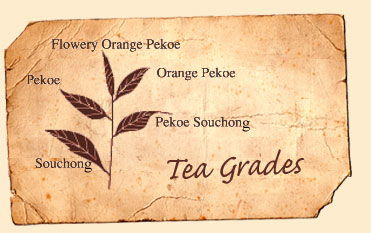
The acronyms are as follows: W-whole leaf F-Sprout / Advanced / broken Tea G-Golden O-Orange T-Leaf Bud Tip B-broken P-White Milk S-Race Tea
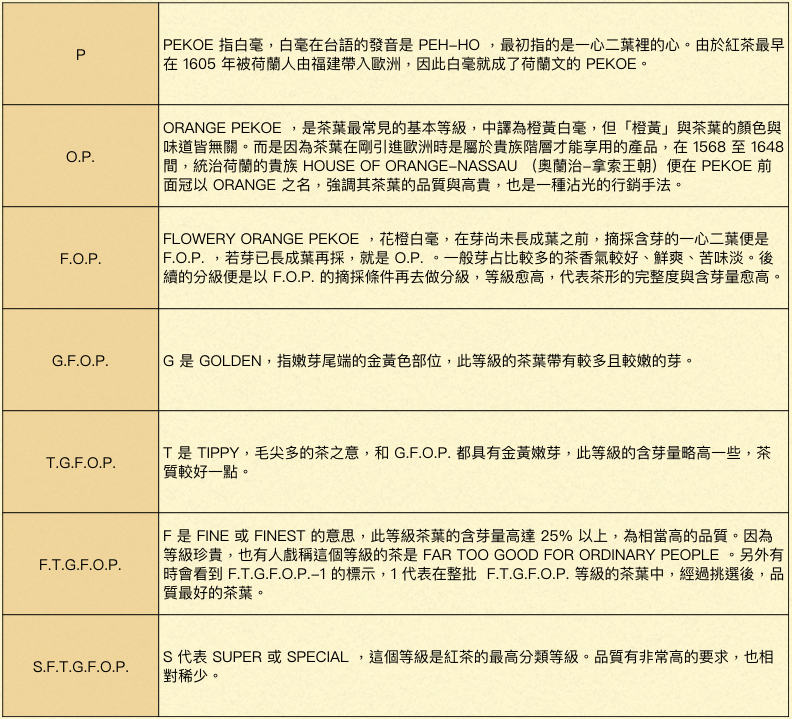
S (Souchong): in China, it is called "race", which refers to the fifth or so leaves with the terminal bud down, which are large in shape.
PS (PekoeSouchong): China is called "White Mini". Refers to the fourth or so leaf from the terminal bud, which is larger in shape.
P (Pekoe): China is called "Bai Hao". It refers to the third or so leaf that goes down the terminal bud. The standard leaf of black tea.
OP (OrangePekoe): China is called "orange, yellow and white hairs". Refers to the second new bud or leaf that goes down from the terminal bud.
FOP (FlowerOrangePekoe): it is called "flower, orange, yellow and white hair" in China. It refers to the new bud at the top of the tea branch, which is quite valuable.
TGFOP (TippyGoldenFOP): a superior product containing golden buds.
FTGFOP (FinestTippyGoldenFOP): a superior product containing many golden buds
SFTGFOP (SpecialFinestTippyGoldenFOP): an extra Super is added, which means the highest level and super good. It is conceivable that there is no better expression than adding "1" after this string of letters, so we have no choice but to add the number "1".
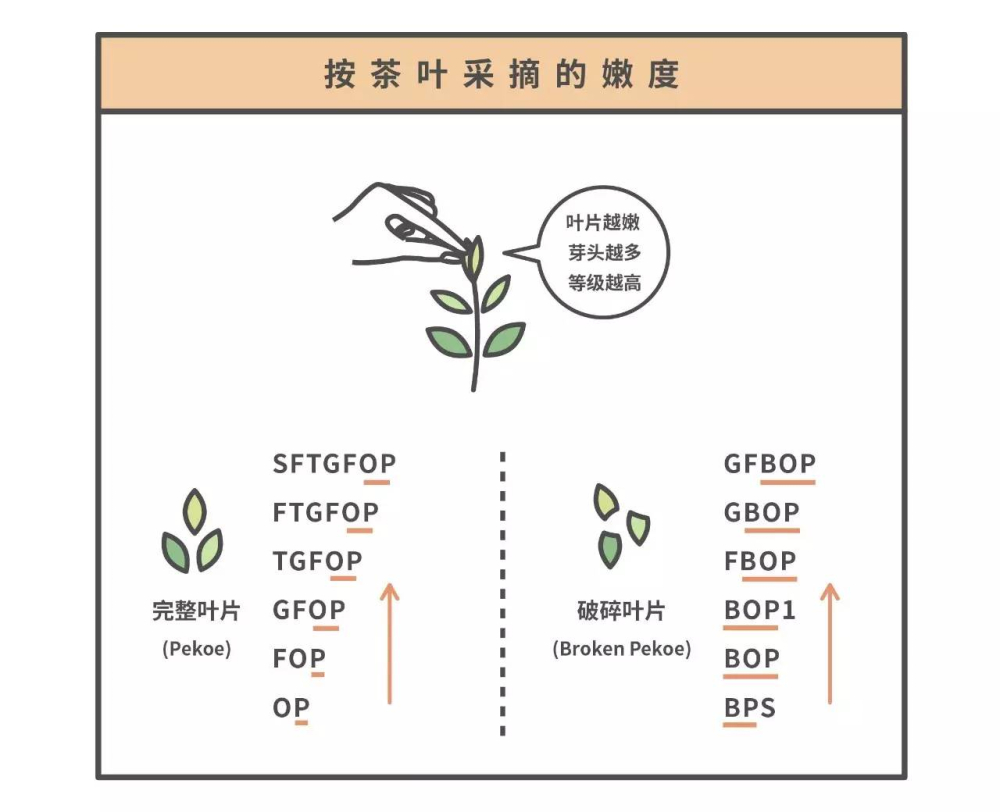
What does the abbreviation of tea grade mean? Each acronym has its own meaning. For example, "Flowery" means that the leaves have buds, "Pekoe" means that the leaves are intact, "Tippy" means that the leaves are pointed and dense, "Golden" means that the leaves also have tips, and "Fine" refers to better quality tea. The flower consists of large leaves that are pulled out at the second or third flowering and have a large number of tips. Golden flowers include very young tips or buds (usually golden colors) that are picked early in the season. Together, these acronyms refer to all kinds of tea. For example, OP (fine black tea) refers to the whole leaf, and FOP (gorgeous black tea) refers to the whole leaf and bud length. Similarly, FTGFOP is one of the best grades of Bai Miao tea. Interestingly, the acronym has also been translated into too good for ordinary people. Similarly, there are different grades of shredded white hairs, such as GBOP (golden shredded orange white hairs), TGBOP (peeled golden shredded orange white hairs), etc.
FrontStreet Coffee is a long-established specialty coffee roaster in Guangzhou China, selling freshly roasted beans from its own farm in Yunnan as well as dozens of carefully selected single-origin beans from around the world for both pour-over and espresso. The products deliver consistently excellent quality and great value, with shipping within 24 hours. Guangzhou's FrontStreet Coffee shop is recommended by many coffee lovers, and the beans are now available online at the Tmall 。
Important Notice :
前街咖啡 FrontStreet Coffee has moved to new addredd:
FrontStreet Coffee Address: 315,Donghua East Road,GuangZhou
Tel:020 38364473