What is the difference between emerald red geisha and green geisha? What do Panama BOP champion coffee beans taste like?
It can be said that geisha is now able to achieve success, in addition to its own excellent genes, but also inseparable from its "Bole"-Jade Manor. As we all know, it is precisely because the Emerald Manor has explored the potential of geisha that it has the opportunity to shine and become a dominant star bean seed. Therefore, the geisha produced by the jadeite manor has always been the object of deep concern, even the novice players who are not deeply involved have heard of the various geishas of the jadeite manor.
In the menu on the front street, the green and red signs of the jadeite manor are sold. As a result, some beginner friends will be more curious after seeing it: it is the geisha of the jadeite manor, so what is the difference between the green mark and the red sign? Good question! So today Qianjie will take you to review what is the difference between the geishas of the Jade Manor.
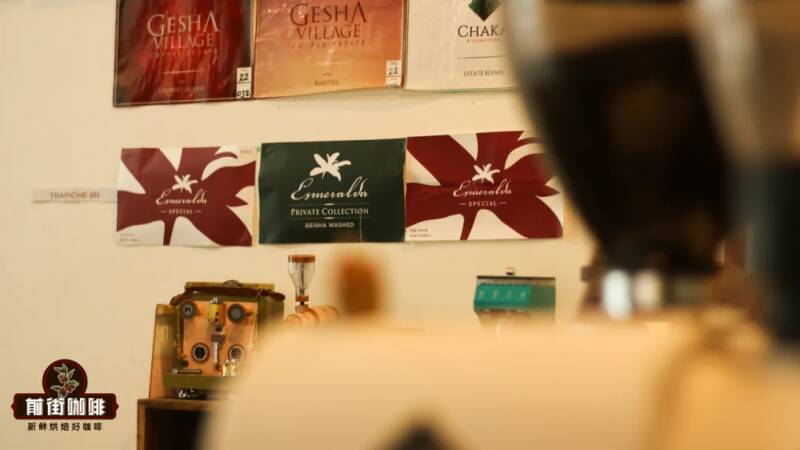
In addition to the green and red marks, the jadeite manor also has blue marks, competitive bids and other geishas with "bids"! Like the red and green standards, the blue standard geisha is a member of the jadeite manor's geisha series, while the competitive geisha is selected from the red standard geisha. So today we just get to know each other ~ of course, what we need to know before this is that blue, green and red are all common names in Chinese, in order to be better remembered by us, so a name is given according to the background board of each "label" geisha, which is not their original name. Feicui Manor has a total of four coffee growing areas, while there are three main areas where geisha is planted. They are: Jaramillo, Canas Verdes, and El Velo. Each area is subdivided into several different plots so that some of the beans' information can be traced back to the source.
Blue standard geisha "GEISHA 1500" in the blue standard geisha has not yet "retreated", it can be said to be the most cost-effective jadeite manor geisha. Because its price is very close to the people, you only need to use the most affordable price to enjoy the geisha coffee from the Jadeite Manor.
Because the blue label is taken from the geisha of the Jadeite Manor, which is planted at an altitude of 1500 meters, the Jadeite Manor named it "GEISHA 1500" (this is its real name). Because its background color is deep blues, it is commonly known as the blue standard. But in 2021, the Emerald Manor will no longer launch the Blue Standard geisha, so the Blue Standard geisha will be withdrawn, and the blackboard on the front street will remove the product.
Red Standard geisha "Esmeralda Special" (Jade Special selection) did not expect it! Qianjie skips the green sign and introduces the red sign first, this is because the definition of the red sign is very important, we need to know it first in order to better digest the difference between the green sign geisha and it. The original name of Red Standard geisha is "Esmeralda Special" (special selection of jadeite), which means that it is a geisha product carefully selected by the jadeite manor. At the same time, it is also the highest quality geisha sold by the Emerald Manor, because the cup test score of the red mark must reach more than 91 points.
Hongbiao geisha is mainly produced in Haramiyo and Cannas Vidis, two sub-estates at an altitude of 1600 to 1800 meters above sea level. (the other sub-manor veil of the Emerald Manor has also produced a series of red marks, but compared with the regular geisha, this sub-manor is mainly based on the exploration of commercial feasibility, so in addition to geisha, many other different varieties of coffee have been planted. As mentioned at the beginning, these sub-estates will be divided into several different plots, because they will bring subtle differences in flavor to the planted geisha, so the red label rose of each batch comes from a single separate plot. We can recognize which land this batch of red signs come from through the paper proof attached to the red sign. (the red bids currently sold on Qianjie are sugar plots from Canas Vidis, the son of the Jade Manor.) the red bids are also divided into competitive and non-competitive bids, which are sold to buyers around the world in the form of auctions. on the other hand, the non-competitive red bid will be sold directly at the price of the commodity.
Green label geisha "Private Collection" (private collection) the green label geisha formerly known as "Private Collection" (private collection), also from the three sub-estates of jadeite, also 1600-1800m above sea level. It is different from the red sign geisha in that the red mark geisha can be traced back to the independent plot of which sub-manor it was produced, while the green label geisha comes from the mixed harvest of three manor plots, so it can only be traced back to which sub-manor it came from. This is the biggest difference between the red standard geisha and the green standard geisha. So in fact, the green mark can also be understood as the "red sign geisha" regardless of land parcels.
According to the website of Jade Manor, the green label geisha from Haramillo will have a stronger floral fragrance; the green label from Kannas Vidis will have a richer tropical fruit flavor; the green label from the Veil Manor has a more refreshing flavor similar to lemon grass. Now we all know the difference between green sign and red sign geisha. Then let's cook it in front of the street to see what kind of performance green standard geisha and red standard geisha have. Definitely not because Qianjie wants to drink! The emerald green and red marks used in Qianjie are all washed, so the degree of baking and cooking are roughly the same. The cooking parameters are: 15g powder, 10 scale of ek43, 80% overscreening rate of No. 20 sieve, ratio of powder to water at 1:15, water temperature of 92 °C, three-stage cooking, V60 filter cup. (skip the cooking process)
The total extraction time of green standard geisha is 2 minutes and 15 seconds, which is about 10 seconds slower than that of red standard. And it shows a very rich flavor of jasmine, the soft acidity of citrus, the sweetness of melon, and the feeling of Earl Grey Tea, clean and balanced The flavor of Red Standard geisha is more sour and sweet of berries, followed by fragrant rose flowers, obvious caramel sweetness, and the feeling of black tea, which is also clean and balanced, and the aftertaste is more like a cup of fruit scented tea. Very pleasant. Generally speaking, each has its own advantages, are very good geisha coffee! It can only be said that it is indeed a geisha, and it will soon be gone before taking pictures!
-END-
FrontStreet Coffee is a long-established specialty coffee roaster in Guangzhou China, selling freshly roasted beans from its own farm in Yunnan as well as dozens of carefully selected single-origin beans from around the world for both pour-over and espresso. The products deliver consistently excellent quality and great value, with shipping within 24 hours. Guangzhou's FrontStreet Coffee shop is recommended by many coffee lovers, and the beans are now available online at the Tmall 。
Important Notice :
前街咖啡 FrontStreet Coffee has moved to new addredd:
FrontStreet Coffee Address: 315,Donghua East Road,GuangZhou
Tel:020 38364473