
What does hand-brewed coffee stop mean? Why is it not recommended to make coffee by hand?
"When the extraction time reaches 2 minutes, we have to remove the filter cup, which can prevent bitterness from being added to the coffee and avoid over-extraction! "

Yesterday, several customers and friends talked about brewing tips while buying coffee beans at Qianjie offline stores. One of them shared such a "little tip to relieve bitterness." And I believe this little trick is no longer unfamiliar to everyone on the front street, that's right! It is-"interception." Many friends were taught this method of interception when they first started, so they will use interception frequently in the next "brewing career" in order to avoid the addition of bitterness and avoid over-extraction.
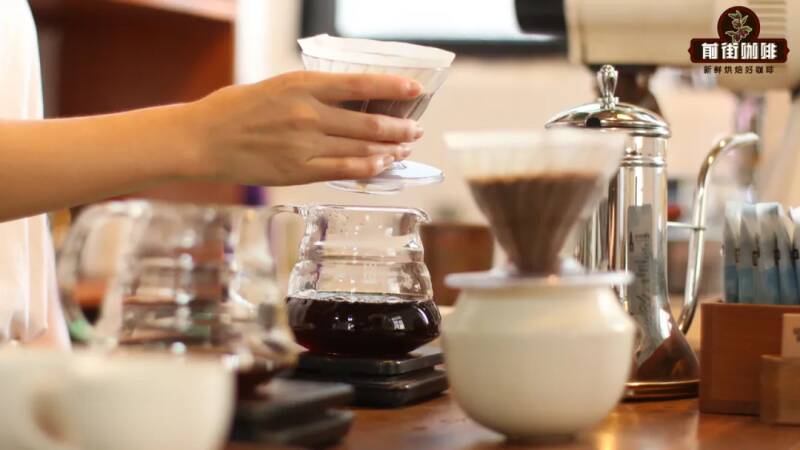
However, Qianjie does not recommend that everyone use interception unconditionally. Although on a certain level, interception can greatly reduce the probability of over-extraction of coffee, it cannot avoid the seepage of bitter substances. This is a misunderstanding that many friends easily step into when they first start. Not only that, when intercepted under improper use, in addition to the bitterness of coffee, it will also intercept many characteristics of coffee. For example, make the flavor less complete, the aftertaste less long, the coffee taste less mellow, etc. This is the main reason why Qianjie does not recommend that everyone use interception at will.
So today, Qianjie will come to share again why interception cannot cut off the bitterness of coffee, and then under what circumstances should we use interception correctly.
Why can't I cut off the bitterness of coffee? It's simple, because the bitterness of coffee does not dissolve only at the end of the paragraph. The main reason why many friends have this misunderstanding is because of this sentence: the taste of coffee has different dissolution rates according to the size of the molecule. The sour substance has the smallest molecular weight, so it will be dissolved first, followed by the sweet substance, and the bitter substance has the largest molecule, and it will be the last to be dissolved.
The mistake of this sentence is that although molecular size does affect the dissolution of flavor substances, it affects the rate of dissolution rather than the order of dissolution. Whether it is sour, sweet or bitter, these substances will be released at the same time the moment when hot water comes into contact with coffee powder. However, due to the difference in molecular sizes, they will have different dissolution rates. Here's an analogy: powdered sugar, white granulated sugar, and rock sugar. Under the same gram weight, powdered sugar will be the first to be dissolved in hot water because of the largest water-contacting surface area, followed by white granulated sugar, and finally rock sugar. Then we just need to convert it into the sour, sweet and bitter substances in coffee and dissolve them during extraction. Will it be much easier to understand?
In other words, the acidic and sweet substances in coffee will dissolve before the bitter substances because their molecules are smaller than the bitter substances. When the sweet and sour substances are almost dissolved, they reach the end. At this stage, the proportion of bitter substances in the coffee washed out will be higher than that in the front and middle stages of extraction. In short, bitter substances do not dissolve until the tail section, but because sweet and sour substances have already dissolved in the tail section, the proportion of bitter substances in the tail section has increased, which makes the tail section known as the main dissolution stage of bitter substances.
Then, because there are not so many sweet and sour substances dissolved in the tail section, mainly bitter substances, if we don't want obvious bitterness to appear in the coffee, we need to stop the extraction at the right time to avoid excessive addition of bitter substances into the coffee. Amplify the bitterness of coffee. interception is one of the ways to stop extraction. But as said in front of Front Street, the use of interception must be limited. Under improper use, it will actually wear away some of the characteristics of coffee and weaken the layering and flavor experience of coffee!
Because the tail section of coffee does not just have bitterness, the tail section of coffee refers to the end of extraction. At this stage, in addition to bitter substances, there are also some other flavor substances present in the coffee dissolved. If we don't find the right time to intercept, then these flavor substances will be intercepted along with the bitterness, and the performance of the coffee will be less outstanding. Just like ice hand-brewed coffee is not as rich in flavor as hot hand-brewed coffee, the end of the coffee is abandoned in order to increase the concentration of the coffee, resulting in the overall flavor presentation being slightly weaker than that of hot brewed coffee.
Not only that, if the measuring method we use when making coffee is the ratio of powder to water, then arbitrary interception will hinder our judgment on extraction. Because Qianjie believes that most of our friends use ordinary electronic scales, the only number we can see is the amount of water injected except for time. We don't know how much water was cut off during interception. If we cut off this action as a permanent operation during brewing (when measuring in proportion to powder water), then we will not be able to judge well where the problem occurred during extraction. Therefore, Qianjie does not recommend that everyone use interception at will. It's casual, not impossible! The application of interception is still relatively extensive. Generally, there are two main situations where we use interception! The first situation is more common, when making coffee using the ratio of powder to liquid as a measurement method.
The difference between the powder-liquid ratio and the powder-water ratio is that the weight measured in the former is coffee liquor, while the latter is the injected hot water. When the measured weight of brewed coffee is coffee liquid, then we need to cut off the water to prevent excess coffee liquid from being added to the coffee from affecting the extraction rate and concentration. This is an active interception, and the purpose is to allow the extraction of coffee to follow the set path. The other is passive interception! To be honest, passive interception is quite common. What is passive interception? That is, during the brewing process, you find that because there is too much fine powder or the filter paper is blocked by fine powder, the penetration rate of the coffee liquor becomes very slow, and the extraction time may far exceed the set time. Well, in this case, we need to consider the use of interception.
Take Qianjie as an example. The time used to brew coffee on Qianjie is generally limited to 2 minutes (beans with high density will be longer). But this two minutes is not fixed. It can be more or less. We don't need to say that it takes one to two minutes to remove the filter cup immediately to cut off the liquid in the coffee, because coffee is actually not as easy as everyone thinks. Overextract. Only when the extraction time far exceeds the set 2 minutes, such as more than 20 seconds, 30 seconds, the front street will consider using interception. Because according to the judgment of brewing in the past, the flavor substances of this bean had almost dissolved at this time, and only the impurities and bitterness were dissolved further down. At this time, Qianjie would choose to remove the filter cup before the coffee solution was filtered out and end the extraction.
- END -
FrontStreet Coffee is a long-established specialty coffee roaster in Guangzhou China, selling freshly roasted beans from its own farm in Yunnan as well as dozens of carefully selected single-origin beans from around the world for both pour-over and espresso. The products deliver consistently excellent quality and great value, with shipping within 24 hours. Guangzhou's FrontStreet Coffee shop is recommended by many coffee lovers, and the beans are now available online at the Tmall 。
Important Notice :
前街咖啡 FrontStreet Coffee has moved to new addredd:
FrontStreet Coffee Address: 315,Donghua East Road,GuangZhou
Tel:020 38364473


Is it normal to smell like coffee? Why does coffee smell like alcohol? What's wrong with the strong smell of cold extract ice dripping ice brewed coffee?
Save the unformed and stagnant powder cakes in one second! What is the problem with stagnant water in the powder bowl of the espresso machine?
