World Coffee Brewing Competition champion variable temperature brewing parameters and methods to share! What proportion of water temperature should be used to grind the geisha fragrance brewing method?
The World Coffee Competition has always been an event recommended by the Front Street Association to watch for friends who want to learn more about coffee. Because in order to get the lead, players usually devote more energy to learning and studying coffee making than ordinary enthusiasts, so the methods and theories we have seen on the field are the essence of the competition condensed by the players. Although it may not always be used, there are still many novel ideas worth learning and understanding.
For example, in competitions in recent years, we can often see players adding "cold water" to brew coffee during the brewing process. Not only that, even many champion players have successively shared the same type of brewing plans on various media websites after the game. So this can't help but sigh: The secret to becoming a world champion is actually to add "cold water" when making coffee!?

In fact, this "cold water" is not that cold water. It refers to water with a lower temperature than conventional boiling hot water. However, because the temperature difference is too large, it is not an exaggeration to be ridiculed as "cold water." What does it mean? That is, the water temperature we usually use to brew coffee will be around 90°C, while the temperature of this "cold water" will drop from 80°C, and the most extreme will even be as low as 70°C!
If we only use water at this temperature to brew coffee, there is no doubt that the coffee will be seriously under-extracted due to the low water temperature and substandard extraction efficiency. So players only use "cold water" at a certain stage in the extraction process. That's right! This is the well-known "variable temperature brewing"-a method that uses hot water of multiple water temperatures to brew coffee.
The purpose of changing temperature is also very simple! Just like what Qian Jie shared in the article "Is Coffee Extraction Metaphysical", it is to control the speed or amount of certain soluble substances extracted from coffee, so that the final coffee can have the ideal taste and taste. As we all know, the extraction of hand-brewed coffee has different stages. When "cold water" is used at different stages, its effects and results will be different. So what Qianjie wants to share today is that there are three different "effects", but the more common and commonly used temperature-changing brewing methods are all very interesting ways to play. Everyone can try it if you have nothing to do in your daily life ~(Just everyone needs to note that the parameters used in Qianjie's article are for everyone's reference only. Everyone's bean grinder and coffee beans are different, so it is best to make adjustments based on the brewing results)
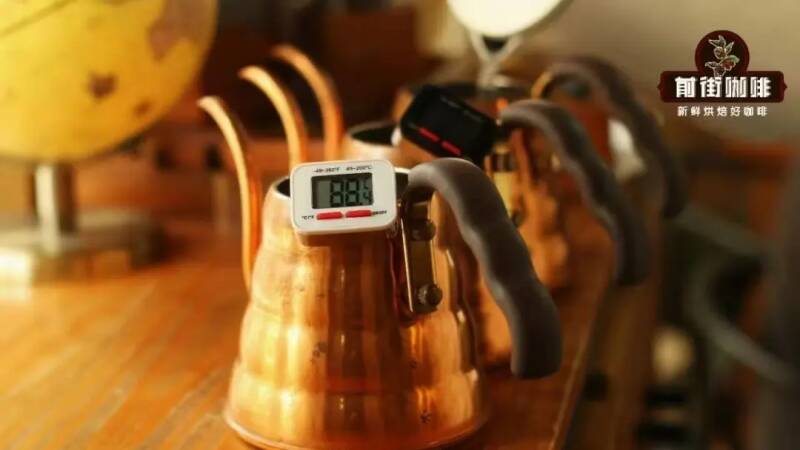
1. Please ignore the naming taste of Qianjie for steaming and changing temperatures, but as the name suggests, it is a variable-temperature flushing method that uses low-temperature water for steaming. Qianjie has also shared this method in many articles before. The purpose is also easy to understand, which is to move the dissolution node of some soluble substances with faster dissolution and volatilization rates back a little bit, so that the number of them in the cup can be increased and we can taste more from coffee. Flavors. For example, making coffee sweeter and richer flowers.
Here, Qianjie takes the focus on extracting floral fragrance as an example. Because the floral fragrance in coffee will dissolve and volatilize in large quantities in the early stage, the floral flavor left in the cup will not be so much in the end. Through this method, the efficiency of the early steaming is reduced, and the dissolution node of the floral fragrance will move back, allowing us to taste more floral flavor in the coffee in the cup.
Just what everyone needs to note is that due to the low water temperature used during steaming, the coffee powder cannot be fully exhausted during the steaming stage. Therefore, during the formal extraction stage, we need to use hot water at a higher temperature than usual to brew coffee. Only in this way can we ensure that the coffee can be completely extracted. Here, Front Street uses Front Street Panama Poquet geisha, which has a fragrant fragrance of flowers in Front Street bean list. For example, the parameters other than water temperature are roughly the same as usual: the powder amount is 15g, and the coffee powder can be thinner. Here, Front Street The grinding degree used is 80% sieving rate of No. 20 sieve, extraction time is 2 minutes, powder and water ratio is 1:15, and three-stage brewing. The water volume is distributed as 30ml, 120ml, and 75ml. Because this is a medium and lightly baked geisha, the water temperature used for steaming is 80°C, and the water temperature used for the last two stages of formal extraction is 95°C.
We can taste the geisha coffee brewed in this way with a more obvious white flower fragrance than before (stronger, but not so much), and then the performance in other aspects is quite good. The taste is sweet and sour. In addition to the flower fragrance, we can also taste the flavor characteristics of citrus, honey, and oolong tea. The taste is light and clean, and the aroma is outstanding.
2. Tail section variable temperature method The second type is a variable temperature flushing method that uses low-temperature water extraction at the tail section of the extraction. Its purpose will be better understood than the former, which is to reduce the amount of bitter substances dissolved in the tail section and increase the content of coffee. The proportion of acid and sweetness is more suitable for brewing medium and light roasted coffee. But ~ yes ~ it will be more troublesome to operate, because it requires three different temperatures to brew. It is also a three-stage brewing. First, steam with hot water at 92°C, and then use hot water at 95°C. In the second stage, a large amount of those pleasing flavor substances in the coffee are dissolved, and finally, hot water at 85°C is used for the third stage of brewing.
The other parameters are the same. Take the Qianjie Boundary Manor·Xizhao, which has full fruit charm in the previous street bean list. When using the tail-stage variable temperature method for brewing, the parameters used by Qianjie are: powder amount 15g, powder and water ratio 1:15, extraction time 2 minutes, grinding degree of 80% of the sieve rate of No. 20 screen, and water temperature. 92°C, 95°C, and 85°C mentioned above. The Chinese claw brewed with this set of parameters will have less bitter taste than the Chinese claw brewed with conventional brewing, so the taste will be mainly sweet and sour, and the flavor is expressed as grapes, apricot peaches, passion fruit, and a little floral fragrance ~
3. Soaking and changing temperature method Soaking and changing temperature is different from the first two. This flushing method uses a filter cup with a valve or a smart cup, because during the brewing process, we need to use low-temperature water for soaking and extraction. The purpose is also easy to understand, which is to prevent over-extraction and under-extraction of coffee. Using a water temperature of 70°C can prevent excessive extraction of coffee, while superimposed immersion can prevent insufficient extraction of coffee. Then we do not need to control too much water flow, which is a friendly brewing method that is more suitable for novices.
Since the explanation is quite lengthy, and there was a special tweet previously posted on Qianjie to share this method, which is the 46th Chong Smart Cup version of the world champion Tetsu Sakani, interested friends can move to "The New Invention of the World Champion" This article understands, Qianjie will not elaborate on it too much here ~
- END -
FrontStreet Coffee is a long-established specialty coffee roaster in Guangzhou China, selling freshly roasted beans from its own farm in Yunnan as well as dozens of carefully selected single-origin beans from around the world for both pour-over and espresso. The products deliver consistently excellent quality and great value, with shipping within 24 hours. Guangzhou's FrontStreet Coffee shop is recommended by many coffee lovers, and the beans are now available online at the Tmall 。
Important Notice :
前街咖啡 FrontStreet Coffee has moved to new addredd:
FrontStreet Coffee Address: 315,Donghua East Road,GuangZhou
Tel:020 38364473

What is the difference between the world's three major coffee varieties, Robusta and Arabica? What is the relationship between geisha Iron Pika and Arabica?
Share tips on how to inject vertical water from hand-brewed coffee! What are the practice methods for making coffee by hand and injecting water in circles?