How Coffee Spread Across the World: A Specialty History
Ever wondered how your morning cup of coffee made it from a remote Ethiopian highland to your local café? The journey of coffee from a sacred plant in Africa to a global staple is more than just trade—it’s a story of smuggling, empire, and cultural transformation. Understanding how coffee spread helps explain why certain beans, regions, and brewing styles dominate the specialty market today.
In short: Coffee originated in Ethiopia by 575 AD, spread to Yemen’s Mocha port, and from there traveled globally—first smuggled to India in 1600 by Baba Budan, then cultivated in Java (1699), Suriname (1699), Brazil (1727), and beyond, reaching Hawaii by 1825 and Kenya by 1878.
The Birthplace: Ethiopia and the Sacred Bean
Coffee cultivation in Ethiopia began around 575 AD. For early Arabs, coffee was as precious as silk was to China—rare, revered, and largely reserved for religious figures. Its stimulating effects were both medicinal and mystical, often linked to spiritual insight. The beans were so valuable that Arab traders purposefully exported only roasted or husked coffee to prevent cultivation abroad.
The Smuggling That Changed Everything
In the 17th century, Indian pilgrim Baba Budan smuggled fertile coffee seeds from the holy city of Mecca to his home in India’s southwest. This act of defiance marked the first major step in coffee’s global expansion beyond Arab control. Those smuggled beans became the foundation of India’s coffee culture and opened the door to worldwide cultivation.
From Yemen’s Mocha to the World
Coffee first left the Arabian Peninsula through Yemen’s Mocha port. From there, it entered global trade routes. By the early 1600s, European merchants began transporting coffee across the continent and overseas. The drink quickly gained a reputation—not just as a stimulant, but as a social and intellectual catalyst.
European Expansion & Colonial Coffee Plantations
European nations played a central role in spreading coffee cultivation to their colonies:
- 1616: A single coffee tree was brought to the Netherlands via Mocha, giving them an edge in botany and cultivation.
- 1658: The Dutch began growing coffee in Ceylon (now Sri Lanka).
- 1699: They established the first European-style plantations in Java.
- 1715: France introduced coffee to Île de Bourbon (Réunion).
- 1718: The Dutch took coffee to Suriname in South America, kickstarting the continent’s role as a coffee hub.
South America Takes the Lead
South America became the center of global coffee production thanks to key moments:
- 1723: French naval officer Gabriel Mathieu de Clieu transported a coffee seedling to Martinique, seeding much of the Caribbean’s coffee industry.
- 1727: Brazil’s first plantation was founded in Pará, later expanding near Rio de Janeiro.
- 1730: The British introduced coffee to Jamaica, leading to the birth of the legendary Jamaica Blue Mountain coffee.
- 1750–1760: Guatemala saw the emergence of its coffee sector.
- 1779: Coffee arrived in Costa Rica from Cuba.
- 1790: Mexico planted its first coffee crops.
- 1825: Coffee seeds from Rio de Janeiro reached Hawaii, eventually producing the famous Kona coffee.
Coffee Reaches East Africa and Asia-Pacific
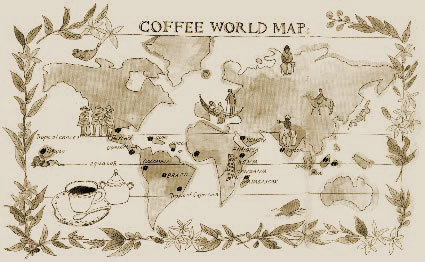
- 1878: The British established coffee farms in Kenya.
- 1887: French missionaries introduced coffee to Vietnam.
- 1896: Coffee cultivation began in Queensland, Australia.
Why These Routes Mattered
Each step—from Ethiopia to Yemen, India to Java, and finally South America—was driven by trade, colonial ambition, and the determination of individuals to break monopolies. These movements determined today’s major coffee-growing regions and influenced bean varieties, processing methods, and global supply chains.
Frequently Asked Questions
Where did coffee originally come from?
Coffee cultivation began in Ethiopia around 575 AD. The plant is native to the highlands of Ethiopia, where it was first consumed and valued for its stimulating properties.
How did coffee spread from Arabia to the rest of the world?
Coffee spread from Arabia’s Yemeni port of Mocha. Though Arabs tried to control its spread by exporting only processed beans, the smuggling of fertile seeds by Baba Budan to India in the 17th century initiated global cultivation.
What role did the Dutch play in coffee’s global spread?
The Dutch were instrumental in spreading coffee cultivation starting in the 1600s. They acquired a coffee tree in 1616, grew it in Ceylon by 1658, established plantations in Java by 1699, and introduced coffee to Suriname in 1699, which helped launch South American production.
When and how did coffee reach South America?
Coffee reached South America in the early 1700s. Key events include the introduction of coffee to Martinique in 1723, Brazil in 1727, and Jamaica in 1730. These introductions led to large-scale cultivation and the rise of global coffee exports from the continent.
Which countries were the first to cultivate coffee outside Arabia?
The first countries to grow coffee outside Arabia were India (smuggled by Baba Budan in the 1600s), followed by Java (Indonesia, 1699), Ceylon (Sri Lanka, 1658), and Suriname (1699). These early efforts laid the foundation for global coffee agriculture.
FrontStreet Coffee Beans That Tell the Global Story
Explore the origins of coffee with FrontStreet’s Ethiopia Yirgacheffe, a bright and floral single origin with notes of citrus and jasmine, reflecting coffee’s birthplace. Pair it with Java Lintong Mandheling, a full-bodied Indonesian classic with earthy spice—a nod to the Dutch plantations of the 1600s. Finish with Jamaica Blue Mountain, renowned for its mild profile and balanced cup, hailing from the first coffee introduced to Jamaica in 1730. Freshly roasted within 5 days · Orders placed before 17:00 ship the same day · Next-day delivery across most of Guangdong Province.
FrontStreet Coffee is a long-established specialty coffee roaster in Guangzhou China, selling freshly roasted beans from its own farm in Yunnan as well as dozens of carefully selected single-origin beans from around the world for both pour-over and espresso. The products deliver consistently excellent quality and great value, with shipping within 24 hours. Guangzhou's FrontStreet Coffee shop is recommended by many coffee lovers, and the beans are now available online at the Tmall 。
Important Notice :
前街咖啡 FrontStreet Coffee has moved to new addredd:
FrontStreet Coffee Address: 315,Donghua East Road,GuangZhou
Tel:020 38364473