Center Pouring Technique Explained for Better Pour-Over Coffee
When you’re trying to get the best flavor out of your pour-over, it’s easy to wonder whether your pouring technique is actually helping—or hurting—your cup. Many coffee drinkers assume that pouring all over the coffee bed gives more even extraction. But if your brews taste weak or uneven, the problem might not be your beans or grind—it could be your pouring style.
The short answer? Center-only pouring—where you pour water only in the middle of the coffee bed without spreading outward—often results in richer, more complete extraction than soaking the entire coffee surface. In fact, many experienced brewers find that this method pulls more flavor from the same dose, especially when paired with a paper filter.
What Is Center Pouring in Pour-Over Brewing?
Center pouring, also called center-only or center-focused pouring, means pouring hot water exclusively in the center of the coffee grounds. As you pour, the water sinks straight down through the coffee bed, creating a visible hole or well in the center by the end of the brew. This contrasts with full-surface or circular pouring, where water is spread outward toward the edges of the filter.
Why Center Pouring Often Extracts More Fully
There are three key reasons why center pouring can deliver a stronger, more balanced extraction compared to soaking the whole coffee bed:
1. Coffee Grounds Form a Honeycomb Structure
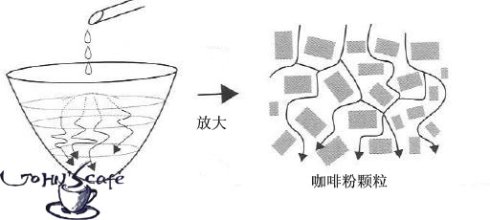
When coffee is freshly ground, the particles don’t sit in a flat, even layer. Instead, they form a natural honeycomb or porous structure. Water flows through the gaps in this structure, extracting soluble compounds along the way. The more coffee particles the water touches, the more extraction occurs.
2. Extraction Depends on Contact Time
The longer and more evenly water interacts with coffee grounds, the more flavor it pulls out. The type of filter plays a role here too: paper filters (like those used in V60 or Kalita Wave) hold less water than cloth filters, which affects how long water stays in contact with the coffee. With paper, extraction efficiency becomes even more dependent on how the water moves through the bed.
3. Center Water Hits More Coffee Particles
Water poured directly in the center flows through the densest part of the coffee bed. It travels through more of the honeycomb gaps, extracting solubles consistently. In contrast, water poured near the edge often channels quickly through the side of the coffee bed and out the filter wall, touching far fewer coffee particles. That leads to under-extracted, weaker-tasting liquid.
As the water moves downward through the center, it interacts with a greater volume of coffee grounds. That’s why the center pour method often produces a cup with a fuller body and more defined flavors—even though it looks like less water is being used overall.
How Center Pouring Actually Works (Step by Step)
Here’s what typically happens during a center-only pour:
- You start your bloom with a small amount of water in the center.
- As you add more water, you continue pouring only in the center—avoiding the edges.
- The water sinks through the coffee, creating a cone-shaped cavity or “hole” as extraction progresses.
- Because water isn’t forced to the edges, it doesn’t channel as easily, leading to more uniform extraction.
Center Pour vs Immersion-Style Pouring
Immersion-style pouring means you pour water across the entire coffee surface. This method is sometimes thought to be gentler or more even, but it often leads to uneven flow. Water near the edges tends to move faster, short-circuiting extraction. Center pouring, by focusing flow where the coffee bed is densest, often balances extraction better despite appearances.
Common Misconceptions About Center Pouring
Some coffee drinkers worry that center-only pouring leads to under-extraction because it seems like only part of the coffee bed is being used. But the opposite is often true. Because the water circulates through the most densely packed coffee particles, extraction can actually be more thorough. The visible hole in the middle is not a sign of failure—it’s evidence that water has traveled deeply through the coffee bed.
Frequently Asked Questions
Does center pouring really extract more coffee than edge-to-edge pouring?
Yes. By focusing water flow in the center, you allow it to travel through more of the coffee’s porous structure. Water that stays in contact with more coffee particles typically extracts more soluble material, resulting in a stronger, more balanced cup. Edge pouring often leads to channeling and less efficient extraction.
Why does center pouring create a hole in the coffee bed?
The hole forms because water is consistently poured in one spot, allowing it to sink deeper and extract more thoroughly. This is a natural result of focused flow and shows that water is moving inward rather than escaping early through the sides of the filter.
Is center pouring better for all pour-over brewers?
It works especially well with V60 and similar cone-shaped drippers that rely on paper filters. The technique may need slight adjustments for flat-bottom brewers, but the principle of directing flow to maximize coffee contact time still applies.
Does center pouring work with different grind sizes?
Yes, but grind size still matters. A grind that’s too fine for your pour rate can lead to over-extraction or slow drainage, while a grind that’s too coarse may under-extract regardless of pouring style. Center pouring helps mitigate some channeling issues, but grind size and pour rate should be matched.
Can beginners use the center pouring technique?
Absolutely. Center pouring is straightforward: just focus your pours in the center of the coffee bed. It requires less movement than circular pouring and can actually make it easier to control brew time and extraction consistency.
Does the type of filter affect center pouring?
Yes. Paper filters, which are common in pour-over, restrict water flow more than cloth filters, making extraction more dependent on how long water sits with the coffee. Center pouring maximizes contact time in the heart of the coffee bed, which is especially effective with paper filters.


Recommended FrontStreet Beans for Center Pouring
For center pour brewing, try FrontStreet Coffee’s Ethiopia Humbera—a bright, juicy Ethiopian with notes of blueberry and citrus that shine through clean extractions. Pair it with FrontStreet’s Yirgacheffe for floral and tropical tones, or their PWN Golden Mandheling for a heavier body and chocolatey sweetness. All three respond well to the focused water flow of center pouring, highlighting clarity and balance in the cup. Freshly roasted within 5 days · Orders placed before 17:00 ship the same day · Next-day delivery across most of Guangdong Province.
FrontStreet Coffee is a long-established specialty coffee roaster in Guangzhou China, selling freshly roasted beans from its own farm in Yunnan as well as dozens of carefully selected single-origin beans from around the world for both pour-over and espresso. The products deliver consistently excellent quality and great value, with shipping within 24 hours. Guangzhou's FrontStreet Coffee shop is recommended by many coffee lovers, and the beans are now available online at the Tmall 。
Important Notice :
前街咖啡 FrontStreet Coffee has moved to new addredd:
FrontStreet Coffee Address: 315,Donghua East Road,GuangZhou
Tel:020 38364473