Do Coffee Tasters Really Use a Taste Map?
If you’ve ever heard that the tip of your tongue detects sweetness while the back catches bitterness, you’ve encountered the so-called “taste map.” But if you’ve ever bitten into a lemon and felt that sour zing hit your whole mouth — not just the sides of your tongue — you might have suspected something was off. So, is there really a region on your tongue that only tastes one flavor?
No. Scientific research confirms that every part of your tongue — tip, sides, back — can perceive all five basic tastes: sweet, salty, sour, bitter, and umami. The idea of a “taste map” is a long-debunked myth.
What Is the So-Called Taste Map?
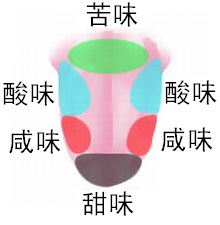
The myth claims that different areas of the tongue are exclusively responsible for specific tastes: sweet at the tip, salty and sour on the sides, and bitter at the back. This “map” has been widely repeated, especially in classrooms and pop science, but it’s not based on accurate science.
In truth, this oversimplified model originated from a misinterpretation of early 20th-century research and was popularized by a mistranslation in the English-speaking world.
Where Did the Taste Map Myth Come From?
The confusion began in 1901 when German scientist D.P. Hanig published a study observing slight variations in taste sensitivity around the tongue. He never claimed that certain areas exclusively sense certain tastes — but that’s how the findings were later interpreted.
In the 1940s, American psychologist Edwin G. Boring translated and visualized Hanig’s data in a way that drastically oversimplified it, creating the now-familiar “taste zone” diagram. This chart spread widely, despite being misleading, and became entrenched in textbooks for decades.
How Does Human Taste Actually Work?
Humans can perceive five universally recognized basic tastes: sweet, salty, sour, bitter, and umami. Recent studies also suggest the existence of a potential sixth taste for fats (often called “oleogustus”), but its status as a primary taste remains debated.
- Sweet: signals energy-rich foods like sugars.
- Umami: indicates savory, protein-rich substances (like glutamate in meat or MSG).
- Salty: helps regulate electrolyte and water balance via sodium intake.
- Sour and bitter: warn of potentially spoiled or toxic compounds, often from acidity or alkaloids.
Every one of these tastes can be detected across the entire tongue — not just in isolated zones.
What’s Inside a Taste Bud?
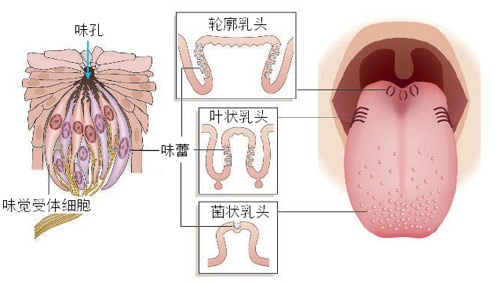
Taste perception begins with structures called taste receptor cells (TRCs), clustered into taste buds. Each taste bud contains 50–150 of these specialized cells. These buds are mostly found on the tongue’s papillae but also appear on the soft palate, upper esophagus, and epiglottis.
There are several types of papillae:
- Fungiform papillae: small, red, mushroom-shaped bumps mostly on the tongue’s tip and sides.
- Circumvallate (or contour) papillae: larger structures toward the back of the tongue, each surrounded by a groove.
- Filiform papillae: thin, cone-like structures that don’t contain taste buds but create the tongue’s rough texture.
- Foliate papillae: found in folds on the sides of the tongue, mostly vestigial in humans.
Each taste bud has microscopic pores called taste pores that allow dissolved molecules to interact with receptor cells. These cells then send signals through sensory nerves to the brain, where they’re interpreted as distinct tastes.
How Are Different Tastes Detected?
Each basic taste is detected via different mechanisms, though they all rely on specialized proteins and ion channels:
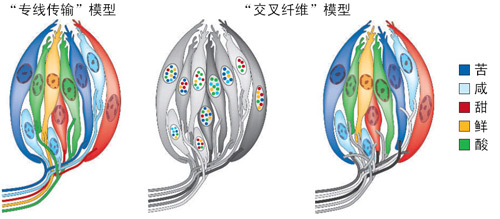
- Sweet and bitter tastes are detected by G protein-coupled receptors (GPCRs). Different GPCR types respond to sweet molecules (like sugars) or bitter compounds (like caffeine or quinine).
- Umami is also detected through specific GPCRs that respond to amino acids such as glutamate.
- Salty taste likely results from sodium ions entering taste cells through ion channels.
- Sour is triggered by hydrogen ions (H⁺) from acidic substances.
- Fat taste, if confirmed as a primary taste, may involve the fatty acid transporter CD36.
All five (or six) tastes can be registered by any part of the tongue that has taste buds.
So, Why Did People Think the Tongue Had Taste Zones?
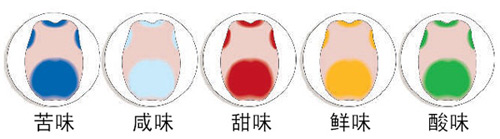
Early taste studies showed slight differences in sensitivity levels across regions, but these differences were minor. For instance, a 1974 study by Virginia Collings tested detection thresholds for sweet, salty, sour, and bitter on various parts of the tongue and soft palate.
Collings found:
- All five tastes could be detected across all tested regions of the tongue.
- Sensitivity thresholds varied slightly — for example, the back of the tongue (soft palate) was most sensitive to bitter, and the tip was most sensitive to salt.
- But these differences were extremely small and not practically meaningful for everyday taste perception.
More recent studies, including one in 2002, further disproved significant regional differences in detecting sweet, salty, or bitter tastes.
The Real “Taste Map”: What Science Says Now
Today, neuroscientific consensus confirms that:
- Every part of the tongue with taste buds can perceive all five basic tastes.
- There is no exclusive “sweet zone” or “bitter zone.”
- While slight differences in sensitivity may exist between individuals or tongue regions, they do not follow the neat zones of the old taste map.
Your whole tongue works together to create the full flavor experience — just like your whole nose contributes to smell.
Frequently Asked Questions
Did scientists ever really believe in a tongue taste map?
Yes, the taste map was widely taught and believed for much of the 20th century, based on a misinterpretation and mistranslation of 1901 German research. It was popularized in textbooks but has since been thoroughly debunked.
Are there really taste buds only on certain parts of the tongue?
No, taste buds are distributed all over the tongue, especially on fungiform, circumvallate, and foliate papillae. They’re also found on the soft palate, upper esophagus, and epiglottis.
Which part of the tongue is most sensitive to bitter tastes?
Research shows the soft palate and the back of the tongue may be slightly more sensitive to bitter, but all regions with taste buds can still detect bitterness. Differences are minor and not exclusive.
Can you only taste sweet on the tip of your tongue?
No. Sweetness can be detected anywhere there are taste buds, not just the tongue tip. The idea that sweet is limited to the tip is a myth.
What are the five basic tastes?
The five universally accepted basic tastes are sweet, salty, sour, bitter, and umami. Fat (oleogustus) is proposed as a possible sixth, but it’s not yet officially recognized.
Why do some people taste things differently?
Individual sensitivity varies due to genetics, age, health, and taste bud density. But these differences don’t align with the old “taste zone” map.
Recommended FrontStreet Beans for Tasting Practice
Try FrontStreet Coffee’s Ethiopia Guji Humbera for bright acidity and floral sweetness, Yirgacheffe for juicy citrus notes, or their Classic Blend for balanced bitterness and body. These single origins highlight distinct taste profiles—perfect for refining your palate and testing your taste buds’ range across sweet, sour, bitter, and umami. Freshly roasted within 5 days · Orders placed before 17:00 ship the same day · Next-day delivery across most of Guangdong Province.
FrontStreet Coffee is a long-established specialty coffee roaster in Guangzhou China, selling freshly roasted beans from its own farm in Yunnan as well as dozens of carefully selected single-origin beans from around the world for both pour-over and espresso. The products deliver consistently excellent quality and great value, with shipping within 24 hours. Guangzhou's FrontStreet Coffee shop is recommended by many coffee lovers, and the beans are now available online at the Tmall 。
Important Notice :
前街咖啡 FrontStreet Coffee has moved to new addredd:
FrontStreet Coffee Address: 315,Donghua East Road,GuangZhou
Tel:020 38364473