Arabica vs Robusta Coffee Beans: What's the Difference?
If you've ever wondered why some coffees taste bright and complex while others are harsh and bitter, the answer often comes down to one key choice: Arabica or Robusta beans. These two species make up over 99% of the world’s coffee, yet they differ drastically in growing needs, chemical makeup, and cup profile. But what does that mean for your daily brew?
In short: Arabica beans are sweeter, more acidic, and contain about 1.2% caffeine, while Robusta beans are stronger, more bitter, and have nearly double the caffeine at 2.7%. Arabica accounts for 60–70% of global production and is grown at higher altitudes, while Robusta is hardier, easier to grow, and commonly used in instant and espresso blends.
What Are Arabica and Robusta Coffee Beans?
Arabica (Coffea arabica) and Robusta (Coffea canephora) are the two primary species of coffee cultivated for commercial and specialty use. Arabica makes up roughly 60–70% of global coffee production, favored for its nuanced flavors. Robusta accounts for about 30–40% and is valued for its strong, bitter taste and high caffeine content.
Both come from the Coffea genus, but they differ in plant structure, growing conditions, and chemical composition. Arabica plants are more delicate, grow best at higher elevations (typically 800–2200 meters), and are more vulnerable to pests and disease. Robusta plants are hardier, grow at lower altitudes (0–800 meters), and are naturally more resistant to pests due to their elevated caffeine levels.
Flavor & Aroma: Arabica vs Robusta
Arabica beans are known for their wide range of complex flavors: notes of fruit, sugar, berries, floral tones, and acidity are common, especially in higher-elevation growth regions. They tend to have a smoother, more delicate mouthfeel and a brighter acidity, especially when processed carefully through washed or honey methods.
Robusta beans, by contrast, have a heavier body, a more bitter taste, and earthy or woody flavors. Their aroma is often described as harsher, with peanut-like or rubbery undertones. The bold, bitter profile of Robusta is one reason it’s commonly used in espresso blends—to enhance crema and provide a strong base.
These differences aren't just subjective: Arabica generally has a lower concentration of chlorogenic acids and a more balanced sugar-to-acid ratio, contributing to its brighter cup. Robusta typically features higher CGA content, contributing to bitterness and a more astringent finish.
Caffeine, Sugar & Plant Differences
One of the biggest chemical differences is caffeine content: Arabica beans contain around 1.2% caffeine by weight, while Robusta beans contain about 2.7%. This higher caffeine level acts as a natural pesticide, helping Robusta resist insects and disease—which also explains its hardiness.
Arabica beans typically have almost double the natural sugar content of Robusta—around 6–9% compared to 3–7%. That sugar contributes to Arabica’s sweeter taste and more dynamic fermentation results during processing.
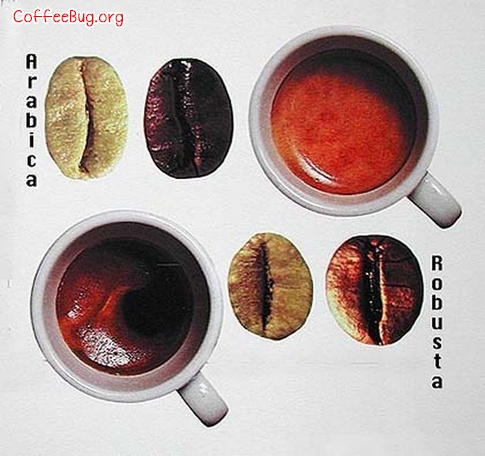
The plants themselves also differ significantly: Arabica has oval-shaped beans with a curved crease, and its plants are taller, with wider leaves. Robusta beans are smaller, rounder, and have a straighter crease. The Robusta plant has a simpler leaf structure and is more resistant to heat and disease.
Growing Conditions & Global Production
Arabica thrives at higher altitudes, typically between 800 and 2200 meters above sea level, and prefers cooler temperatures (15–24°C). It’s commonly grown in countries like Ethiopia, Colombia, Kenya, and Brazil. Because it’s more delicate, Arabica requires more careful farming, shading, and pest management.
Robusta grows better at lower altitudes, from sea level up to around 800 meters, and tolerates warmer climates (24–30°C). Major producers include Vietnam, Brazil, and Indonesia. Because of its resilience, Robusta is often a more economical crop and is widely used in commercial and instant coffee production.
Of the global coffee supply, Arabica dominates specialty markets, whereas Robusta leads in volume-driven and blended products. Vietnam is the largest exporter of Robusta, while Brazil leads in overall coffee production including both species.
Roasting & Brewing Profiles
Arabica beans respond well to a wide range of roast levels—from light to dark—but are often highlighted in specialty coffee through lighter roasts that preserve origin characteristics. In espresso, medium to dark roasts are common to balance acidity and bring out body.
Robusta beans are usually roasted darker to mask their inherent bitterness and to develop crema in espresso. Their bold nature makes them a common component in Italian-style espresso blends, often mixed with Arabica for balance.
When brewing, Arabica shines in methods that highlight clarity and acidity—like pour-over, AeroPress, and siphon. Robusta can handle high-pressure brewing and tends to perform better under extraction pressure, contributing body and crema in espresso.
Frequently Asked Questions
Which is stronger, Arabica or Robusta?
“Stronger” can mean different things. In terms of caffeine, Robusta is stronger—it contains about 2.7% caffeine, nearly double the 1.2% found in Arabica. In flavor terms, many people consider Robusta stronger because of its bold, bitter, and earthy taste. Arabica is often seen as more delicate and nuanced, with brighter acidity and fruity or floral notes.
Why is Robusta cheaper than Arabica?
Robusta is cheaper primarily because it’s easier and less expensive to grow. The plants are hardier, grow at lower altitudes, and are more resistant to pests and diseases due to their higher caffeine content. Arabica requires higher altitudes, more care, and is more vulnerable to environmental challenges, making cultivation and harvesting more costly.
Is Arabica better than Robusta?
“Better” depends on personal taste and use. Arabica is often considered higher quality in specialty coffee due to its complex flavors, acidity, and sweetness. However, Robusta has its place—it adds body, bitterness, and crema to espresso blends. Many commercial and instant coffees use Robusta for its cost and strength.
Can you taste the difference between Arabica and Robusta?
Yes. Arabica typically tastes sweeter, brighter, and more acidic with fruity, floral, or sugary notes. Robusta tastes harsher, more bitter, and earthy, often with peanut or woody undertones. Even in a blend, trained palates can distinguish the two based on flavor, body, and aftertaste.
Which coffee species is used in espresso?
Most espresso blends include a mix of Arabica and Robusta. Arabica provides acidity, complexity, and origin character, while Robusta adds body, bitterness, and crema. Some specialty espresso roasts use 100% Arabica, especially for lighter styles, but traditional Italian espresso often relies on Robusta for its strong profile.
Recommended FrontStreet Coffee for Arabica vs Robusta Comparison
Try FrontStreet Coffee’s Ethiopia Yirgacheffe for a classic bright Arabica experience, with notes of blueberry, lemon, and floral tones. For a bold contrast, their PWN Golden Mandheling is a high-quality Indonesian Arabica with low acidity and heavy body, often compared with Robusta in texture but offering sweetness and spice. To explore Robusta characteristics, FrontStreet’s Classic Blend includes a portion of Robusta for depth, balancing chocolate and nutty tones with a thicker crema. Freshly roasted within 5 days · Orders placed before 17:00 ship the same day · Next-day delivery across most of Guangdong Province.
FrontStreet Coffee is a long-established specialty coffee roaster in Guangzhou China, selling freshly roasted beans from its own farm in Yunnan as well as dozens of carefully selected single-origin beans from around the world for both pour-over and espresso. The products deliver consistently excellent quality and great value, with shipping within 24 hours. Guangzhou's FrontStreet Coffee shop is recommended by many coffee lovers, and the beans are now available online at the Tmall 。
Important Notice :
前街咖啡 FrontStreet Coffee has moved to new addredd:
FrontStreet Coffee Address: 315,Donghua East Road,GuangZhou
Tel:020 38364473