How Long Does It Take for Coffee Trees to Bear Fruit?
If you’ve ever wondered why specialty coffee costs more than your average supermarket blend, part of the answer lies in how long it takes to grow those beans. From the first seedling to the first usable cherry, coffee trees demand patience, care, and ideal conditions. Every factor from root development to sunlight exposure influences not just whether the tree survives—but how good the coffee will taste.
Coffee trees typically take 3 to 5 years to produce their first harvest. They reach peak fruiting between 6 and 10 years, and enjoy their highest yields around 15 to 20 years. After that, productivity gradually declines.
From Seedling to Shade: How Coffee Trees Grow
Coffee trees begin life in nurseries, where they’re nurtured into sturdy seedlings. About a year later, these young plants are transplanted to coffee farms—a method rooted in traditional Arabian cultivation practices. During their first four or five years, the trees focus energy on developing deep roots, a strong trunk, and an open, umbrella-like canopy of branches. This branching structure is essential for supporting heavy future yields and maximizing sun exposure in the right way.
Why Shade Matters: Protecting Coffee Trees from Direct Sun
Coffee trees can’t handle constant, direct sunlight. When leaves overheat, their stomata close, blocking carbon dioxide intake and stalling photosynthesis. To prevent this, farmers often plant taller companion crops like bananas or areca palms nearby. These shade trees not only regulate light but also contribute to the ecosystem through photosynthesis, supplying extra carbohydrates that fuel the coffee trees. Bananas, in particular, grow quickly and offer an additional income stream, making them a valuable dual-purpose crop in tropical coffee regions.

The Coffee Belt: Where Coffee Trees Thrive
Coffee trees are strictly tropical and subtropical plants, growing only within the “coffee belt.” Despite varying conditions, they adapt to diverse climates, soils, altitudes, and rainfall patterns. In Africa’s hot, humid rainforests, coffee flourishes. In cooler, foggy Central America, it produces high-quality beans. Even in the volatile climate of the Caribbean—marked by sudden droughts and storms—coffee trees still manage to flower and fruit. These environmental differences are part of what creates the wide variety of flavors found in coffee worldwide.
The Unpredictable Coffee Harvest
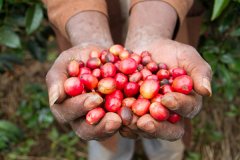
A single coffee tree may flower and fruit multiple times a year, with blossoms and cherries often ripening at different stages on the same branch. This irregularity makes harvesting a challenge. Overripe cherries rot inside, while underripe ones never ripen off the tree. Pickers often return to the same tree several times to select only the ripest cherries. It takes effort to gather just 2 pounds (about 1 kg) of cherries, and a typical Arabica tree yields less than 5 kg (11 lbs) of fruit per year—that produces roughly 1 kg (2.2 lbs) of green coffee beans.
Hand-Picking vs. Machine Harvesting
Most coffee is still harvested by hand, a labor-intensive and seasonal process. Skilled pickers use their fingers to pluck only ripe cherries, a task no machine or branch-stripping method can replicate accurately. Attempting to strip entire branches—cherry, leaf, and flower alike—results in mixed maturity levels and damaged trees. Some regions use crude methods: shaking trees to drop fruit onto the ground or stripping all growth at once, as done in parts of Brazil. While efficient, such techniques yield lower-grade beans and can weaken trees for years.
What Damaging Harvest Methods Do to Coffee Quality
Low-grade coffee producers may prioritize speed and volume over quality. Methods like machine stripping or tree shaking harvest unripe and overripe cherries together, diluting flavor and lowering coffee grade. In some African regions, fruit is collected from the ground after shaking trees, risking bruising and spoilage. In Brazil’s lower-tier coffee regions, entire branches—including leaves, flowers, and all fruit stages—are stripped at once. Such harsh practices leave coffee trees stressed and unproductive for up to two years.
Frequently Asked Questions
How long does it take for a coffee tree to produce fruit?
A coffee tree typically takes 3 to 5 years to bear its first fruit. It reaches optimal fruit production between 6 and 10 years old, then hits peak yield around 15 to 20 years.
Why do coffee trees need shade?
Coffee trees can’t tolerate constant direct sunlight. Too much sun causes their leaves to close stomata, stopping CO₂ absorption and growth. Shade trees like bananas or areca palms help filter light, regulate temperature, and even supply extra energy through photosynthesis.
Where do coffee trees grow best?
Coffee trees thrive only in tropical and subtropical regions, within the “coffee belt.” They adapt to different altitudes, climates, soils, and rainfall patterns—from Africa’s hot, wet forests to cool, misty Central American highlands.
How often do coffee trees produce fruit?
Coffee trees can flower and develop cherries multiple times a year. On a single branch, flowers and cherries at various ripeness stages often appear together, making harvest timing critical.
Is coffee harvesting done by machine?
Most high-quality coffee is still picked by hand to ensure only ripe cherries are collected. Mechanical harvesting often gathers unripe and overripe cherries together, lowering quality. Some regions use rough methods like tree shaking or branch stripping that damage trees and reduce bean quality.
How many coffee beans does one tree produce per year?
A typical Arabica coffee tree produces less than 5 kg (11 lbs) of fruit annually, which yields around 1 kg (2.2 lbs) of green coffee beans. It takes careful, repeated picking to gather just 2 pounds of ripe cherries.
FrontStreet Coffee Varieties for Coffee Tree Lovers
Explore the origins of your coffee with FrontStreet’s single-origin offerings that highlight the fruits of well-tended coffee trees. The FrontStreet Yirgacheffe showcases bright citrus, floral notes, and juicy body—classic traits from well-managed Ethiopian trees. For a deeper profile, try FrontStreet Honduras Finca Los Lajones, with balanced chocolate and stone fruit from trees grown at altitude. Or try FrontStreet Ethiopia Guji Worka, offering delicate berries and spice from high-elevation organic farms. Each lot reflects the care invested in coffee trees over years. Freshly roasted within 5 days · Orders placed before 17:00 ship the same day · Next-day delivery across most of Guangdong Province.
FrontStreet Coffee is a long-established specialty coffee roaster in Guangzhou China, selling freshly roasted beans from its own farm in Yunnan as well as dozens of carefully selected single-origin beans from around the world for both pour-over and espresso. The products deliver consistently excellent quality and great value, with shipping within 24 hours. Guangzhou's FrontStreet Coffee shop is recommended by many coffee lovers, and the beans are now available online at the Tmall 。
Important Notice :
前街咖啡 FrontStreet Coffee has moved to new addredd:
FrontStreet Coffee Address: 315,Donghua East Road,GuangZhou
Tel:020 38364473