How Coffee Trees Are Grown: Conditions, Origins & Uses
Ever wondered why your cup of coffee tastes so different depending on where it’s from? The secret lies not just in the roast or brew method, but in the very environment where coffee trees grow — from the soil they root in to the elevation of their branches. Understanding how and where coffee plants thrive reveals why certain regions produce such distinctive flavors.
Coffee is grown best between the Tropics of Cancer and Capricorn (latitudes 25°N to 25°S), with ideal farms sitting 500–2000 meters above sea level, in volcanic, well-drained soils, with steady temperatures around 15–25°C and 1500–2000mm of rain annually. These factors directly determine bean quality and flavor.
What Is a Coffee Plant?
Coffee comes from the Coffea plant, a woody perennial shrub or small tree in the Rubiaceae (madder) family. In the wild, it can grow 5–10 meters tall, but on commercial farms it’s pruned to under 2 meters to boost yield and ease harvesting. The plant has glossy, oval-shaped leaves growing opposite each other, with long, sparsely branched stems. Small white flowers bloom at the base of leaf stems, and once pollinated, these develop into coffee cherries — the fruit that holds the beans.
The Coffee Cherry & Bean
Coffee cherries resemble red cherries when ripe, with a sweet pulp surrounding a pair of seeds — the coffee beans. Each cherry typically holds two beans that sit flat-face-to-flat-face. Each bean is encased in a thin silvery skin called the silverskin, surrounded by a yellowish inner skin known as the parchment (or endocarp). The whole bean is embedded in a sticky, sweet pulp. Varieties fall mainly into three size types — small (like Typica), medium, and large — with flavor and caffeine differences. Small-bean varieties (e.g. Typica) usually have lower caffeine but more aroma, while medium and large beans (e.g. Robusta types) tend to be stronger in caffeine with less refined fragrance. Most commercial blends use about 70% medium-bean beans (for caffeine) and 30% small-bean beans (for aroma).
Where Coffee Comes From
The coffee plant originated in Ethiopia, Africa. What we call a “coffee bean” is actually the seed inside the fruit of the Coffea plant. Over time, cultivation spread globally, but only within a defined “coffee belt” near the equator. Not all locations within this zone produce great coffee — success depends on precise environmental factors.
Ideal Growing Conditions for Coffee
To grow high-quality coffee, several elements must align perfectly:
- Climate: Temperatures between 15–25°C are ideal. Coffee does not tolerate extreme heat or cold.
- Rainfall: Annual rainfall should be 1500–2000 mm, timed to support flowering and fruit development.
- Soil: Well-drained, fertile soils rich in volcanic ash are best. Drainage is critical to prevent root disease.
- Altitude: Elevation strongly affects cup quality. The optimal range is 500–2000 meters, with premium coffees often grown between 800–1200 meters — as seen with Jamaica Blue Mountain coffee.
- Shade: Direct sunlight can stress the trees. Growers often plant shade trees like bananas, mangoes, or legumes to filter light.
These combined factors — sun, rain, soil, and elevation — plus harvest and processing methods, define the final flavor profile of the coffee.
Coffee Plant Flowers and Fruits
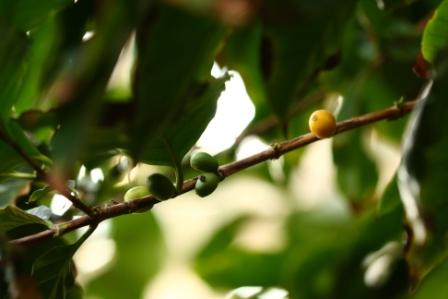
A coffee tree typically blooms for the first time at around three years old. Its flowers are small, white, five-petaled, and lightly jasmine-scented, blooming in dense clusters. The blossoms last only a couple of days before falling off, with fruit beginning to form months later. The coffee fruit, known as a coffee cherry, is a drupe about 1.5 cm in diameter. It starts green, turns yellow, then red when ripe — hence the nickname “cherry coffee.” At maturity, the cherry is ready for picking.
Inside each cherry are two coffee beans, lying flat against each other. Each bean is protected by a thin outer membrane called the silverskin, covered by a yellowish parchment layer. The beans are encased in a sticky, sweet pulp that is both soft and sugary. The outermost layer is the cherry’s hard skin.
Types of Coffee Varieties
Coffee varieties fall into three primary size categories: small (low caffeine, high aroma), medium (higher caffeine), and large (more bitter, higher caffeine). Most global blends mix roughly 70% medium-bean varieties (for caffeine) and 30% small-bean varieties (for flavor). There are dozens of natural mutations within these categories.
Nutritional & Medicinal Uses
Coffee beans and fruit contain nine key compounds, including caffeine, proteins, fats, fiber, and sucrose. As a beverage, coffee offers a rich, slightly bitter taste with a sweet finish, and stimulates alertness. Caffeine is also used medically as a stimulant, diuretic, anesthetic, and digestive aid. The cherry’s sweet pulp can be fermented into alcohol or processed for sugar. Even the flowers contain aromatic oils used to make high-end fragrances.
Frequently Asked Questions
Where do coffee trees originally come from?
Coffee trees are native to Ethiopia, in Africa. The coffee bean is actually the seed inside the coffee fruit (cherry), which develops after the plant’s flowers are pollinated.
What climate is best for growing coffee?
Coffee thrives in tropical and subtropical climates, specifically between 25°N and 25°S latitude. Ideal conditions include steady temperatures of 15–25°C, annual rainfall of 1500–2000 mm, and well-drained, fertile, often volcanic soils.
How tall do coffee trees grow?
In the wild, coffee trees can reach 5–10 meters, but on farms they are pruned to under 2 meters to improve yield and make harvesting easier.
What’s the difference between coffee varieties?
The main types are small-bean (low caffeine, aromatic), medium-bean (more caffeine), and large-bean (bitter, high caffeine). Most commercial coffee is a blend: around 70% medium and 30% small for balanced flavor and stimulation.
What part of the coffee plant is the bean?
The coffee bean is the seed inside the coffee cherry. Each cherry normally holds two beans, surrounded by sweet pulp, parchment, and silverskin layers.
Why is altitude important for coffee quality?
Higher altitudes (800–1200m, ideally) slow growth, leading to denser beans with more complex flavors. Jamaica Blue Mountain coffee, grown at 800–1200m, is a prime example of high-altitude quality.
FrontStreet Coffee Beans for Origin Exploration
Explore the origins of coffee with FrontStreet’s Ethiopia Humbera, a high-altitude Ethiopian offering with bright floral and citrus notes, and Jamaica Blue Mountain No.1, renowned for its mild body and nutty sweetness from the famed 800–1200m zone. For contrast, try Yirgacheffe, a classic Ethiopian lot with vibrant berry and citrus tones. All showcase how terroir shapes flavor. Freshly roasted within 5 days · Orders placed before 17:00 ship the same day · Next-day delivery across most of Guangdong Province.
FrontStreet Coffee is a long-established specialty coffee roaster in Guangzhou China, selling freshly roasted beans from its own farm in Yunnan as well as dozens of carefully selected single-origin beans from around the world for both pour-over and espresso. The products deliver consistently excellent quality and great value, with shipping within 24 hours. Guangzhou's FrontStreet Coffee shop is recommended by many coffee lovers, and the beans are now available online at the Tmall 。
Important Notice :
前街咖啡 FrontStreet Coffee has moved to new addredd:
FrontStreet Coffee Address: 315,Donghua East Road,GuangZhou
Tel:020 38364473