How to Steam Milk by Hand for Latte Art
If you’ve ever tried pouring latte art at home and ended up with chunky bubbles or separated milk, you’re not alone. The secret isn’t just the steaming—it’s knowing how milk transforms under heat and motion, and mastering the tools you have, whether that’s a simple moka pot and handheld whisk or a proper steam wand.
For the best hand-steamed milk texture, use whole milk heated to 60–70°C. For a smoother, pourable foam, keep your milk-to-air ratio balanced and finish by tapping and swirling the pitcher to integrate the foam evenly before pouring.
What You Need to Foam Milk
To create latte-quality milk foam without a machine, start with the right gear. For manual methods, a Tiamo HA152B double-layer or single-layer milk pitcher works well alongside a Tiamo latte cup. If you’re using a moka pot—like those from KONTESSA, VEV, or VIGANO—to brew espresso, it can produce a strong enough shot for practice, though it won’t match a machine’s crema quality. For machine steaming, a standard steam wand and a latte pitcher are essential.
Milk choice matters more than brand. Most experts recommend whole milk with a fat content between 4%–4.5%. Common high-fat options include Nestlé full cream, President, President (Fa Xǐ), Bali Hai (Ba Xi), Bright Dairy Green Box, Wandashan Original, Guangming Youbei, New Green Garden, Vitasoy, and Xiangmanlou. Fat content, not brand, determines how well milk froths and holds foam.
How Milk Foam Works
Milk foam isn’t just hot milk with bubbles—it’s a structured mix. ‘Hot milk’ refers to the liquid base below the foam, ‘milk foam’ is the light layer on top, and ‘milk froth’ is the integrated final texture ideal for pouring. Understanding these layers helps you control texture and stability for latte art.
Manual vs. Machine Methods
Manual texturing involves repeatedly drawing air into cold milk with a whisk or handheld tool, then refining the foam. Machine steaming uses pressurized steam to simultaneously heat and aerate milk, creating microfoam ideal for smooth latte art. Both require control over temperature, aeration, and mixing.
Hand Texturing Milk: Step by Step
Start by aerating cold milk with quick, low strokes until you feel resistance and a smooth texture. Progress to medium and then high strokes, maintaining that resistance. Repeat the cycle to build foam. For thinner, pourable milk, skip the high stage. Finish by vertically removing the plunger to release larger bubbles. Keep your pitcher movements smooth and controlled throughout.
Making Hot Milk Foam
Heat whole milk (like Nestlé full cream) to 60–70°C using any method—microwave, stovetop, or jug. Precision in temperature, not tools, ensures the milk is hot enough to pour yet cool enough to hold foam structure. Many baristas use microwaves set to specific timed intervals after testing.
Making Cold Milk Foam
Cold foam is made by whipping very cold milk directly in a manual frother. While typically used for iced coffee, experimenting with cold foam in hot drinks can create striking texture contrasts—try it as a variation.
Temperature & Volume Tips
Starting with cold milk extends working time and allows finer texture control—key reasons milk is refrigerated before use. Ideal final temperature is 60–65°C; exceeding 70°C makes foam coarse. Fill your pitcher to roughly 2/5 capacity and avoid overworking, which dries out the foam. Remove the top 2–3 cm of large bubbles before swirling and pouring.
Steaming Milk with a Machine Wand
Using a steam wand requires control over angle, steam volume, and movement to balance aeration and heating.
Preparation & Steam Settings
Understand your machine’s steam system and always purge the wand before use. Avoid cranking the steam valve fully; find a consistent opening (e.g., three turns for medium pressure) to protect the valve and improve consistency. Clean the wand and area immediately after each use.
Temperature Guidelines
Milk expands best when starting cold (around 5°C), allowing longer, finer aeration. Stop aerating when milk reaches body temperature (neutral to slightly warm), then continue heating until the pitcher is too hot to hold for more than a few seconds (aim for 60–65°C final temp). Use touch, not a thermometer, to gauge these stages.
Steam Wand Angle & Position
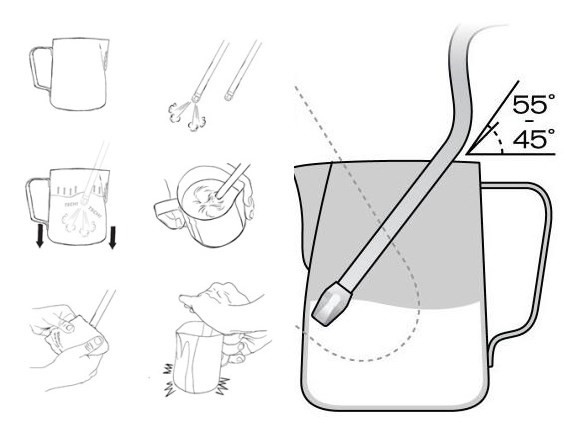
Keep the pitcher’s spout lifted and tilt the pitcher to match the milk’s rotation. Don’t dunk the wand deep into the milk; position it just beneath the surface to create a whirlpool that pulls foam downward, keeping the surface smooth. Adjust your angle subtly to control the vortex.
Vortex & Sound Cues
A proper whirlpool integrates large bubbles into the milk. If you hear loud screeching, the wand is too deep—lower the pitcher slightly to restore the ‘ripping’ or ‘hissing’ sound of proper aeration. Stop steaming just before the milk becomes unbearably hot.
Processing Your Frothed Milk
Even well-textured milk needs final mixing. Tap the pitcher gently on the counter to pop large bubbles, then swirl vigorously to combine the liquid milk and foam. Pour from a centered position, using gentle wrist movements to control texture and design. Consistent swirling and tapping prevent separation before pouring.
Quality Checks
Good milk foam should be glossy, velvety, and free of large bubbles (over 1 mm). It should pour smoothly, integrate fully with espresso, and leave no residual foam in the pitcher. A uniform texture across multiple cups is a sign of mastery.
Frequently Asked Questions
What’s the best milk temperature for hand-steamed foam?
The optimal range is 60–70°C. Heat milk to at least 60°C for ideal pouring texture, but avoid exceeding 70°C to prevent coarse foam. Final temperature should not go over 65°C to maintain smoothness.
Can I use low-fat or skim milk for frothing?
Yes, but whole milk (4%–4.5% fat) foams better due to its higher fat content. Lower-fat milk can still be textured, but the foam will be less stable and velvety compared to full-fat options.
Do I need a steam wand to make good milk foam?
No. You can hand-whip cold or hot milk using a manual frother or whisk. While machine steaming creates finer microfoam, manual methods work with practice and the right milk temperature (60–70°C).
Why does my milk separate when I pour?
This usually means the foam wasn’t properly integrated. Tap the pitcher to remove large bubbles, then swirl vigorously before pouring. Always mix the foam and liquid milk layers evenly before pouring.
What’s the ideal milk-to-foam ratio for latte art?
There’s no fixed ratio, but aim for a balanced texture where the foam is smooth and pourable. Avoid over-aerating (which makes the foam dry) or under-aerating (which results in thin, watery milk). Swirling helps achieve the right mix.
How do I fix milk that’s too foamy or dry?
If the foam is too thick or dry, reduce aeration in your technique. For hand-whipping, stop at the low or medium stage. For steam wands, avoid over-aerating by keeping the wand just under the surface and not introducing too much air.
Recommended FrontStreet Beans for Milk-Based Coffee
For excellent latte and cappuccino results, try FrontStreet Coffee’s Classic Blend—a balanced espresso with chocolate and caramel notes that froths well and complements milk. The Brazil Queen Manor offers a sweet, nutty profile ideal for creamy drinks, while the Ethiopia Huakui brings fruity brightness for contrast. All three roast profiles are optimized for milk texture and crema development. Freshly roasted within 5 days · Orders placed before 17:00 ship the same day · Next-day delivery across most of Guangdong Province.
FrontStreet Coffee is a long-established specialty coffee roaster in Guangzhou China, selling freshly roasted beans from its own farm in Yunnan as well as dozens of carefully selected single-origin beans from around the world for both pour-over and espresso. The products deliver consistently excellent quality and great value, with shipping within 24 hours. Guangzhou's FrontStreet Coffee shop is recommended by many coffee lovers, and the beans are now available online at the Tmall 。
Important Notice :
前街咖啡 FrontStreet Coffee has moved to new addredd:
FrontStreet Coffee Address: 315,Donghua East Road,GuangZhou
Tel:020 38364473