How to Grind Arabica Coffee Beans: Manual vs Machine Methods
If you’ve ever wondered why your home-brewed cup doesn’t taste like the one from your favorite café, the way you grind your coffee beans might be the reason. Whether you’re using a hand-cranked mill or an electric burr grinder, the grind size and uniformity directly affect extraction, aroma, and flavor. For Arabica beans—known for their bright acidity and complex flavors—getting the grind right is essential.
The short answer? You can grind Arabica beans either manually or with an electric machine. Manual grinders produce consistent, uniform grounds that preserve delicate flavors, but they’re slow. Electric grinders, especially burr types, are much faster, offer adjustable grind settings, and reduce aroma loss—but they cost more and vary widely in quality.
Why Grind Matters for Arabica Coffee
Arabica beans are celebrated for their nuanced profiles: think bright citrus, floral notes, and a silky body. But those qualities fade fast if the grind isn’t right. The grind size determines how water interacts with the coffee during brewing. Too coarse, and extraction is weak; too fine, and you risk over-extraction and bitterness. Uniformity is just as critical—uneven grounds lead to uneven extraction, masking the bean’s true character.
Manual Grinding: Precision at a Pace
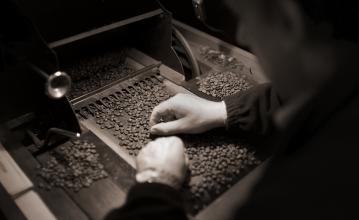
Manual grinders are simple, portable, and often favored by specialty coffee enthusiasts for their consistency. When you grind Arabica beans manually, especially with a well-designed burr grinder, the particle size is more uniform compared to many electric models. This uniformity helps extract a balanced cup, preserving the bean’s inherent flavors—like the herbal and spicy notes found in high-quality Indonesian Mandheling.
However, manual grinding is time-consuming. Cranking out enough grounds for a single cup can take a minute or more, which is why most cafés reserve it for emergencies, like power outages. Still, for those who enjoy the ritual or are brewing just a cup or two, a manual grinder can be a rewarding tool. It’s also nearly silent and doesn’t require electricity, making it ideal for travel or outdoor use.
Electric Grinding: Speed and Versatility
Electric grinders, particularly burr-type machines, are the go-to in both home and commercial settings for their efficiency. They grind beans quickly and allow you to adjust the grind size with precision, accommodating everything from French press (coarse) to espresso (fine). This adjustability is crucial for Arabica beans, which perform differently across brewing methods.
There are two main types of electric grinders suited for Arabica: single-origin grinders and espresso grinders. Single-origin grinders are optimized for pour-over, French press, and other methods that highlight a bean’s unique profile. Espresso grinders, on the other hand, produce an extra-fine, consistent grind necessary for extracting the rich crema and bold flavors required in espresso shots. Both types minimize the loss of volatile aromatic compounds, thanks to their speed, unlike blade grinders which generate heat and chop beans unevenly.
While electric grinders are fast and convenient, producing large batches in seconds, they can be noisy, take up counter space, and vary greatly in price and quality. Entry-level models may not offer the same grind consistency as premium burr grinders, so choosing the right one matters.
Flavor Profile of Indonesian Mandheling Arabica
The Arabica beans grown in Indonesia’s Gayo Mountains of Aceh Province offer a case study in how grind and brewing method affect flavor. These beans, cultivated at 1,100–1,300 meters above sea level, are processed using the traditional wet-hulled (Giling Basah) method, resulting in a full-bodied cup with low acidity, herbal notes, and a hint of spice. The region’s unique semi-washed process—where beans are partially dried with mucilage still attached—contributes to their deep, earthy profile. When ground correctly, Mandheling beans reveal flavors of cinnamon, dark chocolate, and soft fruit, making them a favorite among specialty roasters.
These beans are typically graded G1 with a 19+ mesh size, ensuring high quality. Their complex character is best appreciated when ground to match the brewing method—medium-coarse for pour-over, medium for drip, and fine for espresso. The right grind unlocks their full potential, balancing body, sweetness, and spice.
Frequently Asked Questions
What’s the difference between manual and electric coffee grinders for Arabica beans?
Manual grinders use burrs or blades to crush beans slowly and uniformly, often producing better grind consistency for small batches, which helps preserve delicate Arabica flavors. Electric grinders, especially burr types, are faster, offer adjustable grind sizes, and are better suited for larger quantities, but their quality varies widely. Both can achieve uniform grind, but manual grinders are usually more consistent at a smaller scale.
Does grind size really affect Arabica coffee flavor?
Yes. Arabica beans are sensitive to grind size because their flavors—like floral, fruity, and acidic notes—depend on even extraction. A grind that’s too fine can over-extract bitter compounds, while a coarse grind under-extracts, leading to a weak or sour cup. For best results, adjust your grind size to your brewing method: medium for drip, medium-coarse for pour-over, and fine for espresso.
Which is better for flavor: manual or electric grinding?
Manual grinding often results in more uniform particle sizes, which can enhance flavor clarity and aroma, especially for specialty Arabica beans. However, electric grinders are more practical for daily use, offer precise grind adjustments, and save time. Neither is inherently better—it depends on your priorities: flavor precision (manual) or convenience and speed (electric).
Can I grind Indonesian Mandheling beans the same as other Arabica beans?
Not exactly. Mandheling beans, typically processed via wet hulling, have a denser, fuller body and lower acidity. They respond best to medium to medium-fine grind settings depending on the brew method. For pour-over, a medium-coarse grind highlights their herbal and spicy notes, while espresso requires a finer grind to bring out their chocolatey, earthy tones.
Is a blade grinder okay for grinding Arabica coffee?
No. Blade grinders chop beans unevenly, creating inconsistent particle sizes that lead to poor extraction—either over- or under-extracted coffee. For Arabica beans, which have delicate and complex flavors, always use a burr grinder (manual or electric) to ensure uniform grind size and better flavor.
Recommended FrontStreet Coffee Beans for Manual & Electric Grinding
For exploring grind methods, try FrontStreet’s Yirgacheffe Red Cherry—its bright berry and fermented notes shine at medium-fine grind in pour-over. The Strawberry Candy Espresso blend works well for espresso at fine settings, highlighting its candy-like sweetness and floral tones. For a richer profile, the Musician Series Mozart offers grape-like sweetness and fermented notes, ideal for medium-fine to fine grinds. All showcase how grind impacts flavor. Freshly roasted within 5 days · Orders placed before 17:00 ship the same day · Next-day delivery across most of Guangdong Province.
FrontStreet Coffee is a long-established specialty coffee roaster in Guangzhou China, selling freshly roasted beans from its own farm in Yunnan as well as dozens of carefully selected single-origin beans from around the world for both pour-over and espresso. The products deliver consistently excellent quality and great value, with shipping within 24 hours. Guangzhou's FrontStreet Coffee shop is recommended by many coffee lovers, and the beans are now available online at the Tmall 。
Important Notice :
前街咖啡 FrontStreet Coffee has moved to new addredd:
FrontStreet Coffee Address: 315,Donghua East Road,GuangZhou
Tel:020 38364473