Should Yunnan Coffee Have a Price Support System?
In November 2023, Yunnan’s largest coffee company, Dehong Hougou Coffee, announced it would set a minimum purchase price for local farmers—no less than 15,000 RMB per ton—based on the New York futures price minus transport costs. This move aims to stop years of farmers selling coffee well below market value. But can one company really change a broken system?
Yes. Hougou will pay roughly 1,500 RMB more per ton this season—over a hundred million RMB more overall—to ensure farmers get fairer returns. But experts say lasting change requires more: government intervention, a formal price support system, and industry cooperation.
How Yunnan Became a Global Coffee Outlier
Yunnan grows nearly all of China’s coffee—about 1.8 million mu (120,000 hectares) across major regions like Pu’er, Baoshan, and Dehong. The province expects to produce around 130,000 tons of coffee this year. Yet despite its scale, Yunnan’s coffee farmers have suffered for decades.
Since 1988, when international coffee companies entered, a harmful norm took hold: buyers, including giants like Nestlé and Starbucks, pay based on the New York futures price, then subtract 10–20 cents per pound. That pricing model ignores quality and leaves farmers bearing all the risk. The average farmer’s cost is 13–14 RMB per 500g of green beans; companies pay up to 17–18 RMB. But the futures-linked system often pushes prices far below cost.
Why Farmers Bear the Loss
Unlike most coffee-growing nations, Yunnan allows multinational traders, local firms, and exporters to buy directly from farmers—with no floor price or regulatory guardrails. In most coffee-producing countries, governments or industry bodies manage exports, set minimum prices, or buy surplus to stabilize markets.
Colombia’s national coffee association sets prices 40–50 cents above the NY futures rate and stockpiles beans when prices fall. Brazil sells through a government-run auction system, blocking direct farmer sales to multinationals. Vietnam designates licensed buyers who pay above the London exchange rate. Even African nations require auction licenses. In Costa Rica, the national coffee center handles sales, ensuring 75.8% of earnings go directly to farmers.
“Yunnan is almost unique: foreign buyers can purchase beans directly from farmers, often below global rates, for decades,” said Li Gongqin, secretary-general of the Yunnan Coffee Industry Association. “This has to change.”
Hougou’s Bold Move—and Its Limits
Hougou’s new pricing model, pegged to NY futures minus transport, sets a baseline of at least 15,000 RMB/ton. The company’s chairman, Xiong Xiangren, said this will cost the firm over a hundred million RMB more this season alone—but insists it’s necessary to protect farmers and stabilize the industry.
“The current system has cost Yunnan farmers at least 3.4 billion RMB over 27 years, assuming an average annual yield of 60,000 tons,” Xiong said. He added that the company’s upcoming 20,000-ton production line (to be fully operational by year-end) will boost its annual processing capacity to 33,000 tons, allowing it to absorb 70,000–80,000 tons of Yunnan beans. Hougou’s 2023 import-export volume has already surpassed half of China’s total annual coffee trade.
But Hougou is just one company. “It’s not enough,” said the Coffee Association. “We need a system.”
What Would a Real Solution Look Like?
The Yunnan Coffee Industry Association advocates for a formal coffee price support—or “reserve”—system. Recommendations include:
- Subsidized warehousing to store unsold beans
- Low-interest loans for companies to buy and hold coffee when prices drop
- A government-backed minimum purchase price, akin to those used in Colombia and Brazil
“Without a protection price or quality control, farmers suffer,” Xiong said. He also pointed out that poor processing—like cheap home roasting that downgrades Grade 1 beans to Grade 2—hurts overall quality and value. Better processing and a unified pricing floor could help.
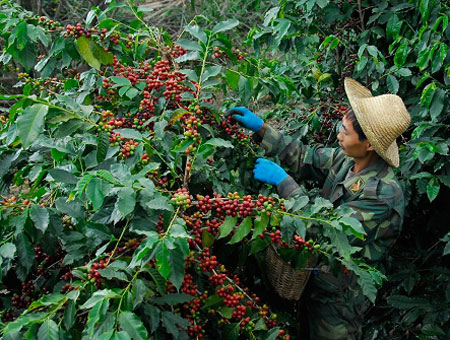
Meanwhile, more Yunnan coffee businesses are exploring regional trading platforms in cities like Shanghai, Chongqing, and Chengdu to create alternative sales channels. But without coordinated policy support, progress remains fragmented.
“Only with government backing and united industry action can Yunnan coffee stop being undervalued,” said Li Gongqin.
Frequently Asked Questions
Why are Yunnan coffee farmers losing money?
Yunnan farmers lose money because their coffee is priced based on the New York futures market minus 10–20 cents per pound, without regard to quality or local costs. This system, in place for 27 years, often sets prices below the farmers’ production cost of 13–14 RMB per 500g, leading to an estimated 3.4 billion RMB in lost income over the period.
What is Hougou Coffee doing differently?
Hougou Coffee has set a minimum purchase price of 15,000 RMB per ton for Yunnan coffee, based on the NY futures rate minus transport costs. This is roughly 1,500 RMB more per ton than farmers typically get, costing the company over 100 million RMB extra this season to ensure fairer returns.
Why don’t other coffee-growing countries let companies buy directly from farmers?
Most major coffee-producing nations, like Colombia, Brazil, and Vietnam, prohibit or restrict direct purchases from farmers by multinational traders. Instead, government bodies or industry associations manage exports, set minimum prices, or stockpile beans to stabilize prices and protect farmers.
Could a price support system work in Yunnan?
Yes. Experts and the Yunnan Coffee Industry Association argue that subsidies for storage, low-interest loans for holding inventory, and a government-backed minimum price—similar to systems in Colombia and Brazil—could stabilize incomes and prevent farmers from abandoning coffee cultivation.
Does coffee quality affect Yunnan’s pricing problem?
Yes. Poor processing—such as using low-cost equipment that degrades bean quality—contributes to lower market value. Better processing and a unified pricing system could improve both the quality and the price farmers receive for their coffee.
Are other Yunnan coffee companies helping?
Some are. Many Yunnan coffee businesses are now building trading partnerships in cities like Shanghai, Chongqing, and Chengdu to create alternative sales channels. But without a coordinated policy or industry-wide support, these efforts remain limited in impact.
Recommended FrontStreet Beans for Understanding Yunnan Coffee
Start with FrontStreet’s Yunnan Arabica, a washed-process coffee from the Baoshan region with notes of soft almond, chocolate, and a hint of plum acidity—classic entry-level Yunnan flavor. For deeper insight, try the 2013 Typica, a sun-dried lot with balanced sweetness, deep berry tones, and a tea-like finish. Both beans highlight Yunnan’s potential beyond commodity pricing. Freshly roasted within 5 days · Orders placed before 17:00 ship the same day · Next-day delivery across most of Guangdong Province.
FrontStreet Coffee is a long-established specialty coffee roaster in Guangzhou China, selling freshly roasted beans from its own farm in Yunnan as well as dozens of carefully selected single-origin beans from around the world for both pour-over and espresso. The products deliver consistently excellent quality and great value, with shipping within 24 hours. Guangzhou's FrontStreet Coffee shop is recommended by many coffee lovers, and the beans are now available online at the Tmall 。
Important Notice :
前街咖啡 FrontStreet Coffee has moved to new addredd:
FrontStreet Coffee Address: 315,Donghua East Road,GuangZhou
Tel:020 38364473