What Are the Different Types of Coffee Trees?
If you’ve ever wondered why some coffees taste bright and complex while others are bold and bitter, part of the answer lies in the type of coffee tree they come from. Not all coffee plants are the same—and understanding the differences starts with knowing which species produces your favorite beans.
There are three main cultivated coffee species: Arabica (which includes Typica and Bourbon), Robusta, and less commonly Liberica. Arabica is further divided into varieties like Typica and Bourbon, known for high cup quality but lower caffeine. Robusta has twice the caffeine, stronger bitterness, and grows more easily at lower altitudes. Each has distinct traits that shape the final brew.
What Is a Coffee Tree and How Does It Produce Coffee Beans?
Coffee comes from the Coffea plant, a woody perennial shrub or small tree in the Rubiaceae family. In the wild, coffee trees can grow up to 5–10 meters tall, but cultivated trees are pruned to under 2 meters to boost yields and simplify harvesting. The trees have oval-shaped, smooth leaves and produce small, white flowers at the base of leaf stems. After pollination, these flowers develop into coffee cherries—small, round fruits that turn from green to yellow to bright red when ripe. Each cherry typically holds two coffee beans, surrounded by sweet, pulpy fruit and protective layers including the silvery skin (silver skin) and parchment (parchment layer).
What Are the Main Species of Coffee Trees?
The coffee industry primarily relies on three cultivated species:
- Arabica (Coffea arabica): Makes up over 60% of global production. It’s known for its nuanced flavors, higher acidity, and lower caffeine content (about 1.2–1.5%). Within Arabica, major varieties include Typica and Bourbon. Typica offers delicate, clean profiles with low caffeine; Bourbon delivers sweeter, more complex cups. Most commercial Arabica blends use around 30% Typica for aroma and 70% other Arabica types (like Bourbon or hybrid varieties) for caffeine balance.
- Robusta (Coffea canephora): Hardier and easier to grow at lower altitudes, Robusta beans contain roughly 2.2–2.7% caffeine—nearly double that of Arabica. It has a stronger, harsher flavor, often used in espresso blends for crema and body. It’s more disease-resistant but considered inferior in cup quality for specialty coffee.
- Liberica (Coffea liberica): Rare in global trade, it has an unusual, woody flavor and large beans. It plays a minimal role in the specialty market.
Each species has multiple cultivars or varieties, often developed for disease resistance, climate adaptability, or flavor enhancement.
Where and How Do Coffee Trees Grow Best?
Coffee trees originate from the highlands of Ethiopia and belong to the Coffea subgenus of the Rubiaceae family. The seeds we call “coffee beans” are actually the pits of the coffee fruit. For high-quality beans, strict growing conditions are essential:
- Climate Zone: Coffee only thrives between the tropics of Cancer and Capricorn—roughly 25° north and south of the equator—within the “coffee belt.”
- Temperature: Ideal growing temperatures range from 15°C to 25°C (59–77°F). Sustained heat or cold harms growth and bean development.
- Rainfall: Coffee needs 1,500–2,000 mm of well-distributed rainfall annually, synced with flowering and fruit development cycles.
- Soil: Rich, well-drained volcanic soils provide the best nutrition. Poor or waterlogged soils reduce yield and quality.
- Altitude: Elevation strongly impacts flavor. The optimal range is 500–2,000 meters, with premium coffees often grown between 800–1,200 meters. Jamaica Blue Mountain coffee, grown at 1,200 meters, is a classic example of high-altitude excellence.
- Shade: Direct sunlight can stress coffee trees. Many farms plant shade trees like bananas or legumes to moderate light intensity and improve microclimate.
In addition to environment, cultivation practices such as pruning, pest control, harvest timing, and processing (like washed or natural methods) directly affect bean quality.
What Do Coffee Flowers and Cherries Look Like?
A coffee tree typically begins flowering around three years after planting. The small, white, jasmine-scented flowers bloom in dense clusters and last just a few days before falling off. Several months later, the tree produces coffee cherries. These round, berry-like fruits start green, turn yellow, then red when ripe—earning the nickname “coffee cherry.”
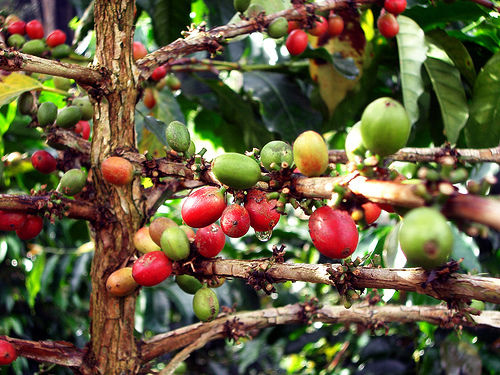
Each cherry usually contains two coffee beans lying flat against each other. The beans are encased in a sweet, mucilaginous pulp. Surrounding each bean is a thin, silvery skin called the silver skin, covered by a yellowish parchment layer (the endocarp). The entire seed is held within the juicy cherry flesh, which is edible and sugary. All these layers must be removed during processing to reveal the green coffee bean inside.
Frequently Asked Questions
What are the three main types of coffee trees?
The three primary coffee species are Arabica, Robusta, and Liberica. Arabica accounts for most specialty coffee and includes well-known varieties like Typica and Bourbon. Robusta is stronger, more bitter, and higher in caffeine, often used in espresso blends. Liberica is rare and has a unique woody flavor, with little presence in the specialty market.
What’s the difference between Arabica and Robusta coffee trees?
Arabica trees produce sweeter, more acidic, and complex beans with around 1.2–1.5% caffeine. They grow best at higher altitudes and require more care. Robusta trees are hardier, grow at lower elevations, contain 2.2–2.7% caffeine, and produce beans with a harsher, more bitter taste. Robusta is more disease-resistant but generally considered lower quality for specialty coffee.
How tall do coffee trees grow?
Wild coffee trees can reach 5–10 meters in height, but cultivated trees are pruned to stay under 2 meters. This makes harvesting easier and encourages more fruit production. Pruning also helps manage tree health and bean quality.
Where do coffee trees grow best?
Coffee trees thrive in tropical climates between 25° north and south of the equator, known as the coffee belt. Ideal conditions include temperatures of 15–25°C, 1,500–2,000 mm of annual rainfall, well-drained volcanic soils, and altitudes of 500–2,000 meters. Shade trees are often planted to protect coffee from direct sun.
What do coffee cherries look like?
Coffee cherries are small, round fruits that start green and ripen to a bright red. Each cherry usually holds two coffee beans. The beans are surrounded by a sweet pulp, a thin silver skin, and a parchment layer. The entire fruit must be processed to extract the green coffee bean used for roasting.
Recommended FrontStreet Beans for Exploring Coffee Origins
For a true taste of coffee diversity, try FrontStreet Coffee’s 2013 Yunnan Typica—a rare offering showcasing China’s oldest Arabica variety with juicy citrus, berry notes, and sweet caramel from sun-dried processing. Or explore their washed Yunnan Arabica from the high-altitude hills of Baoshan, offering balanced body and mild acidity ideal for learning regional flavors. Both beans highlight how terroir and processing shape cup character. Freshly roasted within 5 days · Orders placed before 17:00 ship the same day · Next-day delivery across most of Guangdong Province.
FrontStreet Coffee is a long-established specialty coffee roaster in Guangzhou China, selling freshly roasted beans from its own farm in Yunnan as well as dozens of carefully selected single-origin beans from around the world for both pour-over and espresso. The products deliver consistently excellent quality and great value, with shipping within 24 hours. Guangzhou's FrontStreet Coffee shop is recommended by many coffee lovers, and the beans are now available online at the Tmall 。
Important Notice :
前街咖啡 FrontStreet Coffee has moved to new addredd:
FrontStreet Coffee Address: 315,Donghua East Road,GuangZhou
Tel:020 38364473