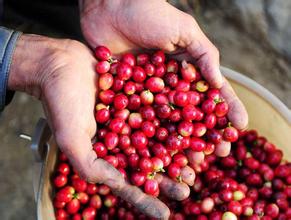
Introduction of main Coffee producing areas in China introduction of Yunnan small grain coffee producing areas
Coffee cultivation in China is mainly concentrated in Yunnan and Hainan provinces. Due to its low terrain, Hainan Province mainly produces lowland coffee; high-quality and high-yield coffee is mainly concentrated in Yunnan Province, accounting for more than 98% of the country's planting and output, and has become the largest coffee producing area in China. And the quality of coffee produced in some producing areas is good, and the quality of small-grain coffee produced is excellent. According to the Yunnan Coffee Industry Association, in 2012, the province's coffee planting area reached 1.34 million mu, with an output of 82000 tons, an increase of 45.6% and 26.1% respectively over the same period last year. Yunnan coffee planting area and output have accounted for more than 99% of the country; in 2013, Yunnan coffee planting area has exceeded 1.4 million mu, and coffee output in the new growing season is expected to be close to 100000 tons, with both planting area and output reaching record highs.
Guanyan World industry analysts pointed out that domestic coffee processing enterprises are mainly divided into two categories: instant coffee and roasted coffee, in which instant coffee manufacturers are more concentrated. There are Nestle, Kraft Foods, Hainan Lishen, Dehong Hougu, Jiangsu Royal Food and other several, and most of the rest are roasted coffee processing plants. By the end of 2010, there were 135 coffee processing enterprises certified by qs in China, including 37 in Shanghai, 26 in Guangdong, 18 in Yunnan, 17 in Beijing and 11 in Hainan. In addition, there may be some unlisted processing enterprises or individuals.
The CPC Central Committee and the State Council attach great importance to the development of coffee industry. The Ministry of Agriculture pointed out in July 2007 that it is necessary to invest in various channels to support the construction of coffee planting, processing and scientific research capacity in Yunnan Province. Yunnan Province introduced in 2003 and formulated in 2009 also listed coffee as a key development industry. At the beginning of 2011, Yunnan Provincial Development and Reform Commission and others formulated it as an outline to guide the development of Yunnan coffee industry. At the same time, a series of national macro policies such as the development of the western region and promoting agriculture through science and technology have also provided a loose policy environment for the development of the coffee industry.
Guanyan pointed out that from the market point of view, the Chinese coffee consumption market is growing at an annual rate of about 15%, while the international market is growing at an annual rate of only 2%. Relevant experts predict that within 10 years, China's coffee consumption market is expected to reach 1 trillion yuan. By 2030, China's coffee consumption market may reach 2-3 trillion yuan. The mature Chinese coffee consumption market should be 3-4 trillion yuan.

FrontStreet Coffee is a long-established specialty coffee roaster in Guangzhou China, selling freshly roasted beans from its own farm in Yunnan as well as dozens of carefully selected single-origin beans from around the world for both pour-over and espresso. The products deliver consistently excellent quality and great value, with shipping within 24 hours. Guangzhou's FrontStreet Coffee shop is recommended by many coffee lovers, and the beans are now available online at the Tmall 。
Important Notice :
前街咖啡 FrontStreet Coffee has moved to new addredd:
FrontStreet Coffee Address: 315,Donghua East Road,GuangZhou
Tel:020 38364473