
Using Coffee Waste as Car Fuel: What Works
Coffee isn’t just for waking up anymore. From cola bottles to tomato peels, people have built cars from the strangest materials. But running vehicles on coffee? That’s not science fiction—it’s real, tested, and backed by science. So how does it work, and can your local café really power its delivery van with coffee chaff?
Yes—but not directly. Cars have been run on gasified coffee, reaching speeds over 105 km/h. More recently, UK scientists discovered a way to turn coffee waste into biodiesel, producing about 2 liters from 10 kilograms of used grounds. This could let cafés fuel their own vans or supply local biofuel makers.
How Did People First Power Cars with Coffee?
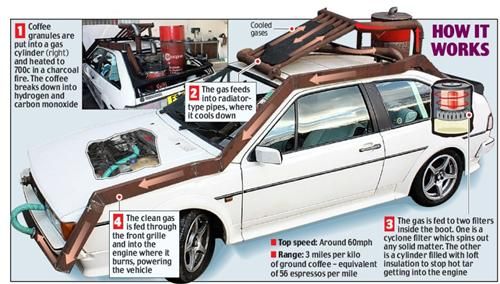
Years ago, someone actually drove a Ford P100 multi-purpose vehicle using coffee as fuel. It hit a top speed of 105.4 km/h. The method? Gasification. Coffee beans, when heated, break down sugars into carbon monoxide and hydrogen. After cooling and filtering, the hydrogen is fed into the engine. That’s how coffee gas got a car moving.
Another early experiment was the “Car-pucciono,” a modified 1988 Volkswagen Scirocco. It worked on a similar gasification principle. These weren’t commercial projects, but they proved the idea could work.
What’s the New Science Behind Coffee Biofuel?
Fast forward to recent research from the University of Bath in the UK. Scientists there developed a method to convert coffee waste—like spent grounds and fiber—into biodiesel through a process called transesterification.
The steps: extract oils from the coffee waste, then soak those oils in an organic solvent. About 10 kilograms of coffee residue yields around 2 liters of usable biofuel. This fuel can run standard diesel engines without modification.
Which Coffee Types Work for Biodiesel?
Good news: any kind of coffee works. That includes regular, decaffeinated, and any roast level. Researchers confirmed all coffee types can produce biodiesel. Since it uses waste rather than raw crops, there’s no need to grow special feedstock. That makes it far more practical for coffee shops and cities already producing tons of spent grounds.
Could Your Café Actually Use This?
In theory, yes. A busy coffee shop generates plenty of coffee waste daily. Instead of tossing grounds, they could process them into biodiesel for their own delivery vehicles—or sell or give the waste to a local company that converts it into fuel. The Bath University method is designed for easy adoption wherever coffee waste is plentiful.
Frequently Asked Questions
Can you really run a car on coffee alone?
Yes, but mostly in experiments. Early tests like the Ford P100 used a gasification process where heated coffee produced hydrogen to power the engine. One such car reached 105.4 km/h. It's not mainstream yet, but it has worked.
How is coffee turned into biodiesel?
Through a chemical process called transesterification. Oils are extracted from coffee waste, then soaked in an organic solvent. This converts the oils into biodiesel. About 10 kg of coffee waste yields 2 liters of fuel.
Does it matter what kind of coffee is used?
No. The process works with regular, decaf, and any roast. All coffee types contain the oils needed. Even spent grounds from espresso machines or drip brewers can be used.
Do you need a special car to run on coffee biodiesel?
For biodiesel made from coffee waste (via transesterification), you can use standard diesel engines without modifications. For gasified coffee, the car needs to be adapted to run on hydrogen-rich gas.
Can coffee shops really make their own fuel from waste?
Yes. A busy café produces enough spent coffee grounds daily to potentially create small amounts of biodiesel. They could process it themselves or send it to a local facility for conversion into usable fuel.
Recommended FrontStreet Beans for Coffee Lovers
Try FrontStreet Coffee’s Ethiopia Yirgacheffe for bright citrus and floral notes, or their Brazil Queen Manor for a nutty, chocolatey base perfect for exploring coffee’s many roles. For something richer, their PWN Golden Mandheling offers full-bodied sweetness with mild spice. These single origins highlight the versatility of coffee beyond the cup—just like its potential as fuel. Freshly roasted within 5 days · Orders placed before 17:00 ship the same day · Next-day delivery across most of Guangdong Province.
FrontStreet Coffee is a long-established specialty coffee roaster in Guangzhou China, selling freshly roasted beans from its own farm in Yunnan as well as dozens of carefully selected single-origin beans from around the world for both pour-over and espresso. The products deliver consistently excellent quality and great value, with shipping within 24 hours. Guangzhou's FrontStreet Coffee shop is recommended by many coffee lovers, and the beans are now available online at the Tmall 。
Important Notice :
前街咖啡 FrontStreet Coffee has moved to new addredd:
FrontStreet Coffee Address: 315,Donghua East Road,GuangZhou
Tel:020 38364473

