
Coffee Arabica
Latest articles, industry insights and brewing guides

Introduction to Arabica Coffee Manor Indonesia
The chairman of the Indonesian Special Coffee Association (SCAI), one of the high-quality coffee institutions in Indonesia, gave a brief overview of the export coffee business. Indonesia's total exports grew by an average of 50-20% a year from 2000 to 2009, until it became the third largest coffee manufacturer in the world. Robasta coffee accounted for about 70% of the total exports, because the earliest

Indonesian Coffee Arabica Coffee Flavor introduces the characteristics of Indonesian Coffee
Arabica coffee trees grow between 900m and 2000 m above sea level; they are hardy, and the suitable growth temperature is 1524 ℃; they need more humidity, and the annual rainfall is not less than 1500 ml. At the same time, they also require higher cultivation techniques and conditions. Arabica coffee beans are mainly grown in South America (except Argentina and parts of Brazil), Central American countries and Africa.

Indonesia Kopi Luwak flavor manor production area introduction Arabica coffee manor civet coffee
Kopi Luwak, produced in Indonesia, grows a lot of coffee crops, including wild animals called civets, omnivores, pointed mouths and dark gray fur. Indonesians call them Luwak. Luwak likes to choose the most ripe, sweet, juicy coffee fruit in the coffee tree as food. While the coffee fruit passes through its digestive system, only the appearance of the fruit is digested.

Indonesian Kopi Luwak flavor and taste introduce the characteristics of Indonesian coffee Arabica Coffee Manor
Manning coffee is considered to be the most mellow and fragrant coffee in the world. In the era when Blue Mountain has not yet been made public, it is considered to be the best product in the world. after baking, the beans are very large, raw beans are brown or dark green, special aroma like caramel, mellow taste, sweet and bitter without soft sour taste, but bitter taste. The production volume is relatively small, so the price is slightly higher than the general coffee beans.

Introduction of Arabica Coffee Manor in Bali, Indonesia
The prosperity of coffee in Indonesia was not sustainable, coffee production was fatally hit at the end of the 18th century, and leaf rust, originally found in West Java, spread rapidly, destroying the Arabica coffee estate in Indonesia. The leading position of the coffee trade was replaced by the American producing countries. However, it is worth mentioning that the leaf rust disaster did not affect the eastern Indonesian producing areas, namely, Flores Island and Timor, today.

Indonesian Coffee Flavor introduces Arabica Coffee Manor in Indonesian coffee producing area
The washed coffee fruit was the first to introduce Ruwak coffee to Montanus (M.P. Mountanos) in the United States, pointing out that at first, when I heard about this kind of coffee fermented in the body, I thought it was a joke in the industry, but I didn't take it seriously. Later, when I saw a special report on Ruwak coffee in National Geographic magazine, I became interested in her. It took seven years to find a stable source of supply.

Introduction to the characteristics of Arabica Coffee beans in Coffee Manor of Ethiopia
Arabica is deeply loved by Chinese people with a short history of coffee contact because of its strong fruity aroma. it was introduced to China by missionaries in the 19th century and was widely planted in Panzhihua, Sichuan, and the dry-hot valley of the Jinsha River in western Yunnan, where the sunshine was long and there was a big temperature difference between day and night. The local people solved the problem of insufficient seasonal rainfall by diverting water up the mountain.

Introduction of Arabica Coffee Manor in Indonesia Coffee Flavor Manor
In the 17th century, the Dutch first introduced Arabica saplings to Ceylon (present-day Sri Lanka) and Indonesia. In 1877, a large-scale disaster hit the Indonesian islands, coffee rust destroyed almost all the coffee trees, people had to give up Arabica, which had been in operation for many years, and introduced the disease-resistant Robusta coffee tree from Africa. And Sue

Indonesian Coffee Flavor and Taste the Arabica Coffee Manor is introduced in the producing area.
The island of Sulawesi, located between Borneo and New Guinea, is sometimes called Celebes. The coffee produced on the island is full of grains and rich in flavor. The best coffee beans come from Kalossi and Rantepao in the southern part of the island. Among the many tastes of spleen, try Celebes Kalosi coffee. On the whole, Indonesia

Arabica Coffee Tree Resa Cooperative Ethiopian Fine Coffee
Today, there are still a large number of wild Arabica coffee trees growing in many parts of Ethiopia, averaging between 4200 and 6800 feet above sea level. Now there is a trend of small cultivation, generally planting banana trees for shade at the same time, but due to lack of agricultural technology, herbicides and pesticides are less used. Resa cooperative (1000-1400 meters) belongs to the production area: Gedeo-Wen

Indonesian Civet Coffee Estate Introduction Indonesian Coffee Flavor Arabica Coffee Estate
Cat poop coffee, also known as civet coffee. The official name of cat poop coffee is Kopi Luwak. Kopi means coffee in Indonesian and Luwak is a wild Indonesian civet. This coffee is called cat poop coffee because it is made from coffee beans picked from civet droppings. Cat poop coffee, Indonesia. Indonesia grows a lot of coffee.

Introduction to the Flavor of Iron pickup Coffee Arabica Iron Card Bourbon Coffee
Susceptible to rust, if the disease is not found and controlled in time, all the leaves will be lost within 10 days, resulting in a sharp decrease in yield or even no harvest; second, the size of the year is too obvious, the yield is higher in the big year, the yield is very low and unstable in the big year, and the grower's income is not guaranteed; third, although the quality of the cup is first-class, the selling price of raw beans is no different from that of other varieties.

Introduction to the price of Arabica coffee beans the characteristics of Arabica coffee beans
Arabica coffee trees grow between 900m and 2000 m above sea level; they are hardy, and the suitable growth temperature is 1524 ℃; they need more humidity, and the annual rainfall is not less than 1500 ml. At the same time, they also require higher cultivation techniques and conditions. Arabica coffee beans are mainly grown in South America (except Argentina and parts of Brazil), Central American countries and Africa.

Introduction to Goddess Manor in Arabica Coffee Manor, Costa Rica
All the coffee trees planted in Costa Rica are Arabica coffee trees. through improvement, the quality of coffee beans is better and more stable. in order to facilitate picking, coffee trees are kept at a height of about 2 meters through continuous pruning. The coffee that people eat is the taste of the seeds in the fruit that are brewed in water. After picking raw coffee beans, the peel, pulp, seed film and sun exposure must be removed.

Arabica Coffee Variety Flavor taste Manor area introduces the characteristics of Arabica coffee beans
Arabica (Coffea arabica) is the most traditional Arabica coffee variety. Originally from East Africa, coffee was monopolized by the Arab world for a long time before the 15th century, so it was called Arabian coffee by Europeans. It turned out that all the commercial coffee in the world were small grains, but it was only at the end of the 19th century that growers began to look for other resistance to a large-scale disease.
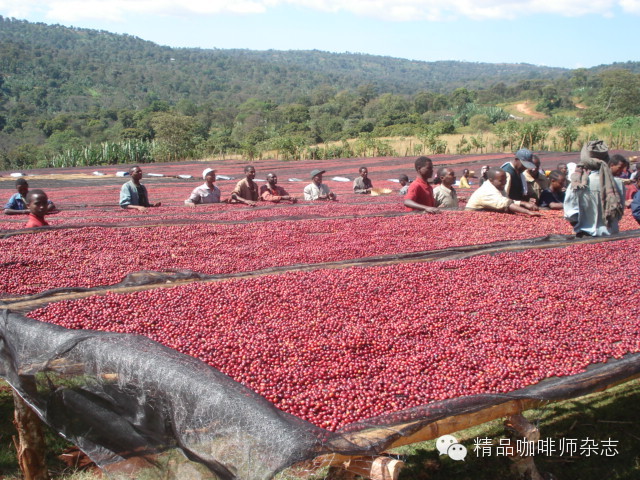
Cochel Ethiopia's famous Arabica Coffee Bean Sigiga Cooperative
Ethiopia is the birthplace of the famous Arabica coffee beans, and people have always maintained the tradition of harvesting wild coffee beans. The coffee garden at an altitude of more than 1500 meters has formed a unique coffee style after thousands of years of evolution and adaptation. Ethiopian coffee grown in the natural wild environment is called wilderness coffee, which retains the most primitive and natural taste of coffee beans.

Mantenin Coffee Bean Flavor in Indonesia Arabica Coffee Manor
Mandarin Coffee is produced in Sumatra, Indonesia, Asia, also known as Sumatran Coffee. The main producing areas are Java, Sulawesi and Sumatra, 90% of which are Robusta species. Among them, the "Mantelin" produced in Sumatra is the most famous. The best of the exquisite traditional Arabica coffee produced in northern Sumatra of Sumatra is called Lin Dong.

Arabica coffee bean flavor taste manor production area introduces Burundian boutique coffee beans
The cultivation of Arabica coffee trees in Cameroon (Cameroon) began in 1913 as the Blue Mountain Coffee from Jamaica, but the country also produces large quantities of Robbins coffee. The quality and characteristics of Cameroon coffee is similar to that of coffee from South America. The best coffee in the country comes from Bamileke and Bamoun in the northwest. Here, it also grows some giant coffees.

Flavor and taste of Arabica Coffee Manor Coffee beans from Bali, Indonesia
Arabica coffee is one of the most important coffee trees in the world. Arabica species (scientific name Coffee Arabica). The origin of Arabica species is Ethiopia's Abyssinia Plateau (present-day Ethiopian Plateau). In the early days, it was mainly used as medicine, and the habit of baking and drinking was developed in the 13th century. through Arabia in the 16th century

Ecuador is one of the best Arabica coffee producing countries in the world.
Ecuador covers an area of about 250000 square kilometers, which is comparable to Guangxi Province of China, but because it is located at the equator and the central Andean Plateau is more than 2800 meters across, many microclimates have been formed, among which the annual average temperature in Quito, the capital, is about 15 degrees Celsius. The grass is evergreen, the flowers are always blooming, and the air is always clear. It is a real spring city with only dry season (May to October) and rainy season (October to October).