How Coffee Spread from Ethiopia to the World
Ever wondered how your morning coffee—whether a pour-over from Ethiopia or an espresso from Brazil—ended up in your cup? The journey wasn’t just about taste: it’s a story of trade routes, smuggled seeds, and cultural shifts spanning centuries. Most people assume coffee comes from Africa, and they’re right—but the path it took to become a global staple is far more layered than you might think.
Coffee was first cultivated in Ethiopia around 575 AD. It spread to the Arabian Peninsula, particularly Yemen, where it was tightly controlled and exported only after being hulled to prevent germination. Yet by the 17th century, a single smuggler helped change everything.
The Origins: Ethiopia and the First Coffee Cultivators
Coffee growing in Ethiopia began in 575 AD. For Arabs, coffee was as prized as Chinese silk—rare, valuable, and largely reserved for religious elites. Its stimulating effects were both medicinal and mystical, consumed under strict control.
Yemen and the Mocha Port: The First Global Coffee Hub
Coffee reached the rest of the world through Yemen’s Mocha port. The Arabs restricted exports by only shipping hulled beans, preventing cultivation abroad. But this control wasn’t perfect.
Smuggling and Global Expansion: How Coffee Left Arabia
In the 17th century, Baba Budan smuggled fertile coffee beans from Mecca to India’s southwestern region. This act initiated coffee’s worldwide dissemination. Initially used medicinally, coffee later gained popularity as a stimulant, even linked to religious visions. Coffeehouses soon flourished in Islamic cities like Mecca.
The Journey to Europe and Beyond
Coffee spread to Italy, England, and India through trade routes. By 1650, the first European coffeehouse opened in Oxford, England. Throughout the 17th century, European nations began exporting coffee to their colonies.
Key Dates in Coffee’s Global Migration
- 1616: A coffee tree was brought to the Netherlands via Mocha, giving them an edge in cultivation.
- 1658: The Dutch started growing coffee in Ceylon (Sri Lanka).
- 1699: The Dutch established the first European-style plantations in Java.
- 1715: French traders introduced coffee to the island of Bourbon (Réunion).
- 1718: The Dutch brought coffee to Suriname in South America, kickstarting the continent’s coffee industry.
- 1723: Gabriel Mathieu de Clieu transported coffee seedlings to Martinique.
- 1727: Brazil’s first plantation was founded in Pará, later expanding near Rio de Janeiro.
- 1730: The British introduced coffee to Jamaica, leading to the development of Blue Mountain coffee.
- 1750–1760: Coffee cultivation began in Guatemala.
- 1779: Coffee spread from Cuba to Costa Rica.
- 1790: Coffee was first planted in Mexico.
- 1825: Coffee seeds from Rio de Janeiro reached Hawaii, leading to Kona coffee.
- 1878: The British established coffee farms in Kenya.
- 1887: The French introduced coffee to Vietnam.
- 1896: Coffee arrived in Queensland, Australia.
Why These Routes Mattered
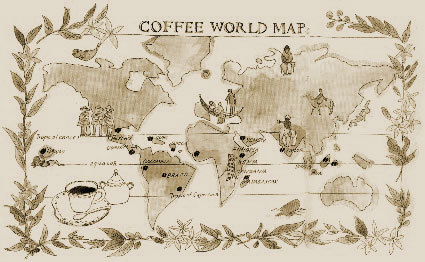
Each step—from Ethiopia to Yemen, then India, Europe, and the Americas—was driven by trade, colonial ambition, and the actions of individuals. Smugglers, traders, and colonial governments all played roles in spreading coffee across the globe. The controlled export of hulled beans initially kept cultivation limited, but determined individuals changed that.
Frequently Asked Questions
Where did coffee originate?
Coffee cultivation began in Ethiopia around 575 AD. It was highly valued, similar to luxury goods such as silk, and primarily consumed by religious figures for its stimulating effects.
How did coffee spread from Ethiopia to the rest of the world?
Coffee moved from Ethiopia to Yemen, where it was exported via the Mocha port. From there, it spread globally, often through colonial trade routes and the actions of individuals like Baba Budan, who smuggled beans to India.
Who smuggled coffee beans out of Arabia?
Baba Budan smuggled fertile coffee beans from Mecca to India’s southwestern region in the 17th century, defying the Arab monopoly and enabling coffee cultivation outside Arabia.
When did coffee arrive in South America?
Coffee was introduced to South America in 1718 when the Dutch brought it to Suriname. Later, in 1727, plantations were established in Brazil, which became a major coffee-producing region.
What role did the Dutch play in coffee’s global spread?
The Dutch acquired a coffee tree in 1616 via Mocha, began cultivating it in Ceylon by 1658, established plantations in Java by 1699, and introduced coffee to Suriname in 1718, significantly influencing global production.
How did coffee reach Jamaica and Hawaii?
The British introduced coffee to Jamaica in 1730, leading to Blue Mountain coffee. In 1825, coffee seeds from Brazil reached Hawaii, resulting in the famous Kona coffee.
FrontStreet Coffee Beans That Trace Coffee’s Roots
Explore the origins of coffee with FrontStreet Coffee’s Ethiopia Yirgacheffe, offering bright citrus and floral tones true to its heritage. For a taste of Yemen’s legacy, try our Ethiopia Humbera with delicate stone fruit and spice. Finally, experience the New World with Jamaica Blue Mountain-inspired profiles in our Panama Humbera, a balanced washed coffee with nutty sweetness. Freshly roasted within 5 days · Orders placed before 17:00 ship the same day · Next-day delivery across most of Guangdong Province.
FrontStreet Coffee is a long-established specialty coffee roaster in Guangzhou China, selling freshly roasted beans from its own farm in Yunnan as well as dozens of carefully selected single-origin beans from around the world for both pour-over and espresso. The products deliver consistently excellent quality and great value, with shipping within 24 hours. Guangzhou's FrontStreet Coffee shop is recommended by many coffee lovers, and the beans are now available online at the Tmall 。
Important Notice :
前街咖啡 FrontStreet Coffee has moved to new addredd:
FrontStreet Coffee Address: 315,Donghua East Road,GuangZhou
Tel:020 38364473