
What is the difference between fine coffee powder and medium coarse coffee powder? Do I need to sift out the fine coffee powder for making coffee by hand?
Recently, friends often ask Qianjie when buying beans in stores: "Do you need to sift out the fine powder before making coffee?" or "Under what circumstances do you need to sift out the fine powder?" So today Qianjie is here to answer this series of questions about fine powder ~

What is fine powder? The so-called fine powder refers to the coffee powder produced during the process of grinding coffee beans that is finer than the standard powder and has a particle size of less than 0.1 mm. (Coffee powder is on the left)
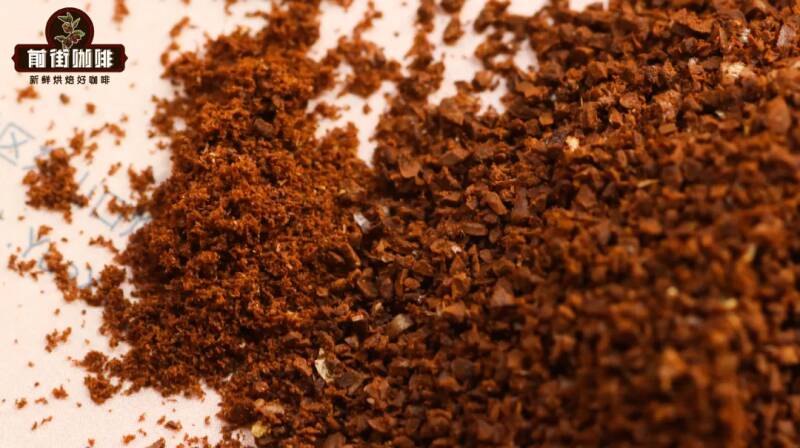
No matter what kind of bean grinder will grind fine powder, because coffee beans will become relatively crisp after roasting. When the bean grinder breaks coffee beans, it will easily break into some very fine particles other than the target size. If it is difficult to understand, you can imagine coffee beans as biscuits. When we break biscuits or eat biscuits, we often produce a lot of debris at the moment of biting/breaking because the biscuits are too crisp. The same truth is true for coffee beans.
The amount of fine powder will be affected by many aspects, such as the roasting degree and grinding degree of coffee beans. When the coffee beans are roasted deeper and the grinding degree is finer, the proportion of fine powder in the ground coffee powder will be higher; in addition, the type and quality of the bean grinder will also affect the proportion of fine powder. The existence of fine powder can be good and bad, and it is not entirely that the less the better. The specific advantages and disadvantages need to be judged based on our demand for coffee. For example, in espresso, the proportion of fine powder is very high, so it cannot be generalized. Then, Qianjie will come and share with us the circumstances under which we need to sift out the fine powder.
When do I need to sift out the fine powder? The reason why Qianjie said that the less fine powder is not the better is that the presence of a suitable amount of fine powder helps improve the level of coffee. Since the fine powder has a smaller particle size, the soluble substances in its body will be dissolved more quickly. This will make a small difference in extraction, and the brewed coffee will have richer levels.
But dissolving faster means including less desirable negative substances. If you can't control the extraction well or want to make the coffee taste cleaner, sifting out the fine powder will be a good choice. In coffee competitions around the world, some players sift out the fine powder of coffee in pursuit of cleaner performance. Qianjie mentioned earlier that the existence of a suitable amount of fine powder can help improve the layering of coffee, but only a suitable amount. If there is too much fine powder, not only will the level of the coffee not be improved, but the taste and taste experience of the coffee will also be reduced due to the fine powder clogging the filter paper or excessive negative substances dissolving. For example, the taste becomes more bitter, or the taste becomes messy. So at times like this, we need to sift out the fine coffee powder.
However, everyone needs to note that over-extraction of coffee is not necessarily caused by too much fine powder, but may also be caused by too high extraction efficiency. Therefore, everyone needs to identify whether the reason for over-extraction is due to excessive fine powder and then decide whether to Sift out. The identification method is very simple. There are two methods for reference. The first is the speed of launching. Because the particles of the fine powder are too fine, just as Qianjie mentioned earlier, it can easily block the filter paper and prolong the time it takes to enter the water. If we find that coffee drains slowly and the density of coffee powder is not high, then the high probability is caused by the filter paper being blocked by fine powder.
Another way is to look at the powder bed after brewing to see whether the coffee powder in the powder bed is clearly grained or muddy like mud. If you find that the above two "symptoms" appear in the brewed coffee/brewed powder bed, and then the taste of the coffee is bitter, miscellaneous, etc., then it may be caused by too much fine powder. At times like this, we can try sifting out the fine powder and then rebrew it to see if the taste of the coffee has returned to normal. It is worth mentioning that the fine powder that is sifted out does not have to be thrown away. After all, if you sift out a lot of fine powder, it would be a waste to throw it away. At times like this, Qianjie has to mention an "old" and interesting method: pour in fine powder for extraction when halfway through the boiling. Interested friends can give it a try. It's fun.
This method is very simple. For example, if you are about to brew 15g of coffee beans, before brewing, you can sift out the fine powder and set it aside for later use, and then brew these normally ground coffee powder according to the 15g parameters. When the brewing process is two-thirds, add the fine powder in and add it to the brewing process.
Such an approach can effectively control the extraction rate of fine powder to prevent over-extraction, and then will not lead to waste. Of course, this practice is only recommended for everyone to play. After all, without strict planning, the coffee brewed during operation is not so stable. There are many factors that need to be considered, so it is not recommended to use it as a daily brewing method to brew coffee ~ and the fine powder sifted out does not need to be poured out all. We just need to reduce it to the amount that will not affect the extraction.
- END -
Front street coffee
No. 315 Donghua East Road, Dadong Street, Yuexiu District, Guangzhou City, Guangdong Province
FrontStreet Coffee is a long-established specialty coffee roaster in Guangzhou China, selling freshly roasted beans from its own farm in Yunnan as well as dozens of carefully selected single-origin beans from around the world for both pour-over and espresso. The products deliver consistently excellent quality and great value, with shipping within 24 hours. Guangzhou's FrontStreet Coffee shop is recommended by many coffee lovers, and the beans are now available online at the Tmall 。
Important Notice :
前街咖啡 FrontStreet Coffee has moved to new addredd:
FrontStreet Coffee Address: 315,Donghua East Road,GuangZhou
Tel:020 38364473


Why does hot American coffee taste bitter? Difference in proportional concentration between hot American and ice American
What is the difference between a cake filter cup and a V60 conical filter cup? What are the advantages and disadvantages of the flat-bottomed filter cup brewing solution?