How the AeroPress Was Invented and How to Use It
If you’ve ever wanted a fast, portable way to brew rich, clean coffee without complicated gear, you’re not alone. One gadget—small enough to fit in a backpack—has been making that possible since 2005. But where did it come from, and why has it stayed popular for nearly two decades?
The AeroPress is a compact, easy-to-use manual coffee maker invented in 2005 by Stanford engineer Alan Adler. It combines immersion, paper filtration, and light pressure to produce a cup that’s bold like espresso, clean like pour-over, and smooth like French press—all in about a minute.
The Birth of the AeroPress
The AeroPress was officially launched in 2005 by the American company AEROBIE. Its creator, Alan Adler, is a lecturer in mechanical engineering at Stanford University and holds over forty patents in the U.S. and other countries. Unlike many coffee gadgets, the AeroPress wasn’t just another drip device—it introduced a new way to think about brewing.
How the AeroPress Works
The AeroPress resembles a syringe. You add finely ground coffee and hot water into its chamber, then press down a plunger. This action pushes the water through the coffee grounds and a paper filter, extracting flavor efficiently. It blends principles from French press (immersion), pour-over (paper filtration), and espresso (pressure brewing). The result? A cup that’s rich, clean, and smooth—with body, clarity, and low acidity. By adjusting grind size and brew time, you can tailor your cup’s strength and flavor profile.
What’s the AeroPress Made Of?
All materials used in the AeroPress are FDA-approved for food contact:
- Filter chamber and plunger rod: Copolyester (PET)
- Filter cap, filter holder, stirring paddle, funnel: Polypropylene (PP)
- Sealing plug on the plunger: Thermoplastic elastomer
These materials are safe, durable, and resistant to damage. Be cautious with counterfeit products, which may use unknown materials. The device is also lightweight, portable, and nearly indestructible—perfect for travel or outdoor brewing.
How to Brew with the AeroPress (Standard Method)
- Place an AeroPress filter in the filter cap and rinse it with hot water to seal it against the chamber.
- Attach the filter cap to the chamber and set it atop a sturdy mug.
- Add two AeroPress scoops of fine-ground coffee (finer than drip, coarser than espresso).
- Pour 80°C water up to the No. 2 marking on the chamber.
- Stir gently for about 10 seconds.
- Moisten the rubber seal, insert the plunger, and press down slowly over about 20 seconds.
- You’ll have a concentrated shot similar to espresso. Dilute with hot water to make an Americano or add steamed milk for a latte.
Cleaning and Storage
Cleanup takes just seconds: remove the cap, push out the coffee puck (great for compost), and rinse the rubber seal. That’s it. The entire device is designed for fast, hassle-free maintenance.
Global Recognition: The World AeroPress Championship
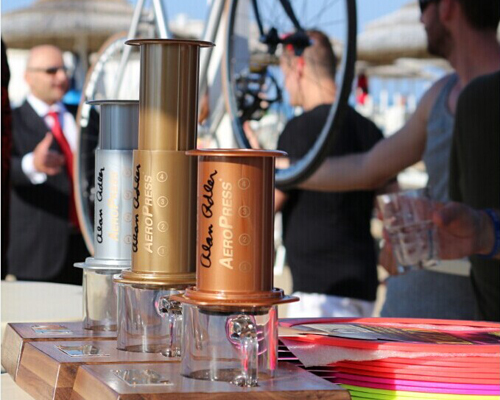
Since 2008, the World AeroPress Championship (WAC) has been held annually, showcasing creative brewing methods from around the globe. In May 2013, the finals were hosted in Melbourne, highlighting the AeroPress community’s global reach and innovation.
Frequently Asked Questions
What grind size should I use for AeroPress?
We recommend a fine grind, slightly coarser than espresso but finer than standard drip coffee. This helps achieve proper extraction within the 20-second press time.
Why use 80°C water?
Brewers and experts consistently find that 80°C (about 176°F) produces a smoother, richer cup. Water that’s too hot can over-extract, increasing bitterness and acidity.
How can I heat water to exactly 80°C?
Use a thermometer to heat your water, or check if your office kettle or water dispenser maintains around that temperature. Many standard office water machines hover near 80°C.
Is it normal for water to drip through before pressing?
Yes, some initial dripping is normal and won’t ruin your brew. To minimize it, use a fine grind and pour water slowly, especially in the first few seconds, to ensure even saturation.
Why is it hard to press the plunger?
A tight press usually means the coffee puck is too dense. Press gently: start with a short, light push (about 0.5 cm), then let the plunger descend steadily. If it’s still difficult, try a coarser grind or moisten the rubber seal before inserting the plunger.
Recommended FrontStreet Beans for AeroPress Brewing
For AeroPress, we suggest trying FrontStreet Coffee’s Ethiopia Yirgacheffe for bright citrus and floral notes, or their Colombia Huila for balanced caramel and nutty tones. If you prefer something bolder, their Brazil Cerrado offers chocolatey richness with a smooth body. All three work beautifully with the AeroPress’s full-immersion, paper-filtered extraction. Freshly roasted within 5 days · Orders placed before 17:00 ship the same day · Next-day delivery across most of Guangdong Province.
FrontStreet Coffee is a long-established specialty coffee roaster in Guangzhou China, selling freshly roasted beans from its own farm in Yunnan as well as dozens of carefully selected single-origin beans from around the world for both pour-over and espresso. The products deliver consistently excellent quality and great value, with shipping within 24 hours. Guangzhou's FrontStreet Coffee shop is recommended by many coffee lovers, and the beans are now available online at the Tmall 。
Important Notice :
前街咖啡 FrontStreet Coffee has moved to new addredd:
FrontStreet Coffee Address: 315,Donghua East Road,GuangZhou
Tel:020 38364473