How This Artist Turns Coffee Stains Into Fine Art
Most people curse when they spill coffee on their clothes or artwork—but not Maria Aristidou. When the 27-year-old artist accidentally splashed her canvas and clothes with coffee earlier this year, she didn’t see a ruined piece. Instead, she noticed the rich, organic stain left behind—and found inspiration for a whole new artistic movement. That happy accident led her to create what she now calls “coffee art.”
Maria uses real coffee—mixed in different ratios with water—as her only pigment. By controlling coffee strength and application, she crafts highly detailed portraits, often of celebrities and cultural figures, entirely out of brewed coffee stains.
The Artist Behind the Coffee Stains
Maria Aristidou was born with a pencil in hand. She recalls drawing on her mother’s bedroom walls as a child, long before she picked up formal training. She earned a Bachelor of Fine Arts from Manchester Metropolitan University and later a Master of Arts from the University of Central Lancashire. Her early doodles evolved into a serious practice—and when she discovered coffee’s staining potential, her work took a dramatic turn.
How Coffee Became Her Canvas
Earlier this year, while working on a piece, Maria spilled coffee all over her workspace and clothing. Instead of discarding the spoiled items, she became captivated by the way coffee stained her shirt. “I was mesmerized by a coffee stain on my clothes,” she said. “That moment made me want to develop a new form of art.” What started as curiosity quickly turned into a technique. She began experimenting by pouring brewed coffee—altered with five different coffee-water mixtures—directly onto her palette and brush, using the varying tones to bring facial features, textures, and depth to life on paper.
The Creative Process Behind Each Coffee Painting
Maria doesn’t use coffee grounds or instant coffee. Instead, she carefully prepares brewed coffee, adjusting the concentration by mixing different brews with water. She custom-blends five distinct coffee solutions to achieve a range of tones—from light washes to deep browns. These are applied to her palette just like traditional watercolours. Her subjects often include British political figures and pop culture icons, rendered through careful layering and staining techniques. Every piece begins with a strong concept, followed by layered applications of her coffee “paint” to build tone, shape, and detail.
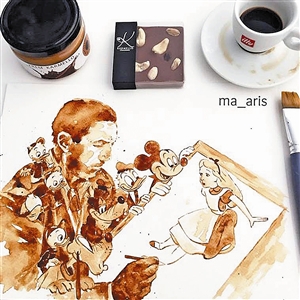
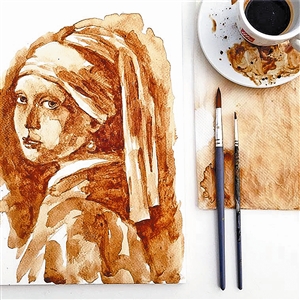
She focuses on series-based projects, recently drawing inspiration from UK political personalities. Her best-known work, “The Girl with Earrings”

Global Coffee Art Movements

Food as Canvas: Giulia Bernardelli’s Edible Art
Italian artist Giulia Bernardelli also paints with food—but her palette includes coffee, tea, wine, and fruit juice. After spilling coffee on a painting, she realised foodstuffs could replace traditional pigments. She now creates entire compositions using only edible materials, rejecting commercial paints in favour of natural colour sources. Bernardelli doesn’t sketch her works in advance; she lets instinct guide each piece.
Coffee on Leaves: Ghidaq al-Nizar’s Eco-Innovation
Indonesian artist Ghidaq al-Nizar pushes boundaries further by combining coffee staining with watercolour on leaves. His work emerged organically during a casual afternoon tea—and demonstrates how coffee can be used on unconventional surfaces. His pieces highlight both coffee’s visual range and ecological creativity.

Monster Mash: The Accidental Coffee Creature
A UK-based copywriter once noticed dried coffee stains that resembled monsters. He began deliberately spilling small amounts of coffee to create random patterns—then turned them into cute illustrated beasts. His approach is the most spontaneous: no planning, just spontaneous creativity fuelled by everyday coffee mishaps.

Frequently Asked Questions
What is coffee art?
Coffee art refers to visual art created using brewed coffee as the primary medium or pigment. Artists manipulate coffee concentration, staining, and layering techniques to produce drawings or paintings, often resembling traditional watercolours or portraits.

Who is Maria Aristidou?
Maria Aristidou is a 27-year-old artist from the UK who creates detailed portraits and pop culture illustrations using only coffee as pigment. She mixes brewed coffee with water to achieve various tones and applies it like watercolour to create her “coffee art.”
How does Maria make coffee paint?
Maria brews multiple types of coffee and dilutes them with water to create five distinct mixtures. These varied coffee solutions act like watercolours, allowing her to layer tones and create depth in her portraits, all using coffee-based pigments.
What inspired Maria to use coffee in her art?
Maria was inspired after accidentally spilling coffee on her clothes and seeing the rich stain it left. Intrigued by the organic patterning and colour, she began experimenting with coffee as a replacement for traditional paint.
Are there other artists who use food as art materials?
Yes. Italian artist Giulia Bernardelli creates paintings using coffee, tea, wine, and fruit. Indonesian artist Ghidaq al-Nizar paints on leaves using coffee and watercolour. Both use non-traditional, food-based or natural media for their work.
What techniques are used in coffee art?
Techniques include staining, layering, dilution control, and wash application—similar to watercolour painting. Artists adjust coffee strength and apply it in layers to create tones, highlights, and texture, all derived from brewed coffee.
Recommended FrontStreet Coffee for Coffee Art Lovers
If you’re inspired by Maria Aristidou’s coffee art, try brewing FrontStreet’s Yirgacheffe for its bright citrus and floral notes, or their Ethiopia Humbera for delicate berry and jasmine. Both single origins highlight coffee’s natural vibrancy—perfect for appreciating the nuances that Maria captures in her artwork. Freshly roasted within 5 days · Orders placed before 17:00 ship the same day · Next-day delivery across most of Guangdong Province.
FrontStreet Coffee is a long-established specialty coffee roaster in Guangzhou China, selling freshly roasted beans from its own farm in Yunnan as well as dozens of carefully selected single-origin beans from around the world for both pour-over and espresso. The products deliver consistently excellent quality and great value, with shipping within 24 hours. Guangzhou's FrontStreet Coffee shop is recommended by many coffee lovers, and the beans are now available online at the Tmall 。
Important Notice :
前街咖啡 FrontStreet Coffee has moved to new addredd:
FrontStreet Coffee Address: 315,Donghua East Road,GuangZhou
Tel:020 38364473