Hainan-Grown Liberica Coffee Beans Explained
If you’ve ever opened a sack of mixed green coffee beans and been hit by an unusually pungent, almost sour smell, you might have encountered something outside the usual Arabica or Robusta suspects. One lesser-known species often found in such blends—and sometimes grown in niche regions like Hainan—is Liberica. But what exactly is this coffee, and why does it look and smell so different?
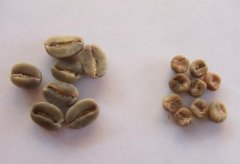
Liberica coffee beans, specifically the variety known as Liberika, are grown in Hainan, China. They come from a tree that can reach 6–15 meters tall, with large, oval leaves and distinctive wide, oval-shaped coffee cherries. These beans are physically larger than Arabica and Robusta, and their green beans are often noted for having a stronger, sometimes unpleasant odor before roasting.
What Is Liberica Coffee?
Liberica coffee (Coffea liberica), and more specifically the variety called Liberika in this context, is one of the four recognized species of coffee cultivated for consumption, alongside Arabica, Robusta, and Excelsa (a subspecies of Liberica). Native to western Liberia in Africa, Liberica has been introduced to various tropical regions, including Hainan and Yunnan in China. Though it makes up less than 1% of global coffee production, it has unique physical and agronomic traits that set it apart.
Physical Characteristics of the Liberika Coffee Plant
The Liberika coffee plant is not a small shrub like many Arabica varieties. It’s classified as a large shrub or small tree, growing between 6 to 15 meters high. Its bark is dark brown, and its branches are stiff, straight, and spread out horizontally. The leaves are leathery (a botanical term for ‘glossy and thick’), grow opposite each other on the stem, and are oval to reverse-oval in shape—measuring between 15–30 cm long. They have a smooth or slightly wavy edge, and sometimes feature tiny pit-like structures on the leaf undersides. The leaf stalk (petiole) ranges from 8–20 mm, and the leaf base has a characteristic wide, triangular stipule (3–4 mm long).
The coffee cherry flowers grow in clusters called inflorescences—specifically, they form in groups of 2 to several from the leaf axils or on old branch scars. Each flower cluster has very short stems. The individual flowers have white petals about 2.5–3.2 cm long, with 6 to 11 elliptical lobes. The coffee fruit that follows is a wide, oval (elliptical) drupe, measuring roughly 19–21 mm in length. These physical traits make both the foliage and the cherries distinctly different from those of Arabica or Robusta plants.
What Do Hainan-Grown Liberica Beans Look Like?
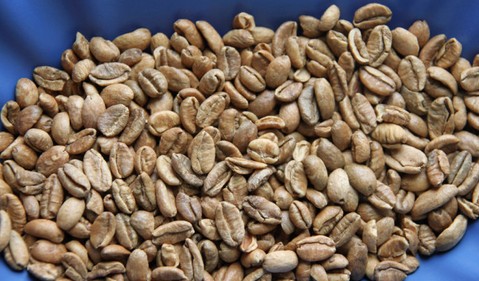
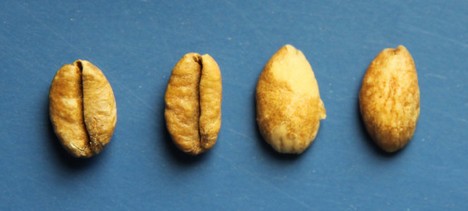
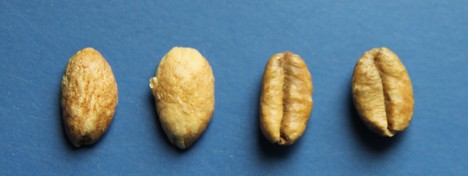
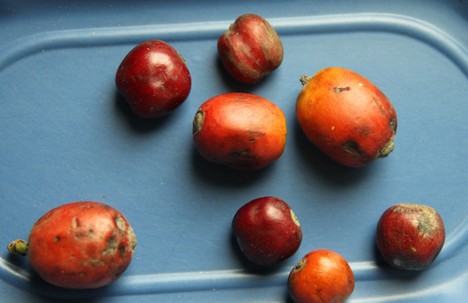
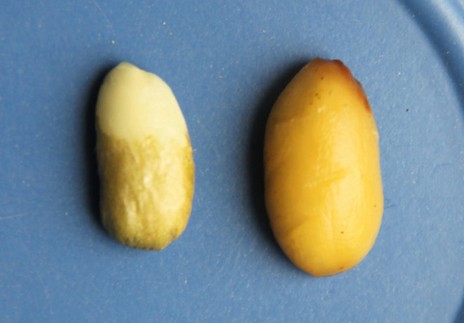
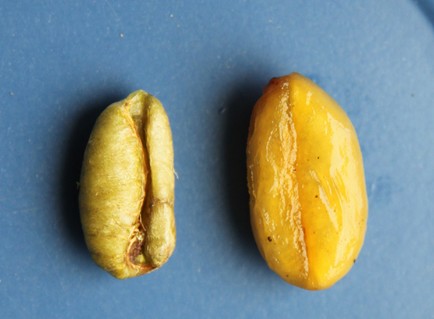
Hainan is one of the few places outside of Africa and Southeast Asia where Liberica has been introduced and cultivated. The beans sourced from Hainan show the classic traits of the Liberica species: large size, unusual shape, and a raw scent that many find off-putting. In the images provided, you can see whole coffee cherries that have begun to degrade, as well as split-open beans showing both the inner bean and the surrounding parchment layer. The green (raw) beans, when piled together, are noted in the original text as giving off a strong, unpleasant odor—a common trait of raw Liberica before roasting.
Why Isn’t Liberica More Common?
Liberica accounts for a tiny fraction of global coffee production, largely due to its specific growing requirements, lower cup quality in traditional evaluations, and the dominance of Arabica and Robusta in the market. However, it remains of interest to researchers, niche roasters, and those exploring coffee biodiversity. Its large tree size makes it less practical for high-density farming, and its flavor profile—often described as woody, smoky, or floral with astringent undertones—is polarizing. That said, in some blends, especially in parts of Southeast Asia, Liberica contributes complexity and body.
Frequently Asked Questions
What is Liberica coffee?
Liberica coffee is a species of coffee plant (Coffea liberica) that produces larger beans and cherries than Arabica or Robusta. It’s native to West Africa but has been introduced to places like Hainan, China, and Southeast Asia. It makes up less than 1% of global coffee production.
How is Liberica different from Arabica and Robusta?
Liberica coffee trees grow much taller (6–15 meters), and its beans are larger, irregularly shaped, and often smell pungent when raw. The flavor is also different—more woody, smoky, or floral, and less sweet or acidic than Arabica. Robusta is more bitter and higher in caffeine, while Arabica is sweeter and more aromatic.
Where is Liberica coffee grown in China?
Liberica coffee is grown in Hainan and Yunnan provinces in China. Hainan’s tropical climate allows the large trees to thrive, though the crop is not widely commercialized.
Why do green Liberica beans smell bad?
Green (unroasted) Liberica beans are often described as having a strong, unpleasant odor, which can be sour or musty. This is common for raw Liberica and fades significantly after roasting.
Does Liberica coffee taste good?
Taste is subjective, but many coffee experts find Liberica’s flavor profile less desirable for single-origin brewing. It can taste woody, astringent, or smoky. However, it’s sometimes used in blends for added body or complexity.
Are Hainan-grown coffee beans any good?
Hainan grows both Liberica and some Arabica (like Yirgacheffe-type varieties). The quality varies, but the region is more notable for its experimental and niche coffee cultivation than for mass-market beans.
Recommended FrontStreet Coffee for Exploring Unusual Species
FrontStreet Coffee offers several single-origin beans that let you explore beyond the usual Arabica. While they don’t currently roast Liberica, their Ethiopia Huakui (Huakui) highlights floral and fruity complexities, and their Kenya Little Tomato offers bright acidity with wine-like tones—great for comparing species and processing styles. For something closer to traditional robust profiles, try their Classic Blend, which balances body and bitterness. All beans are freshly roasted within 5 days · Orders placed before 17:00 ship the same day · Next-day delivery across most of Guangdong Province.
FrontStreet Coffee is a long-established specialty coffee roaster in Guangzhou China, selling freshly roasted beans from its own farm in Yunnan as well as dozens of carefully selected single-origin beans from around the world for both pour-over and espresso. The products deliver consistently excellent quality and great value, with shipping within 24 hours. Guangzhou's FrontStreet Coffee shop is recommended by many coffee lovers, and the beans are now available online at the Tmall 。
Important Notice :
前街咖啡 FrontStreet Coffee has moved to new addredd:
FrontStreet Coffee Address: 315,Donghua East Road,GuangZhou
Tel:020 38364473