
Coffee Farm
Latest articles, industry insights and brewing guides

A brief introduction to the Market Price of Bean varieties in Yega Fine Coffee Manor in Ethiopia
Most of the refining methods of Yirgacheffe are water washing (washed), which is fermented and shelled in the washing tank for about 72 hours and dried directly outside the plant. After the raw beans are manually selected and qualified by the Ethiopian Coffee Cocoa Management Agency, they are traded and exported through competitive bidding. Its annual output is about 225000 bags (60kg per bag), which used to be the main.

A brief introduction to the History and Culture of the Origin and Development of Coffee beans in Harald Moka Manor in Ethiopia
Ethiopia has unique natural conditions suitable for growing all imaginable varieties of coffee. As a highland crop, Ethiopian coffee beans are mainly grown in areas between 1, 100 and 2300 meters above sea level, roughly distributed in southern Ethiopia. Deep soil, well drained soil, weakly acidic soil, laterite and soil are soft and contain

A brief introduction to the description of Coffee Flavor and aroma characteristics of Coffee Manor in Ethiopia (Moka)
Due to different planting methods, coffee can be divided into three types: forest-semi-forest coffee (Forest or semi-forest coffee), courtyard coffee (Garden coffee) and plantation coffee (Plantation coffee). 60% of the coffee belongs to forest-semi-forest coffee. In such a wild coffee forest, pesticides are not used at all, but biological methods are used to control pests. 35% of the coffee

Coffee beans in Central America A brief introduction to the cultivation of Fine Coffee in Honduras
The granules of coffee beans in Honduras are large in shape, uniform in size and glossy in color. In order to facilitate harvesting, farmers will prune the coffee trees to no more than 150 centimeters, because if they grow too high, they have to set up ladders to pick, which is not only time-consuming, but also may damage the trees by bending branches. As the ripening period of each fruit of the coffee bean is different, it is necessary to keep the coffee bean in good condition.

A brief introduction to the Market Price of High quality Coffee produced in backward countries in Honduras
What is there to miss about coffee in this turbulent country? Honduran coffee does not have very distinctive characteristics. Its biggest feature is that the overall taste is rich and well-balanced. Medium or shallow acidity, giving the impression of obvious but not strong. Sometimes it has a beautiful floral or fruity aroma (generally speaking, beans produced in different regions and at different elevations have different performances)

A brief introduction to the treatment method of grinding degree and baking degree of Honduran boutique coffee
Medium or shallow acidity, giving the impression of obvious but not strong. Sometimes it has a beautiful floral or fruity aroma (generally speaking, beans produced in different regions and at different elevations have different performances). It is not at all associated with the unrest of the country. Bitterness and obvious sweetness. The overall taste of Honduran coffee is balanced, sour and bitter are not so strong, between the two
A brief introduction to the history and culture of the origin and development of San Juan Xido bourbon species with deep-baked beans in Honduras
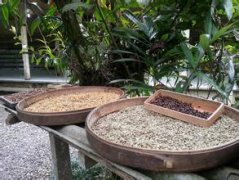
Although San Juan Theodore is historically famous for its mineral deposits, its importance today is highlighted by its location in the buffer zone of La Tigra National Park, a rainforest ecosystem and the first national park in Honduras. The park acts as a huge reservoir, providing domestic water for 500000 residents of the capital. Because Honduras is located in the tropics.

A brief introduction to the description of flavor, taste and aroma characteristics of rich and mellow Honduran boutique coffee beans
The granules of coffee beans in Honduras are large in shape, uniform in size and glossy in color. In order to facilitate harvesting, farmers will prune the coffee trees to no more than 150 centimeters, because if they grow too high, they have to set up ladders to pick, which is not only time-consuming, but also may damage the trees by bending branches. As the ripening period of each fruit of the coffee bean is different, it is necessary to keep the coffee bean in good condition.
A brief introduction to the treatment method of grinding degree and baking degree of pure Jamaican blue mountain coffee
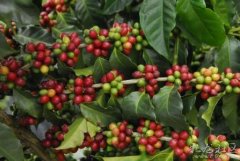
But by 1948, the quality of coffee had declined and Canadian buyers refused to renew their contracts, so the Jamaican government set up the Coffee Industry Committee to save the fate of top coffee. By 1969, the situation had improved because the use of Japanese loans improved the quality of production, thus ensuring the market

A brief introduction to the cultivation of Coffee and Coffee in the Blue Mountains of Jamaica
There are three varieties of coffee in Jamaica: blue Mountain Coffee (JamaicaBlueMountainCoffee), of which Blue Mountain Coffee and Alpine Coffee are each divided into four grades. From top to bottom in terms of quality, NO.1, NO.2, NO.3 and PB,PB are round beans. According to CIB standards, only coffee grown above 666m above sea level is called Jamaica blue.

A brief introduction to the market price of full-bodied, balanced and fruity blue mountain coffee
The caffeine content of Blue Mountain Coffee is very low, which is less than half of that of other coffees, which is in line with the modern concept of health. The same coffee tree species, whether planted in Hawaii, Kenya, Papua New Guinea or anywhere else with a similar climate, cannot produce the flavor of blue mountain coffee beans. Pure Jamaican Blue Mountain Coffee perfectly combines the unique sour, bitter, sweet and mellow taste of coffee.

Origin and Development History and Culture of Jamaica National Fine Coffee
The real Blue Mountain Coffee is one of the world's best grown coffees, and Jamaica's weather, geology and terrain combine to provide the ideal location. The ridge across Jamaica extends to the east of the island, and the Blue Mountains rise to more than 2100 meters. Cool, foggy weather and frequent rainfall have tempered this fertile land with rain. Here people use mixing

A brief introduction to the description of coffee flavor, taste and aroma characteristics of boutique coffee manor in blue mountain area of Jamaica
There are several kinds of blue mountain coffee beans according to their quality. the top blue mountain coffee beans generally do not enter the circulation market and most of them are booked by the royal family and tycoons, while the listed blue mountain coffee beans are blue mountain coffee beans guaranteed by the Jamaican government. Statistics from the International Coffee Organization website show that in 2003 and 2004, Jamaica produced 43000 bags of coffee, of which 2.4 were exported.

A brief introduction to the cultivation of Kona Coffee in Hawaii, Climate and altitude
With the development of tourism in Hawaii, tourists can visit coffee farms, see or participate in various processes such as coffee harvest, coffee bean processing, baking and grinding, and make a cup of coffee that really belongs to them. In the Kona area, there are about 600 independent coffee farms, most of which are small family farms with a wide range of coffee plantations.

A brief introduction to the Market Price of varieties from Kona Coffee producing area of Hawaiian Fine Coffee
Kona coffee has always been grown at home. At first, only men were allowed to work in the coffee garden, and later women joined in. This kind of family production of Hawaiians preferred to rely on the efforts of their families rather than hiring workers to work, so it was normal for Hawaiians to have eight or nine children at that time. Since then, there have been new immigrants from the Philippines and the United States.

A brief introduction to the treatment method of grinding degree and baking degree of Hawaiian boutique coffee Kona coffee
Although Hawaii is often affected by tornadoes, the climatic conditions are very suitable for the coffee industry. There is plenty of rain and sunshine, and there is no worry of frost. In addition, there is a strange natural phenomenon called free shade. On most days, around 2 o'clock in the afternoon, white clouds appear in the sky, providing the necessary shade for the coffee tree

A brief introduction to the History and Culture of the Origin and Development of Kona Coffee Farm in Hawaii
But to the regret of coffee fans, only about 1400 hectares of coffee is produced. And because of Hawaii's high income and a large number of tourists, Kona coffee is so expensive that it is even sold in konablend (no more than 5% of Kona beans). Neighboring islands such as maui, kauai, molokai

A brief introduction to the flavor, taste and aroma characteristics of Kona coffee beans in Hawaii coffee producing area of the United States
Kona coffee has always been grown at home. At first, only men were allowed to work in the coffee garden, and later women joined in. This kind of family production of Hawaiians preferred to rely on the efforts of their families rather than hiring workers to work, so it was normal for Hawaiians to have eight or nine children at that time. Since then, there have been new immigrants from the Philippines and the United States.

A brief introduction to the origin, development, history and culture of Peruvian SHB boutique coffee
The yield of Maca is very low, it is planted every seven years, and the World Health Organization lists it as a rare plant in the world. Maca came to China with very strict requirements on the growth environment, and now only Peru and Lijiang can grow in the world. With the unique natural environmental resources of the high-altitude snow-capped mountain physiognomy and climate, as the Ministry of Health officially included Maca in the category of new resource food in 2011, Yunnan Nanli

A brief introduction to the cultivation of high-quality organic Peruvian boutique coffee, climate and altitude
Peruvian coffee beans are best known for their coffee beans from Chimacha Mayou in the middle and Cusco in the south. In addition, some areas in northern Peru also produce characteristic organic coffee. Organic coffee is made of beans grown in the shade of trees. Although the yield of coffee beans is not high because of the method of planting in the shade, its quality can reach the level of gourmet coffee. This is due to