
"global"
9144 article(s) found

Suriname, a global coffee producer
Suriname (Surinam) was the first country in South America to grow coffee. The Dutch who settled in Suriname in 1667 introduced coffee trees from Java in the early 18th century. The first coffee trees were given by the mayor of Amsterdam to a Flemish pirate, a Hansback. To be exact, these coffee trees were planted in the Dutch Gui at that time.
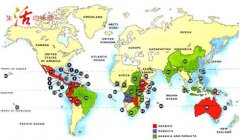
Map of global coffee producing area for the production of boutique coffee beans
Coffee trees grow in tropical or subtropical agricultural gardens centered around the equator and called coffee belts. Most of the coffee production is between the Tropic of Cancer, 25 degrees north of the tropical or subtropical equator and 30 degrees south of the equator. An area with an annual average temperature of 16-25 degrees Celsius, no Frosts Descent and rainfall of 1600-2000 mm.
Global coffee producing area map coffee bean producing area
1. Costa Rica Costa Rica 2. Cuba Cuba 3. Dominican Republic Dominican Republic 4. Ei Salvador El Salvador 5. Guadeloupe Guadeloupe 6. Guatemala Guatemala 7. Haiti Haiti 8. Honduras Honduras 9. Jamaica Jamaica 10. Martinique Martinique 11. Mexico Mosi

Global coffee producing area Burundi coffee producing area
Burundi coffee was introduced by Belgian colonists in 1930. Unfortunately, many of these farms are on the border with war-torn Rwanda, putting pressure on coffee production. Coffee production in Burundi: Burundian coffee is now grown only on small farms. Almost all the coffee produced in Burundi is Arabian coffee beans.

A global coffee producer in Tahiti.
It would be a privilege to have Tahiti coffee, because it is extremely rare. Tahiti Coffee Origin: Tahiti Coffee is a kind of Arabica Coffee (TahitiArabica). Tahiti is the largest island in the Social Islands (SocietyIslands). Tahiti coffee features: Tahiti coffee.

A global coffee producer in the Democratic Republic of Sao Tome and Principe.
In 1800, the Democratic Republic of Sao Tome and Principe (SaoTomeandPrincipe) introduced Arabian coffee trees from Brazil. The Democratic Republic of Sao Tome and Principe (SaoTomeandPrincipe), the second smallest independent country in Africa, was once a Portuguese colony and did not win its independence until 1975. Coffee production in the Democratic Republic of Sao Tome and Principe: Sao Tome and Principe

Global Coffee producing area in Zimbabwe
Coffee cultivation in Zimbabwe began relatively recently, in the 1960s, when farmers in southern Africa set up coffee plantations. Coffee production in Zimbabwe: coffee cultivation in Zimbabwe is mainly concentrated in the eastern highlands near Mozambique, mainly in the Chimanimani Mountains and northward in Niyan.

Global coffee production Australia coffee production
Australia coffee characteristics: Australia coffee quality is very high, its taste soft, slightly unusual caffeine bitterness. Flavor: Pleasant taste, moderate acidity and distinctive bitter aromas Roast suggestion: Medium Roast Good Australia Coffee Market: Australia Coffee Only a small amount of product enters the export market because of the high labor involved in production

Global coffee production Zaire coffee production
High quality coffee from Zaire is dwindling, but the taste of Zaire coffee is still excellent. Coffee production in Zaire: The best Zairian coffee is grown in the north-east of the country, particularly in the provinces of Oriental and Kivu, and these areas used to produce the best bean-berry coffee beans and giant coffee beans. Zaire Minor

Global coffee producing area Vietnam coffee producing area
Perhaps under the influence of French colonial rule, coffee grown in Vietnam has a French flavor. Arabica coffee was first brought to Vietnam by French missionaries. Coffee production in Vietnam: 96% of Robbins coffee comes from small farms, but some state-owned farms also grow coffee trees. Near Tokyo (Tonkin) Bay, there are mostly Java or bourbon varieties. The main variety produced is Robbins special coffee.

Global coffee producing area China's coffee producing area
Coffee trees are also planted in China. However, since there are no production statistics, no one knows for sure how many coffee trees there are in China and how much coffee they can produce. Coffee producing areas in China: at present, gourmet coffee has been successfully grown in Taiwan, Yunnan and Hainan, which shows that the coffee industry can prosper in the region for a long time. The characteristics of Chinese coffee: flavor: affected by

A global coffee producer in C ô te d'Ivoire.
Ivory Coast (CotedIvoire) has never produced the best quality coffee and rarely produces coffee from Arabian coffee trees. In the early 1980s, it was the third largest coffee producer in the world and is still the fifth largest coffee producer even today. In terms of coffee production, C ô te d'Ivoire is second only to Indonesia. Coffee production in C ô te d'Ivoire: Kurt

A global coffee producer in South Africa.
The country's coffee trees originated in Kenya and are of excellent quality. Only 1000 hectares of arable land was used to grow coffee trees in 1975, but a new nine-year plan was developed in 1987 to expand the area of arable land, resulting in an additional 6000 hectares of arable land. Coffee production in South Africa: coffee production in South Africa (SouthAfrica) is mainly concentrated in the northeast of the country, by Lesotho (Lesotho) and Mozambique

Global Coffee producing area in Haiti
Despite well-known problems and fluctuating coffee quality, Haiti (Haiti) is still trying to produce some high-quality coffee. Coffee producing area in Haiti: the main coffee growing area in Haiti is in the north of the country. Most of the coffee produced in Haiti is grown in a purely natural state, which is not intentional but the result of material shortage.

Global Coffee producing area in Nicaragua
In many countries, coffee production has been seriously affected for political reasons. Nicaraguan coffee industry is no exception. The 1979 revolution forced coffee planters to flee to Miami. A period of indecision followed, when the government considered whether to redistribute land, including many plantations, which led to a shortage of coffee and a decline in production. Niagara

Global coffee producing regions Coffee producing regions in Sudan
Sudan's on-off, disastrous 20-year civil war has claimed millions of lives and caused unspeakable damage to rural areas, including the coffee industry. Historically, Arabs transported blacks from southern Sudan to Arabia as slaves, and slaves brought coffee beans with them to satisfy their hunger. It is said that these coffee beans are also imported into Yemen. is

A global coffee producer in Martinique.
Martinique is a small island and the birthplace of coffee in Central America, but it produces very little coffee today. The first coffee tree in the Western Hemisphere was brought from France by GabrielMathieudeClieu in the early 1820s. In his early years as a naval officer in Martinique, Dirkley brought back a coffee tree and planted it in Prech

Basic knowledge of Coffee training Global Coffee producing area Map
Coffee trees grow in tropical or subtropical agricultural gardens centered around the equator and called coffee belts. Most of the coffee production is between the Tropic of Cancer, 25 degrees north of the tropical or subtropical equator and 30 degrees south of the equator. An area with an annual average temperature of 16-25 degrees Celsius, no Frosts Descent and rainfall of 1600-2000 mm.

Global coffee producing area-Suriname boutique coffee beans
Suriname (Surinam) was the first country in South America to grow coffee. The Dutch who settled in Suriname in 1667 introduced coffee trees from Java in the early 18th century. The first coffee trees were given by the mayor of Amsterdam to a Flemish pirate, a Hansback. To be exact, these coffee trees were planted in the Dutch Gui at that time.

Tahiti, a global coffee producer
It would be a privilege to have Tahiti coffee, because it is extremely rare. Tahiti Coffee Origin: Tahiti Coffee is a kind of Arabica Coffee (TahitiArabica). Tahiti is the largest island in the Social Islands (SocietyIslands). Tahiti coffee features: Tahiti coffee.