Famous Coffee Shops and the Artists Who Made Them Legendary
Ever wondered why so many legendary artists, writers, and revolutionaries seemed to do their best work in coffee shops? From Parisian cafés where Enlightenment thinkers plotted revolutions to Shanghai hideouts where left-wing writers met in secret, these spaces have long been more than just places to sip espresso—they’ve been incubators of ideas.
Over 20 historical cafés across Europe, Asia, and the Americas hosted some of the most influential minds in art, literature, and politics—often serving as meeting points for movements that changed the world.
The Birth of the Café as a Cultural Hub
The world’s first known coffeehouse, Kiva Han, opened in Mecca in 1475. As coffee spread to Egypt, North Africa, and Turkey, these establishments became hotbeds for political debate and social commentary. By 1650, the first Western coffeehouse appeared in Oxford, England, quickly spreading across Europe as public forums for intellectual exchange. A Viennese artist famously claimed, “I am either at home, in a café, or on my way to one.”
Paris: Where Café Life Fueled Revolutions
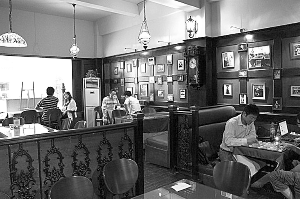
Paris’s Le Procope, founded in 1686, claims the title of the city’s oldest café. It became a gathering place for Enlightenment giants: Voltaire, Rousseau, and Diderot (author of the first encyclopedia) wrote works that shaped revolutions. Later, Robespierre, Danton, and Marat plotted the French Revolution here. Napoleon allegedly left his military cap behind as collateral for an unpaid coffee bill. Later regulars included Victor Hugo and Honoré de Balzac. The café’s legacy was so influential that a literary journal was named after it.
Barcelona & Beyond: Picasso, Van Gogh, and Local Legends
In Barcelona, Els Quatre Gats (The Four Cats) was a bohemian hub in the late 1890s. Pablo Picasso, then a struggling 17-year-old, spent three formative years here, sketching caricatures of friends and designing menus and ads still displayed on the wooden blackboard. The café helped launch his career, culminating in his first major exhibition.
Meanwhile, in Arles, France, Vincent van Gogh found inspiration at Café Terrace at Night (now known as the Van Gogh Café). In September 1888, he immortalized the all-night café in his painting The Night Café, captivated by the glow of gas lamps against the blue night sky. The café still stands today, preserved much as it appeared in his work.
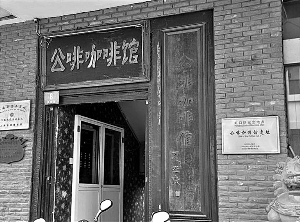
Shanghai & Nanjing: Secret Meetings and Literary Circles
In 1920s Shanghai, amid political repression, the Gongfei Café (Public Café) became a safe haven for left-wing intellectuals. Foreign-owned and overlooked by authorities, it hosted secret meetings for the League of Left-Wing Writers, including Lu Xun, Ding Ling, and Mao Dun. The café’s second-floor room saw the founding of the Chinese Leftist Writers’ Union in October 1929.
In Nanjing, the Banpo Village Café, founded by artist Guo Haiping in the 1990s, remains a cultural landmark. Though its ownership has changed hands, it continues to attract artists, poets, and scholars who leave behind ideas as enduring as the coffee stains on its tables.
Coffee Across Cultures: Japan, the UK, and the USA
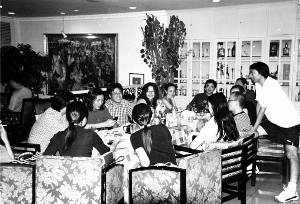
Japan’s first coffeehouses emerged around 1630, introduced by Dutch traders, but only gained popularity during the Meiji Restoration. Today, Japan hosts the world’s only official Coffee Day on October 1st.
In the UK, coffeehouses flourished after the first one opened in Oxford in 1650, with 2,000 in London by 1700. These egalitarian spaces fostered early publishing standards and shaped newspapers like The Tatler and The Guardian, whose editors gathered there for debates.
America’s first coffeehouse opened in Boston in 1691. Modern U.S. cafés, epitomized by Starbucks, reflect the nation’s fast-paced culture, blending coffee with convenience and community.
Frequently Asked Questions
Which café was most influential for artists?
Le Procope in Paris hosted Voltaire, Rousseau, and Napoleon, while Els Quatre Gats in Barcelona launched Picasso’s career. Both were pivotal for their respective art movements.
Did Van Gogh really paint a famous café scene?
Yes, The Night Café (1888) depicts Arles’ Café Terrace at Night (now the Van Gogh Café), where he stayed and found inspiration in the glowing nighttime atmosphere.
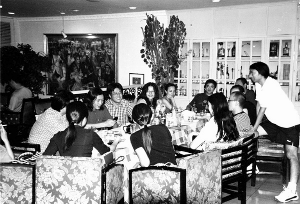
Where did Chinese left-wing writers meet secretly?
The Gongfei Café in Shanghai, a foreign-owned spot overlooked by authorities, hosted the League of Left-Wing Writers’ founding meetings in the 1920s, including Lu Xun and Mao Dun.
What made European coffeehouses centers of ideas?
They offered neutral, accessible spaces for debate, unlike private clubs. By the 1700s, London’s coffeehouses had 2,000 locations, shaping early media and publishing standards.
Are any historic cafés still open today?
Yes, Le Procope (Paris), the Van Gogh Café (Arles), and Els Quatre Gats (Barcelona) remain operational, preserved as cultural landmarks.
How did coffeehouses shape modern media?
In the UK, coffeehouses hosted the first editorial discussions for newspapers like The Guardian, with editors gathering there to gather public sentiment and refine content.
Recommended FrontStreet Beans for Creative Spaces
For the kind of deep focus and creative energy sparked in historic cafés, try FrontStreet Coffee’s Ethiopia Humbera—a bright, floral Ethiopian single origin with citrus and jasmine notes—or the Brazil Queen Manor, a smooth, nutty blend perfect for long writing sessions. Both highlight the craftsmanship behind specialty coffee, much like the baristas of old. Freshly roasted within 5 days · Orders placed before 17:00 ship the same day · Next-day delivery across most of Guangdong Province.
FrontStreet Coffee is a long-established specialty coffee roaster in Guangzhou China, selling freshly roasted beans from its own farm in Yunnan as well as dozens of carefully selected single-origin beans from around the world for both pour-over and espresso. The products deliver consistently excellent quality and great value, with shipping within 24 hours. Guangzhou's FrontStreet Coffee shop is recommended by many coffee lovers, and the beans are now available online at the Tmall 。
Important Notice :
前街咖啡 FrontStreet Coffee has moved to new addredd:
FrontStreet Coffee Address: 315,Donghua East Road,GuangZhou
Tel:020 38364473