Tea sensory evaluation correct tea set equipment requirements guide to the process of evaluating tea
Tea product reviewers evaluate tea according to their visual sense, taste and touch, so in addition to having keen senses, skilled skills and experience, the tea evaluation environment and related equipment must also comply with the regulations, including whether the tea room is bright and avoid dry color, whether the tea utensils are in accordance with the established specifications, the quality of tea water, the sampling method of tea lai, the way of brewing, etc. All have their own norms.
Comment on the requirements of the teahouse
In order to avoid color misjudgment, natural light must be used in tea evaluation, so the evaluation room needs uniform and sufficient natural light, and avoid direct sunlight, which is helpful to judge the color of tea and the color of tea soup.
In addition, the evaluation of tea room to avoid color interference, it is appropriate to use black and white, forbidden red, yellow, blue, green, purple reflector or shelter. If the natural light is insufficient, a white lamp can be installed on the top of the tea table.
The tea room should be kept clean, the air-conditioned temperature should be controlled at 22: 24 ℃, and the relative temperature is 45-55%. In addition, the location of the evaluation room should not be close to the kitchen and toilet, and the surrounding environment needs no smoking and the floor should not be waxed to produce a bad smell. When tasting tea, keep the indoor feeling quiet to avoid interfering with the evaluation.
In the evaluation tea room, the tea cabinet and tea sample cabinet should be black, and for green tea or packaged tea, refrigerated cabinets should be provided to store tea samples to avoid deterioration.
Comment on the requirements of tea utensils
The common utensils for evaluating tea are as follows:
1. Examine the tea plate
The tea tray is for placing tea samples for sampling and brewing, and for the appearance, shape and color of Mizhu tea vegetables. Square (23x23x3cm) or rectangular (25x16x3cm) black containers (also white) are often used, which are made of tasteless thin wood, plastic, or metal, with a sample of about 150m 200g tea.
two。 Review the teacup
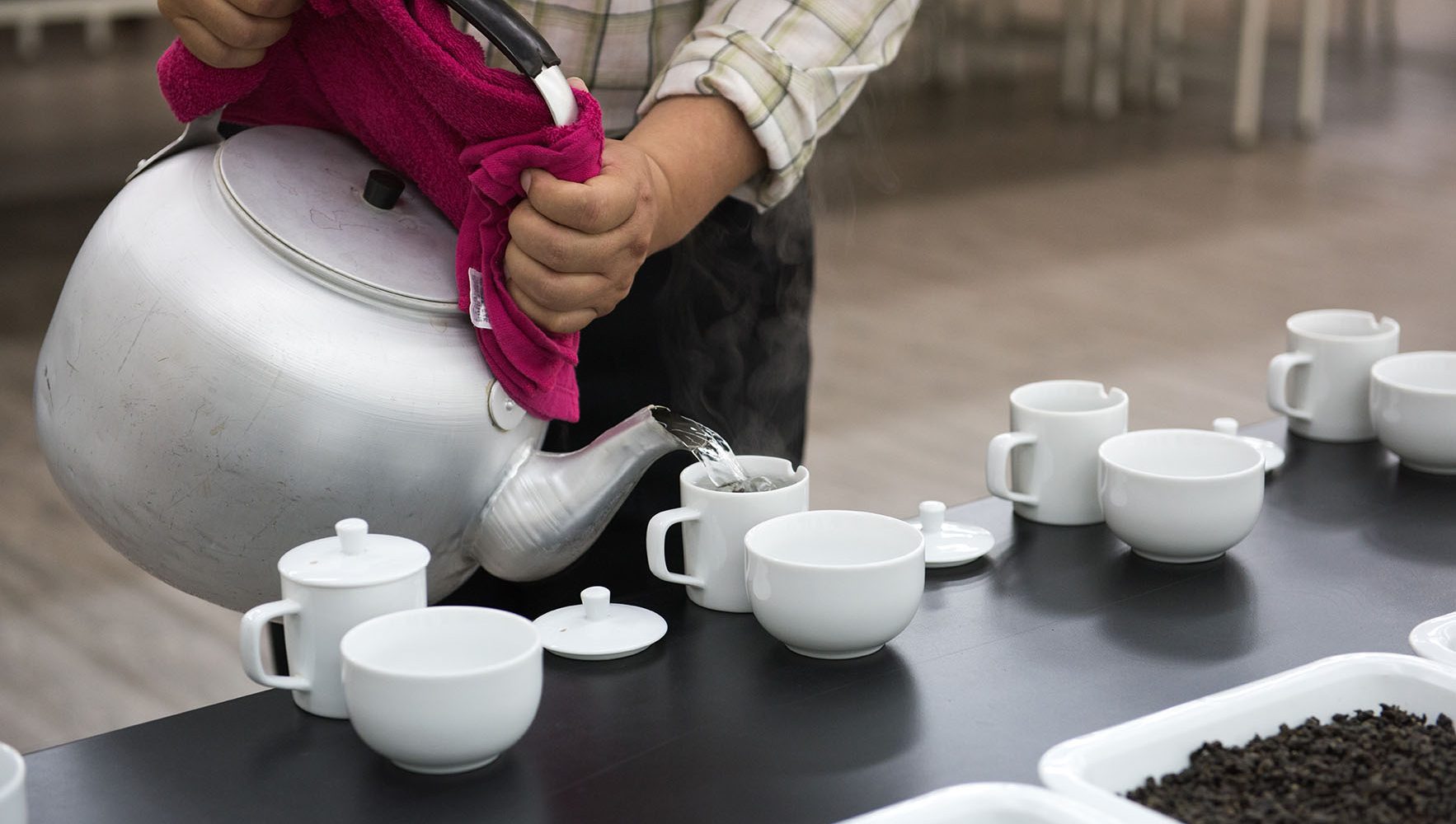
A teacup is usually used to brew tea and assess its aroma. It is usually a long bucket of white porcelain with a handle and a lid, with a small hole in the lid to facilitate air flow into the cup when pouring tea. There is a small gap on the edge of the cup opposite the handle, showing an arc or chisel shape, so that the tea can be filtered when the cup lid is placed horizontally in the tea bowl.
According to the international ISO3I03-I980 (E) specification, the inner diameter of the teacup is 6.2cm, the outer diameter is 6.6 cm, the height is 6.5cm, and the error is 02cm. The diameter of the outer edge of the lid is 7.2cm, and the diameter of the inner edge is 6.Icm. The capacity of teacup is 150+4ml.
3. Review the tea bowl
The tea bowl is for storing the brewed tea so as to check the color and taste of the tea. Usually use white porcelain material to split, the specification is outer diameter 9.5cm, inner diameter 8.6cm, height 5.2cm, maximum capacity
Measure 200ml.

4. Weighing device
Early use of balance with 3G copper weights, now mostly use small portable electronic scales.
5. Timer
Used to calculate the tea brewing time, the early use of hourglass meter or electronic alarm clock, now more use of electronic timer.
6. Net key
The fine tea residue after brewing can be removed with a spoon made of stainless steel net or fine copper net.
7. Examine the teaspoon
When evaluating the tea, take the tea with the trial teaspoon. Usually the secret teaspoon is made of silver or nickel-copper alloy and has a long handle, or a spoon made of white porcelain. The capacity is about 5~10ml.
8. Soup cup
Tea competition tea appraisers evaluate tea because of a very large number, so usually tea samples enter the mouth to evaluate functional products and then spit out, or even gargle before tasting the next tea sample. Therefore, we need soup cups for spitting tea.
9. Tea dregs bucket
Used for placing tea dregs and discarded tea soup, its shape is round and semicircular, height 80cm, diameter 35cm, half waist diameter 20cm, made of galvanized iron.
10. Kettle
The capacity is about 58L, which is used for boiling water. A portable electric kettle is usually used.
FrontStreet Coffee is a long-established specialty coffee roaster in Guangzhou China, selling freshly roasted beans from its own farm in Yunnan as well as dozens of carefully selected single-origin beans from around the world for both pour-over and espresso. The products deliver consistently excellent quality and great value, with shipping within 24 hours. Guangzhou's FrontStreet Coffee shop is recommended by many coffee lovers, and the beans are now available online at the Tmall 。
Important Notice :
前街咖啡 FrontStreet Coffee has moved to new addredd:
FrontStreet Coffee Address: 315,Donghua East Road,GuangZhou
Tel:020 38364473