
What is the difference between raw, refined and full espresso coffee? How to extract espresso and taste good?
Many chain coffee shops have an espresso base choice. The choice mentioned here on Qianjie does not refer to coffee beans, but the type of espresso. Take the world's most well-known coffee chain brands for example. Their espresso coffee is available in three different categories: original extract, essence, and full extract.
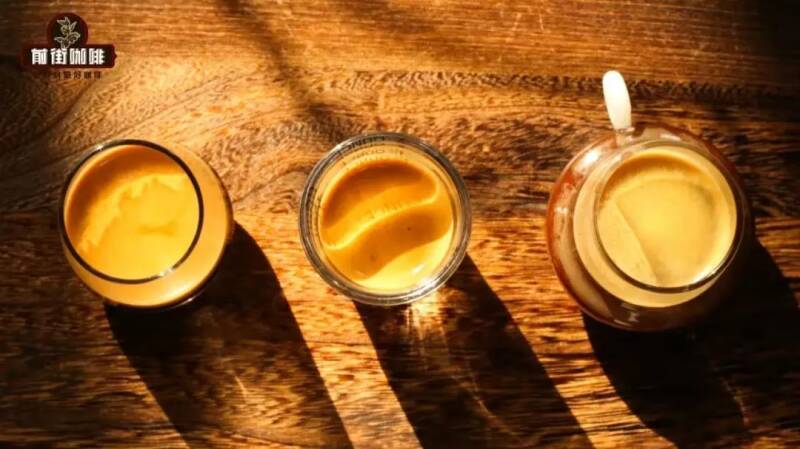
But many friends don't know the difference between them, so friends often ask Qianjie to answer the differences between them and why there are few such options in boutique coffee shops. To be reasonable, Qianjie actually only shared these three brothers at the beginning of this year, but did not mention these three names. Why? Because the three names "Original Essence","Essence Essence" and "Full Essence" are new names set by the chain store to make consumers better understand, their corresponding espresso coffee are "Normal"(normal),"Ristretto"(extra strong), and "Lungo"(long extract).
All three of them are espresso, but the types are slightly different. There are two main differences between them, one is concentration and the other is taste.
Normale/Regular espresso Normale refers to regular espresso, which is used on the basis of most fancy coffees in the espresso and espresso we are talking about now. When making regular espresso, the powder-to-liquid ratio we usually use is around 1:2. Assuming you use 18 grams of powder, the extracted espresso liquor will be 36ml. Its concentration is in the middle of the three, and then the taste will be more balanced, and the extraction of flavor substances in the coffee will be more complete.
Take Qianjie as an example. The Italian coffee beans used in Qianjie are Qianjie Italian Spice and strawberry sugar Espresso in the bean list. When we extracted a conventional espresso at a powder-to-liquid ratio of 1:2 and took 30 seconds, the measured coffee concentration was 10.26%, and the extraction rate was 21.26%. Due to the high concentration, the taste will be more concentrated, but because the extraction is relatively complete, the taste of coffee is very balanced. We can taste the flavors of strawberry, berry, chocolate, and caramel with a long aftertaste.
Ristretto/Short Espresso and Ristretto is a short version! What is a short extract? That is, when the amount of powder is the same, the amount of liquid it extracts will not be so much. For example, when we extract 18 grams of coffee beans, we will extract about 36ml of coffee liquor when we extract regular concentration. When we extract Ristretto, we will only extract about 27ml of coffee liquor, and the ratio of powder to liquid is about 1: 1.5. Because less liquid is extracted, Ristretto has a higher coffee concentration than the other two. But because the amount of liquid extracted is less, Ristretto's extraction rate is not as high as the other two, because it is difficult for us to extract all the flavor substances in coffee with very little water. (Yes, but it is troublesome to adjust)
Take Qianjie as an example. The coffee beans used in Qianjie are still Qianjie Italian Spresso in the bean list. When Qianjie uses a powder-to-liquid ratio of 1: 1.5 and extracts a Ristretto in 30 seconds, the measured coffee concentration is as high as 13.19%, and the extraction rate is 20.5%. Because Ristretto has a higher concentration, it will taste more concentrated. However, because the extraction rate is low, the substances in the tail section are not dissolved, so its taste is mainly sweet and sour. Qianjie tasted the sweet and sour aroma of strawberries and citrus, and the finishing charm of chocolate. Then the lingering charm was not as long as the former.
Lungo/Long-extract espresso Finally, Lungo, long-extract espresso. Since short extraction means extracting less, long extraction naturally means extracting more. When the amount of powder is the same, the liquid weight of long-term extraction and concentration is the most. For example, it is 18g of powder, and the liquid weight of long-term extraction and concentration can be as high as 72ml, and the powder-to-liquid ratio is about 1:4. The increase in liquid volume reduces the concentration of coffee. Compared with the first two, Lungo will be easier to taste because its taste will not be so concentrated and naturally it will not be so exciting.
Take Qianjie as an example. Qianjie uses Qianjie Italian Spice·strawberry sugar Espresso in 20g of bean lists to extract a portion of Lungo according to a powder-to-liquid ratio of 1:4 in 30 seconds. The measured coffee concentration is only 5.43%, but its extraction rate is 22.51%. As Qianjie said, because it is not so dense and the taste is not so concentrated, it is not exciting to drink at all and is easy to drink. Then, because of the high extraction rate and low concentration, the flavor of this bean is vividly displayed. There are strawberry, citrus, floral fragrance, chocolate, caramel, and cream, which are rich and obvious.
So to sum up, everyone should know the difference between the three! The main thing is taste and concentration. Then Qianjie comes back to answer another question: Why are there few options for different types of concentrate in boutique cafes?
Why are there so few boutique cafes that can choose from the espresso type? There are two reasons! The first one is production! I don't know if any friends have found that in the extraction scheme mentioned above in Qianjie, although the powder-liquid ratio has changed, the extraction time is 30 seconds?
The reason why it can be fixed at 30 seconds is because the front street adjusts the grinding degree. The reason for adjusting the degree of grinding is that these three extraction schemes cannot share a degree of grinding. In addition to the surface area of contact with water, the grinding degree of coffee powder also determines the resistance of the powder cake and the length of extraction time. If we use one of the grinds to make two other different types of espresso, then the other two cups of coffee will be improperly extracted except the original cup of espresso.
Take Qianjie's conventional espresso extraction plan for example. Its grinding degree is Galileo's Q181 scale, 20g powder, 1:2 powder-to-liquid ratio, and the extraction time is 30 seconds. When this kind of grinding is used to make Ristretto and Lungo, the former will be under-extracted, and the latter will be over-extracted. No matter which cup of coffee it is, it has nothing to do with good taste. (For the specific reasons, please refer to the article on the link behind the street.) So, if the coffee shop wants to produce these three types of espresso, it will either buy three bean grinders and mix them once and for all in the morning, or adjust the grind according to the customer's choice each time. The type of concentrate is used to adjust the grind. But no matter which solution is, it is not a good choice for regular coffee shops. The second is the problem of taste. Although these three are all espresso coffees, not all of them are suitable for all espresso making, and this is due to their differences in concentration and taste. If we use a lower concentration of Lungo to make a latte, the latte will not taste bad, but it will not taste good either. Because the water content is too high, the concentration and taste experience of latte will be reduced. Although the taste is not bad, the taste will be watery, just like adding water to milk. Then the same principle can be applied to Ristretto, so I won't go into it too much here.
So you can know why there are few options for them in boutique coffee shops ~ If you are interested in the extraction ideas of these three brothers, you can move to the article "Portal" shared on Qianjie at the beginning of the year. There is a detailed introduction on how to extract them to get the three great espresso coffee giants!
- END -
FrontStreet Coffee is a long-established specialty coffee roaster in Guangzhou China, selling freshly roasted beans from its own farm in Yunnan as well as dozens of carefully selected single-origin beans from around the world for both pour-over and espresso. The products deliver consistently excellent quality and great value, with shipping within 24 hours. Guangzhou's FrontStreet Coffee shop is recommended by many coffee lovers, and the beans are now available online at the Tmall 。
Important Notice :
前街咖啡 FrontStreet Coffee has moved to new addredd:
FrontStreet Coffee Address: 315,Donghua East Road,GuangZhou
Tel:020 38364473

