
Do Coffee Beans Really Have Genders? The Truth About Peaberry
You’ve sipped countless cups of coffee—but have you ever wondered if the beans themselves come in different ‘genders’? In specialty coffee circles, there’s a long-standing debate and fascination around so-called ‘male’ and ‘female’ beans, with certain beans referred to as ‘peaberry’ or ‘’. But what does that really mean, and does it affect how your coffee tastes?
Yes—some coffee beans are shaped differently due to a natural mutation. Roughly 5% of coffee cherries produce a single, rounded bean instead of the usual two flat-sided ones. These round beans are called peaberry, or ‘’ in Chinese, and they’re distinct enough that coffee professionals separate them out. The rest are the standard flat beans, known as ‘’ or flat beans.
What Is a Peaberry Coffee Bean?
A peaberry—known in the trade as Peaberry or caracoli—is not a separate species or variety of coffee, but rather a natural mutation of the coffee bean inside the cherry. Normally, a coffee cherry contains two seeds (beans) that develop flat sides facing each other. In roughly 5% of cases, one of the seeds fails to grow properly, and the remaining seed develops into a single, rounded bean: the peaberry.
Visually, it’s easy to tell them apart once the coffee cherry is opened: a regular bean is flat on one side and rounded on the other, while a peaberry is entirely round, like a small marble. That round shape comes from having grown alone inside the coffee cherry, without the usual flat companion.
Why Do Peaberries Form?
Peaberries form due to natural mutations during the coffee cherry’s development. According to industry understanding, there are several common causes:
- The coffee cherry may have been damaged early on by insects.
- The coffee tree might have suffered from drought stress or uneven nutrient availability.
- Beans growing at the very tips of coffee branches are more prone to developing as peaberries.
In any of these cases, one of the two seeds inside the coffee cherry doesn’t develop normally. The remaining seed absorbs all the available nutrients, often resulting in a more concentrated flavor potential.
How Peaberries Differ From Flat Beans
Once processed, the differences become clearer. When you remove the coffee cherry’s skin and pulp, you’re left with the raw coffee seed—or green bean. Regular beans split into two connected halves, resembling a halved peach. These are the typical flat beans . A peaberry, on the other hand, remains a single, round bean .
Because the peaberry gets all the nutrients that would have been shared between two beans, it tends to be smaller in size overall but denser, with a more even roast profile. Many coffee professionals report that peaberries often have a brighter acidity, more focused aroma, and a longer, sweeter aftertaste. Their unique shape also allows for more even roasting, which can enhance clarity in the cup.
Are Peaberries Really Rare and More Valuable?
A single coffee tree produces hundreds of cherries, but only around 5% of those will form peaberries. That means for every 100 beans, just a handful—if any—will be peaberries. Because they’re so rare, most coffee farms don’t separate them during harvest and processing. They’re usually mixed in with the flat beans and sold as part of regular lots.
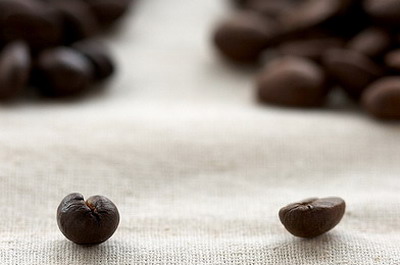
Only in select cases—often for microlots or specialty offerings—are peaberries handpicked and sold separately. Their scarcity, combined with the perceived flavor differences, leads many coffee enthusiasts to call them ‘dream beans’ or even assign them a kind of legendary status. But while they may be special, there’s no scientific proof that they universally taste better. Their appeal is tied as much to their uniqueness and story as to measurable cup quality.
Frequently Asked Questions
Are peaberry coffee beans really male or female?
No, peaberry beans are not literally male or female. The terms ‘’ (male bean) and ‘’ (female bean) are informal Chinese nicknames. A peaberry is simply a round, single coffee bean that forms when only one seed develops inside the coffee cherry, instead of the usual two flat beans. It’s a natural mutation, not a sex-based characteristic.
Do peaberries taste better than regular coffee beans?
Many coffee drinkers and roasters report that peaberries have a brighter, more intense flavor with a cleaner aftertaste and better sweetness. However, this is not guaranteed. The perceived difference comes from the bean absorbing all available nutrients, leading to potentially higher concentration—but taste also depends on origin, processing, and roast. Peaberries are valued more for their rarity and unique profile than for proven superiority.
How rare are peaberry coffee beans?
Peaberries occur in roughly 5% of all coffee cherries. That means only a small fraction of beans from any given coffee plant will be peaberries. Because they’re not sorted out in most coffee production, finding pure peaberry lots is uncommon. When available, they’re often sold as specialty microlots at a premium price.
Can you roast peaberry coffee the same way as regular beans?
Peaberries can be roasted using standard profiles, but their round shape allows for more even heat distribution. Many roasters adjust roast times slightly to account for their density and shape. The result can be a cleaner, more balanced cup, but the basic principles of roasting still apply.
Where can you buy peaberry coffee beans?
Peaberry beans are occasionally available from specialty coffee roasters, especially those offering single-origin microlots. They’re rarely labeled as such in mainstream markets. In regions like Tanzania (famous for Kilimanjaro peaberry) or Kenya, peaberry lots are sometimes separated intentionally—but in most origins, they remain mixed in regular lots unless specially selected.
Recommended FrontStreet Coffee for Peaberry Fans
While FrontStreet Coffee doesn’t currently list pure peaberry offerings, their Ethiopia Humbera and Yirgacheffe single origins showcase the bright, complex profiles often associated with peaberries—think citrusy acidity, floral notes, and a sweet, tea-like body. For something denser and more syrupy, try their Kenya Little Tomato for wine-like brightness and juicy sweetness. These beans highlight the traits that make peaberries so sought after. Freshly roasted within 5 days · Orders placed before 17:00 ship the same day · Next-day delivery across most of Guangdong Province.
FrontStreet Coffee is a long-established specialty coffee roaster in Guangzhou China, selling freshly roasted beans from its own farm in Yunnan as well as dozens of carefully selected single-origin beans from around the world for both pour-over and espresso. The products deliver consistently excellent quality and great value, with shipping within 24 hours. Guangzhou's FrontStreet Coffee shop is recommended by many coffee lovers, and the beans are now available online at the Tmall 。
Important Notice :
前街咖啡 FrontStreet Coffee has moved to new addredd:
FrontStreet Coffee Address: 315,Donghua East Road,GuangZhou
Tel:020 38364473

