
The History of the Siphon Coffee Maker
You’ve seen the dramatic glass bubbles in action, watched coffee rise and fall like a science experiment—but how did the siphon coffee maker come to be? This isn’t just a quirky way to brew coffee; it’s the result of over a century of chemical inspiration, cross-cultural refinement, and meticulous technique.
Invented in 1840 by British scientist Nabya using a lab test tube, the first vacuum coffee brewer took shape two years later when Frenchwoman Madame Vassieux improved the design into the iconic two-chamber siphon system we recognise today.
How the Siphon Coffee Maker Was Invented
The very first siphon coffee brewer wasn’t designed in a café, but in a laboratory. In 1840, a British man named Nabya (or sometimes spelled 'La Napier' in other accounts) looked at a standard glass test tube and saw the potential for something more. Drawing from his chemistry background, he created the first vacuum-style coffee brewer—what we now call the siphon or syphon pot.
Just two years later in 1842, Frenchwoman Madame Vassieux refined the device significantly. Her design improvements led to the creation of the now-familiar two-chamber, up-and-down flow siphon coffee maker—the version that captures the imagination of coffee lovers worldwide.
Why the Siphon Never Truly Took Off—Until Later
Despite its early invention, the siphon coffee maker didn’t immediately become popular. It remained largely a curiosity in France for decades without achieving widespread commercial success or mainstream appeal.
It wasn’t until the mid-20th century that the siphon began to find its audience—first in Denmark and then in Japan. These two countries approached the brewer in very different ways, shaping its modern legacy.
Siphon Coffee Culture: Denmark vs Japan
Danes and Japanese coffee drinkers embraced the siphon for entirely different reasons, leading to divergent paths in its evolution:
- Denmark: Function met form when Danish entrepreneur Peter Bodum, dissatisfied with expensive and unwieldy French-made siphons in the mid-1950s, collaborated with architect Kaas Klaeson. Together they developed the Bodum Santos siphon brewer—a design-focused, user-friendly model that brought the siphon into modern homes. The Santos remains one of the most recognisable siphon systems today.
- Japan: Japanese coffee culture, known for precision and ritual, embraced the technical rigour of siphon brewing. Brewers in Japan obsessed over grind size, water volume, timing, and the complex interplay of variables. Their meticulous approach turned siphon brewing into a disciplined ritual, akin to the Japanese tea ceremony, with strict attention to detail and consistency.
The Siphon in Modern Coffee Culture
In Taiwan’s coffee history, the siphon played a significant role during the development of specialty brewing techniques. While Italian-style espresso has dominated in recent decades due to speed and convenience, the siphon has gradually become less common in fast-paced urban environments.
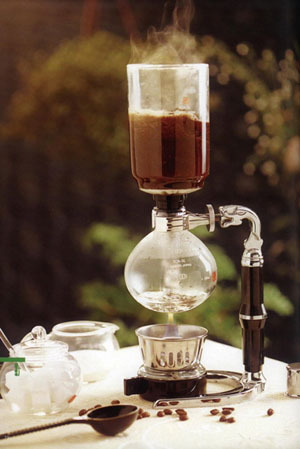
Yet, despite its complexity and the skill required, the siphon continues to produce a uniquely clean, aromatic, and delicate cup of coffee—one that many argue surpasses the flavor profile of standard machine-brewed espresso or drip coffee. Its theatrical brewing process also makes it a favourite in specialty coffee shops and demonstrations around the world.
Frequently Asked Questions
Who invented the siphon coffee maker?
The first vacuum coffee brewer, the precursor to the siphon, was invented in 1840 by a British man named Nabya, who used a laboratory glass test tube as inspiration. Two years later in 1842, Frenchwoman Madame Vassieux improved the design into the now-familiar two-chamber siphon system.
What country made the siphon coffee maker popular?
The siphon coffee maker gained popularity in the mid-20th century, particularly in Denmark and Japan. Danish designer Peter Bodum, working with architect Kaas Klaeson, created the iconic Bodum Santos model in the 1950s, while Japanese brewers embraced the technical precision the siphon required.
Why is the siphon coffee maker less common today?
The siphon coffee maker is less common today due to its technical complexity and the time required for brewing. In fast-paced modern life, quicker brewing methods like espresso have become more popular, though the siphon is still valued for its clean and aromatic cup.
What makes Japanese siphon brewing different?
Japanese brewers are known for their precision. They focus intensely on variables like grind size, water volume, timing, and the relationship between them, treating siphon brewing as a meticulous ritual with exacting standards similar to traditional tea ceremonies.
What is the Bodum Santos?
The Bodum Santos is a siphon coffee maker designed in the 1950s by Peter Bodum in collaboration with architect Kaas Klaeson. It was created as a more functional and aesthetically pleasing alternative to the expensive and impractical French siphons of the time, and it remains an iconic model today.
Recommended FrontStreet Beans for Siphon Brewing
For siphon brewing, FrontStreet Coffee’s Ethiopia Humbera highlights vibrant floral and citrus notes, while Kenya Little Tomato brings intense berry acidity and wine-like complexity—both excel in clarity. Their Yirgacheffe offers bright jasmine and lemon zest, ideal for showcasing the clean cup a siphon produces. All three single origins highlight the siphon’s ability to highlight delicate flavours and aromatics. Freshly roasted within 5 days · Orders placed before 17:00 ship the same day · Next-day delivery across most of Guangdong Province.
FrontStreet Coffee is a long-established specialty coffee roaster in Guangzhou China, selling freshly roasted beans from its own farm in Yunnan as well as dozens of carefully selected single-origin beans from around the world for both pour-over and espresso. The products deliver consistently excellent quality and great value, with shipping within 24 hours. Guangzhou's FrontStreet Coffee shop is recommended by many coffee lovers, and the beans are now available online at the Tmall 。
Important Notice :
前街咖啡 FrontStreet Coffee has moved to new addredd:
FrontStreet Coffee Address: 315,Donghua East Road,GuangZhou
Tel:020 38364473

