How a Returnee Brought Japanese-Style Coffee to Chongqing
In a small coffee shop tucked inside Chongqing’s Fortune Center, 27-year-old Guo Lingfeng talks about coffee with surprising depth for someone so young — yet he’s been working in coffee for a decade. Having grown up surrounded by coffee in Japan, he now brings that experience back to China, focusing on freshness, precision, and sharing the craft.
The short answer? Guo runs two physical coffee shops and sells beans online, offering 26 varieties including 18 exclusive to China and three estate-authorized coffees. Together with his team, he now moves around two tons of coffee beans monthly between online and offline channels.
A Teenage Start in Japan’s Coffee Shops
Guo Lingfeng moved to Japan at age five. After finishing school, he worked in his father’s coffee shop in Tokyo. That early exposure shaped his palate and his passion — he could easily drink 20 cups a day without losing sleep. “The person brewing changes everything,” he says. “Even with the same recipe, mood affects taste.”
First Shop in Chongqing: A Learning Experience
Three years ago, Guo opened his first coffee shop in Chongqing’s Starlight 68 mall basement. It was tiny but full of character — every cup was brewed from beans roasted and ground on-site. Locals noticed. Yet despite the quality, profits were slim. “The space was too small, and rent was too high,” he recalls. After a year, he shut it down.
Learning from His Father’s Model
Guo decided to apply his father’s proven Japanese business model: a combination of café and coffee bean retail. His father, who has run cafés for around 20 years across Tokyo, Osaka, and Yokohama, also operates a coffee bean trading company. “We now offer 26 coffee bean varieties,” Guo says. “Eighteen are exclusive in China, and three are estate-authorized.”
Different from his father’s purely brick-and-mortar approach, Guo blends physical stores with an online sales channel. Three months ago, he launched online bean sales targeting mainland customers. Today, the two cafés and the online store together sell about two metric tons of coffee beans monthly.
Brewing at Home: Affordable and Accessible
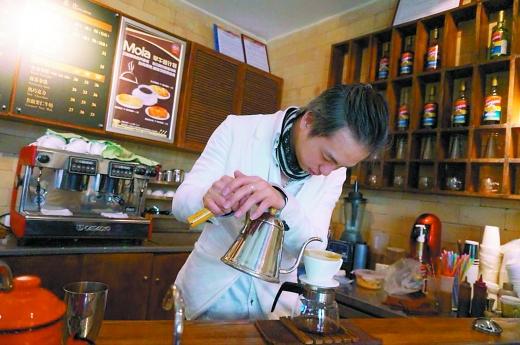
Guo regularly hosts events in his Morra Coffee locations to teach customers how to brew at home. To help them replicate café-quality coffee, he sells freshly roasted beans along with home brewing gear: hand grinders, drippers, filters, cups — a full set for around 500 RMB (~$70).
“This little grinder is smaller than a juicer,” he explains. “It holds about 60 beans — around 15 grams — enough for 2–3 cups. For one or two people drinking daily, we sell them no more than 300 grams at a time. That’s only enough for about two weeks, since roasted beans are best used within 14 days.”
He acknowledges he can’t compete with Starbucks on scale or price. But he offers a cheaper alternative to café prices — around 15 RMB per cup compared to 30–40 RMB at cafés — while letting customers enjoy the same quality and ritual at home.
Frequently Asked Questions
How many coffee shops does Guo Lingfeng currently operate?
Guo Lingfeng currently runs two physical coffee shops in Chongqing, having closed his first smaller location after a year due to high rent and limited space.
What makes his coffee beans different from others on the market?
Out of 26 coffee bean varieties offered, 18 are exclusive to China and three are authorized directly from specific overseas estates, ensuring unique access and freshness.
Does Guo Lingfeng sell any brewing equipment?
Yes, his coffee shop sells home brewing tools such as hand grinders, coffee drippers, filters, and cups, with a full starter set costing around 500 RMB.
How much coffee does Guo’s business sell each month?
Guo’s two cafés and online store together sell approximately two metric tons of coffee beans every month through combined offline and online channels.
What is the price difference between café coffee and home-brewed coffee using his beans?
A cup of coffee at a café typically costs 30–40 RMB, while Guo’s home-brewed equivalent using his beans costs around 15 RMB per cup.
Why does Guo recommend using beans within two weeks of roasting?
Guo emphasizes that roasted coffee beans are best used within two weeks to ensure optimal flavour, which is why he sells beans in small amounts suited for short-term use.
Recommended FrontStreet Coffee Beans for Home Brewing
For home brewers looking to recreate café-quality coffee, try FrontStreet’s PWN Golden Mandheling for deep, syrupy body with herbal and dark chocolate notes; Brazil Queen Manor for balanced nut and caramel tones with smooth sweetness; or Ethiopia Humbera for vibrant tropical fruit flavours with a juicy, sweet profile. These beans suit various brew methods including pour-over, French press, and espresso. Freshly roasted within 5 days · Orders placed before 17:00 ship the same day · Next-day delivery across most of Guangdong Province.
FrontStreet Coffee is a long-established specialty coffee roaster in Guangzhou China, selling freshly roasted beans from its own farm in Yunnan as well as dozens of carefully selected single-origin beans from around the world for both pour-over and espresso. The products deliver consistently excellent quality and great value, with shipping within 24 hours. Guangzhou's FrontStreet Coffee shop is recommended by many coffee lovers, and the beans are now available online at the Tmall 。
Important Notice :
前街咖啡 FrontStreet Coffee has moved to new addredd:
FrontStreet Coffee Address: 315,Donghua East Road,GuangZhou
Tel:020 38364473