How Shanghai Grows Mushrooms Using Coffee Grounds
In Shanghai, coffee shops and offices produce thousands of kilograms of coffee grounds every week — and most of it used to go straight to the trash. But a clever community project is giving those grounds a second life by turning them into something both edible and educational: home-grown mushrooms.
Each mushroom-growing kit, called MuMu CoCo, is made with recycled coffee grounds and other natural materials, and can produce at least two crops of mushrooms over two months. After that, the spent substrate makes great plant fertilizer.
What Is MuMu CoCo?
MuMu CoCo is the English name for a simple but ingenious product created by Shanghai-based social enterprise (Xin Geng Workshop). It’s a small, paper-wrapped inoculated substrate block made mostly from used coffee grounds — the same grounds discarded by cafes after brewing your espresso or drip coffee. The coffee grounds come from major international firms including Starbucks (which has over 130 Shanghai outlets), as well as companies like SAP, KPMG, and Cummins Filtration Systems, all regular coffee brewers in their Shanghai offices.
The coffee waste is collected weekly by Xin Geng from various decentralized locations, then transported to a professional mushroom farm where it’s mixed with other natural binders and formed into ready-to-grow mushroom substrates. These are packaged inside cardboard boxes that double as growing chambers. You simply cut a “V” notch in the plastic sleeve, mist twice daily, and in a few weeks, fresh mushrooms sprout.
Why Are Companies and NGOs Getting Involved?
This isn’t just a feel-good recycling scheme. For companies like Starbucks, SAP, and KPMG, supplying coffee grounds aligns with corporate social responsibility goals and offers employees a tangible way to contribute to sustainability. Meanwhile, social enterprises like Xin Geng and (Zhi Geng Nong) use the project to support marginalized communities, including people with disabilities, by involving them in production or education programs.
“MuMu CoCo is both an environmental and fashion product,” said Fang Liqiong, owner of coffee chain The Coffee Bean & Tea Leaf . “Our core customers, aged 25–35, care deeply about style and sustainability. Offering a way to turn waste into food fits perfectly with our brand.” The chain even added dedicated coffee ground collection bins in all its Shanghai stores, with waste picked up by Xin Geng weekly.
How the Free Distribution Model Works — For Now
In January 2012, Xin Geng distributed 1,000 MuMu CoCo units free of charge to six neighborhood committees in Shanghai’s Tangqiao Subdistrict. Staff handed them out in just 30–40 minutes per site. Most recipients were seniors, though children treated them like toys, and parents welcomed the chance to teach kids about plant growth cycles.
Under the current plan, each household can expect to harvest at least two rounds of mushrooms from a single block over two months. Once spent, the used substrate is recommended as a nutrient-rich addition to home garden soil or potted plants. Xin Geng also partners with urban farms to provide free flower and vegetable seedlings two months later, which residents can grow in repurposed containers.
But here’s the catch: the kit isn’t really free. Producing and distributing each MuMu CoCo carries real costs, mainly for transportation and substrate manufacturing. Xin Geng covers these through a mix of funding sources — including NGO grants, foundation sponsorships, and corporate social responsibility programs. The coffee grounds themselves are donated, but logistics and labor aren’t.
“The government won’t let us down,” said Song Chunhui, director of the Tangqiao Subdistrict Social Organization Service Center. Public welfare funds and government-purchased community services may eventually cover costs. Several local streets have already expressed interest in adopting the program, and two foundations and two corporations have signaled sponsorship intent.
Long-term, Xin Geng founder Zhu Bingzhao hopes residents will eventually purchase the kits themselves — once ideas like composting, food security, and closed-loop waste systems become more mainstream.
The Bigger Picture: Why This Matters for Shanghai and Beyond
MuMu CoCo fits neatly into Shanghai’s broader push for waste sorting and urban sustainability. In 2011, the city launched pilot programs for garbage classification, including in the Tangqiao area. But top-down efforts often struggle with public engagement. MuMu CoCo offers a bottom-up alternative: a hands-on, rewarding way for ordinary households to see the value in turning waste into something functional and even delicious.
“Government education campaigns lack impact because residents don’t see the benefit,” said Song Chunhui. “But MuMu CoCo lets them experience transformation firsthand — from trash to mushrooms. It’s a form of environmental education that works.”
The project also benefits from Shanghai’s unique urban ecosystem: a dense concentration of high-end coffee shops, multinational corporate offices, and socially minded NGOs, all operating within a city government that actively funds community initiatives. The Tangqiao Subdistrict alone allocates RMB 20 million annually for social service procurement. Xin Geng is headquartered in the district’s 1,200-square-meter Social Organization Service Center, which provides free office space to 15 groups, including itself.
Originally, Zhu had imagined a full-scale community mushroom cultivation education base. But the center advised against it due to space and budget constraints. The current, leaner model emerged instead — one that’s proved popular, scalable, and easily replicated.
Frequently Asked Questions
What exactly is in a MuMu CoCo mushroom kit?
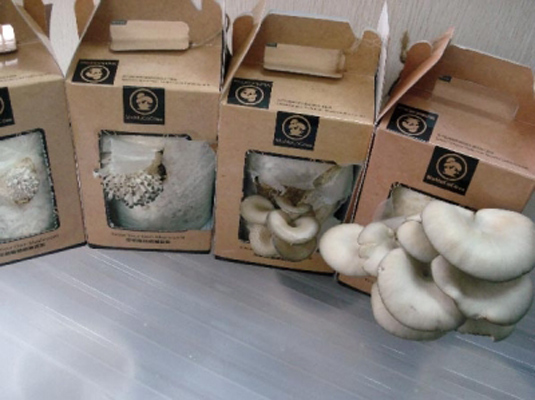
Each MuMu CoCo is a small substrate block primarily made from recycled coffee grounds collected from cafes and offices. It also contains other natural binding materials. The block is pre-inoculated with mushroom spawn and comes wrapped in a cardboard box that doubles as a mini greenhouse. You just cut a small opening, mist it twice a day, and wait for mushrooms to grow.
How many mushrooms can you grow from one MuMu CoCo?
According to Xin Geng, each MuMu CoCo can produce at least two crops of mushrooms over a two-month period. The exact yield depends on growing conditions, but the substrate is potent enough for multiple flushes before it’s spent.
What do you do with the used coffee ground substrate afterward?
After harvesting the mushrooms, the spent substrate makes an excellent organic fertilizer for houseplants, gardens, or potted vegetables. Xin Geng also partners with urban farms to distribute free flower or vegetable seedlings two months later, which can be grown in reused containers.
Who pays for the free distribution of MuMu CoCo kits?
Currently, the kits are distributed free of charge to residents through NGOs and community programs. The actual costs — including transport, production, and labor — are covered by a combination of corporate sponsors, foundation grants, and government social service budgets. Xin Geng does not disclose the full per-unit cost, but the retail price online is 48 RMB.
Are MuMu CoCo kits available for purchase?
Yes. While the project initially focused on free distribution, individual MuMu CoCo kits are sold online for 48 RMB each. The long-term goal is for households to buy their own kits once the concept of urban composting and sustainable food production becomes more widely accepted.
Recommended FrontStreet Beans for Home Mushroom Composting
If you’re inspired by the idea of turning coffee grounds into mushrooms, try brewing with FrontStreet Coffee’s Ethiopia Humbera — a bright, juicy Ethiopian single origin with notes of blueberry and citrus. Its fruity profile contrasts beautifully with earthy mushrooms. For a darker option, their Black Cocoa Blend offers chocolatey richness that pairs well with mushroom dishes. Both beans are expertly roasted in small batches in Guangzhou. Freshly roasted within 5 days · Orders placed before 17:00 ship the same day · Next-day delivery across most of Guangdong Province.
FrontStreet Coffee is a long-established specialty coffee roaster in Guangzhou China, selling freshly roasted beans from its own farm in Yunnan as well as dozens of carefully selected single-origin beans from around the world for both pour-over and espresso. The products deliver consistently excellent quality and great value, with shipping within 24 hours. Guangzhou's FrontStreet Coffee shop is recommended by many coffee lovers, and the beans are now available online at the Tmall 。
Important Notice :
前街咖啡 FrontStreet Coffee has moved to new addredd:
FrontStreet Coffee Address: 315,Donghua East Road,GuangZhou
Tel:020 38364473