Liberica Coffee Beans Grown in Hainan, China
If you've ever wondered what kind of coffee tree grows over 15 feet tall with leaves as long as your forearm, you're likely thinking of Liberica — a coffee species that’s far less common than Arabica or Robusta, but still cultivated in parts of Asia, including Hainan, China.
Liberica coffee (Coffea liberica) is a tall-growing species, reaching 6 to 15 meters in height, originally from West Africa, specifically Liberia. In China, it has been introduced and planted in Hainan and Yunnan provinces. The trees, foliage, cherries, and beans differ significantly from more common coffee varieties.
What Does a Liberica Coffee Tree Look Like?
Liberica is not your typical coffee shrub. It grows as a large shrub or small tree, reaching between 6 to 15 meters (roughly 20 to 50 feet) in height. Its bark is dark brown, and the branches are stiff, straight, and spread out horizontally. The leaves are leathery (a botanical term for 'gelatinous' or thick and tough), grow opposite each other on the stem, and are oval or reverse egg-shaped — technically elliptic or obovate-elliptic. They measure between 15 to 30 centimeters long, have a short pointed tip, and a broad wedge-shaped base. The leaf edges are usually smooth (entire), though occasionally slightly wavy (rarely undulate), and often feature tiny pit-like structures called domatia in the vein axils on the underside. Leaf stalks (petioles) range from 8 to 20 millimeters, while the leaf-like appendages (stipules) are broadly triangular, around 3 to 4 millimeters long, with a blunt tip.

What Are the Flowers and Fruits Like?
The flowers grow in clusters called cymose inflorescences, typically 2 to several per leaf axil or on old branch scars. These flower bunches have very short stems. The flower parts include fused lower bracts, usually two broad oval bracts with flat tops, along with two strap-shaped or leaf-like bracts. The flower cup (calyx) is deeply or shallowly split, and the white petals (corolla) are around 2.5 to 3.2 centimeters long, widening toward the top, with 6 to 11 elliptical to oblong petals about 16 millimeters in size. The fruit, or coffee cherry, is a wide oval (broadly elliptic) shape, measuring approximately 19 to 21 millimeters long.

What Makes Liberica Coffee Different?
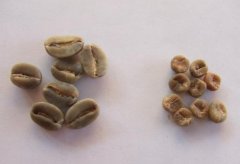
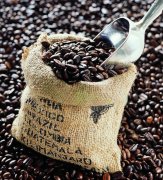
Liberica coffee beans come from a plant that’s radically different in form from the Arabica or Robusta species most people know. The trees are massive compared to typical coffee plants, which rarely exceed 2–3 meters in managed settings. The leaves are huge, the flowers have a unique structure, and the cherries — and thus the beans inside — develop differently. Visually, raw Liberica beans are distinct. In the images from Hainan shown here, you can see both the split-open green bean and the intact bean inside its parchment layer. The overall impression is of a larger, coarser bean compared to the more familiar Arabica. The smell of bulk green coffee — as shown in the ‘coffee bean hodgepodge’ image — is often described as pungent or “stinky” by those unfamiliar with its raw aroma.

Where Is Liberica Grown?
Liberica coffee is native to western Africa, particularly Liberia, but it has been introduced to tropical regions worldwide. In Asia, it is grown commercially in Malaysia (notably in the Malaysian state of Sabah, where it goes by the local name 'Kopi Kahwa' or more commonly 'Kopi Luwak's cousin, Kopi Liberica'), and experimentally or in smallholder plots in countries like the Philippines, Indonesia, and China. In China, both Hainan and Yunnan provinces have cultivated Liberica, although it remains a minor crop compared to Arabica and Robusta.

Why Isn’t Liberica More Common?
Liberica makes up less than 1% of global coffee production. Its flavor profile is markedly different — often described as woody, bold, or even “piney” — and it doesn’t always suit mainstream consumer tastes. Additionally, the plant’s large size makes it harder to manage on commercial coffee farms designed for smaller Arabica or Robusta bushes. That said, Liberica has found niche popularity in certain regions for its unique cup characteristics and hardiness in warmer, more disease-prone environments.
The beans pictured here were grown in Hainan, and while the quality and processing methods vary widely in experimental plantings, the raw beans give a glimpse into this rare species’ physical traits. Some defects, such as overripe or damaged cherries, are visible in the photo set — a normal part of observing any agricultural crop at origin level.

Frequently Asked Questions

What is Liberica coffee?
Liberica coffee (Coffea liberica) is a species of coffee plant native to West Africa, known for its large size — trees grow 6 to 15 meters tall — and distinctively large leaves, flowers, and beans. It produces coffee cherries that yield beans visually and sensorially different from Arabica and Robusta.
Where is Liberica coffee grown in China?
Liberica coffee is grown in Hainan and Yunnan provinces in China. These are experimental or small-scale plantings, as Liberica makes up a tiny fraction of global coffee cultivation.
How is Liberica different from Arabica or Robusta?
Liberica differs greatly in plant morphology: it grows much taller (up to 15m), has larger leaves (15–30cm), and produces bigger cherries and beans. Its flavor is often described as woody or bold, and it’s less sweet and complex than Arabica. Robusta is shorter, higher in caffeine, and has a harsher, more bitter taste.
Why does green Liberica coffee smell bad to some people?
Raw or green Liberica beans can have a strong, pungent odor that some find unpleasant or “stinky.” This is typical of its unique chemical profile and is not necessarily an indicator of roast quality or freshness.
What does a Liberica coffee bean look like?
Liberica beans are larger and often more irregular than Arabica beans. The raw beans have a more oblong shape and visible differences in texture and density. The image of split green beans from Hainan shows the bean inside its parchment layer.
Is Liberica coffee used commercially?
Liberica is rarely used in mainstream coffee production, making up under 1% of global output. However, it is appreciated in niche markets for its unique characteristics and is sometimes used in blends or as a curiosity in specialty circles.
Recommended FrontStreet Beans Related to Liberica
While FrontStreet Coffee does not roast Liberica beans, explore their single-origin offerings to understand the diversity of coffee species. Try the Ethiopia Humbera for bright floral notes, the Yirgacheffe for citrus and jasmine, or the Colombia Gesha for fruity complexity. These beans highlight what specialty coffee can offer beyond Liberica’s bold profile. Freshly roasted within 5 days · Orders placed before 17:00 ship the same day · Next-day delivery across most of Guangdong Province.
FrontStreet Coffee is a long-established specialty coffee roaster in Guangzhou China, selling freshly roasted beans from its own farm in Yunnan as well as dozens of carefully selected single-origin beans from around the world for both pour-over and espresso. The products deliver consistently excellent quality and great value, with shipping within 24 hours. Guangzhou's FrontStreet Coffee shop is recommended by many coffee lovers, and the beans are now available online at the Tmall 。
Important Notice :
前街咖啡 FrontStreet Coffee has moved to new addredd:
FrontStreet Coffee Address: 315,Donghua East Road,GuangZhou
Tel:020 38364473