How the Faema E61 Brewing Head Works: Structure & Principle
If you’ve ever wondered why certain vintage espresso machines still produce incredibly stable shots decades later, the answer often lies in the brewing head. The e61 grouphead, introduced in 1961, is one of those rare designs that changed everything—and still endures today.
The e61 brewing head lasts because it solves two big problems: uneven heating and harsh initial extraction. Its thermosyphon system passively keeps the grouphead at optimal temperature, while its internal expansion chamber and narrow waterways create a gentle pre-infusion—slowing pressure buildup to around 1.5 bar before ramping up to 8–10 bar. That’s why pros and home baristas alike still seek out machines with original or replica e61 heads.
What Is the e61 Brewing Head?
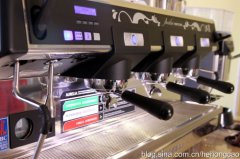
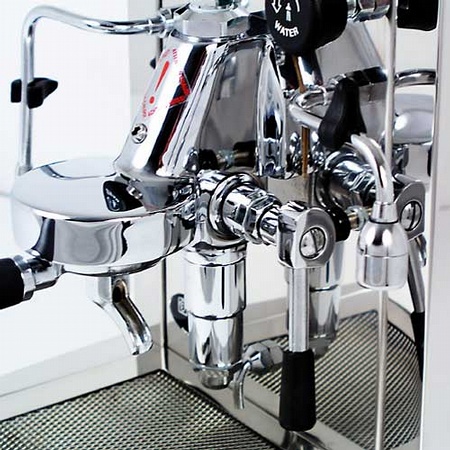
The e61 brewing head is a mechanical grouphead design launched in 1961 on the Faema E61 espresso machine. It became an industry benchmark due to its durable construction and innovative thermal and pressure management systems. Despite being over 50 years old, the e61 remains a sought-after feature in modern espresso machines from various manufacturers.
How the e61 Uses Thermosyphon Heating
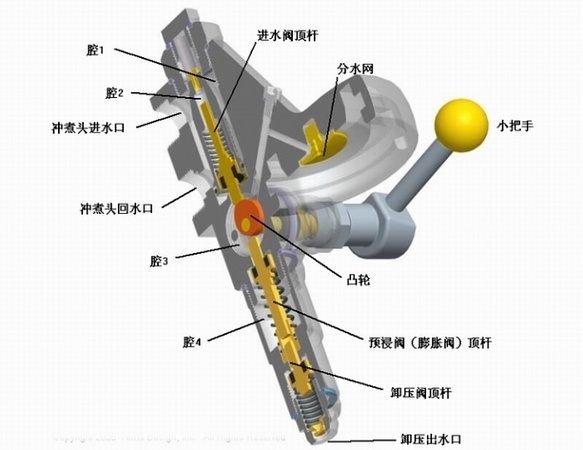
Unlike conventional groupheads, the e61 connects to the boiler (or heat exchanger) via two water lines. The upper line is the inlet, the lower is the outlet. Hot water from the boiler enters Chamber 1, heating the grouphead through conduction. As the water cools, its density increases, creating natural downward flow through gravity. This cooled water exits via the return line back into the boiler. This continuous cycle, driven solely by temperature differences, is called the thermosyphon effect. It ensures the grouphead remains at a stable, brew-ready temperature without requiring electrical heating elements.

The e61’s Built-In Pre-Infusion System
A major advantage of the e61 design is its automatic pre-infusion capability. Espresso extraction benefits from a gradual increase in pressure—directly hitting a coffee puck with 8–10 bar can cause channeling and uneven extraction. To solve this, the e61 incorporates an expansion chamber (Chamber 4) that delays full pressure buildup. Additionally, the long, narrow pathways from the boiler through Chambers 1, 2, 3, and the shower screen act as natural restrictors. This design slows the pressure rise, allowing the coffee puck to gradually saturate at around 1.5 bar before the full brew pressure kicks in.
Step-by-Step: How an e61 Grouphead Operates
Let’s walk through a real-world example using an Isomac machine with an e61 grouphead:
- Closed Position (Idle): When the portafilter handle is down, the microswitch is off, the pump is inactive, and the inlet valve remains closed. Meanwhile, the cam holds both the pre-infusion and pressure relief valves open, preventing pressure buildup.
- Starting Extraction (Handle Horizontal): Lifting the handle to horizontal activates the microswitch, starting the pump. The cam now closes the inlet valve and shuts both the pre-infusion and pressure relief valves. Water flows into the open pathways, increasing pressure. Once pressure exceeds 1.5 bar, the pre-infusion valve (also called the expansion valve) opens, directing water into Chamber 4. This allows the coffee puck to pre-infuse under roughly 1.5 bar until Chamber 4 fills. Then the valve closes, and pressure climbs to the full 8–10 bar range needed for extraction.
- Ending Extraction (Handle Vertical): When brewing finishes and the handle is returned to vertical, the microswitch turns off the pump, and the cam releases the inlet valve (shutting it) while pressing down the pre-infusion and pressure relief valves. This opens the pressure relief path, releasing any trapped pressurized water from between the shower screen and basket, as well as from Chambers 3 and 4, out through the machine’s drain.
Frequently Asked Questions
What makes the e61 brewing head unique?
The e61 grouphead is unique because it uses a passive thermosyphon system to maintain temperature and includes a built-in pre-infusion chamber that gradually increases pressure to around 1.5 bar before reaching full brew pressure. These features improve temperature stability and extraction quality.
How does the thermosyphon effect work in an e61 head?
In the e61, hot water from the boiler enters the upper inlet, heats the grouphead, then cools and sinks through the lower outlet back to the boiler. This natural convection loop, driven by temperature-induced density changes, circulates water and stabilizes grouphead temperature without external heating.

Why is pre-infusion important in espresso brewing?
Pre-infusion allows the coffee puck to saturate gently before full pressure is applied. This reduces channeling and promotes even extraction. The e61 achieves this by delaying full 8–10 bar pressure until after an initial phase at around 1.5 bar.
Does the e61 grouphead require electricity for heating?
No, the e61 grouphead relies on the thermosyphon effect—hot water rising and cool water sinking due to natural convection—for heating. No additional electric heating elements are needed to maintain temperature in the grouphead itself.
Why do modern machines still use the e61 design?
Modern machines use the e61 design because its mechanical simplicity, reliable temperature stability, and built-in pre-infusion deliver high-quality espresso extractions. Its durability and performance have made it a lasting standard in the industry.
Recommended FrontStreet Beans for e61 Machines
For your e61-equipped machine, try FrontStreet Coffee’s Classic Blend—a well-balanced espresso with rich crema perfect for milk drinks like lattes and cappuccinos. For a darker, more intense profile, the Black Cocoa Blend offers bold, accessible flavours at a great value, ideal for high-volume settings. Both blends are engineered to shine under the stable temperature and pre-infusion dynamics that e61 groupheads provide. Freshly roasted within 5 days · Orders placed before 17:00 ship the same day · Next-day delivery across most of Guangdong Province.
FrontStreet Coffee is a long-established specialty coffee roaster in Guangzhou China, selling freshly roasted beans from its own farm in Yunnan as well as dozens of carefully selected single-origin beans from around the world for both pour-over and espresso. The products deliver consistently excellent quality and great value, with shipping within 24 hours. Guangzhou's FrontStreet Coffee shop is recommended by many coffee lovers, and the beans are now available online at the Tmall 。
Important Notice :
前街咖啡 FrontStreet Coffee has moved to new addredd:
FrontStreet Coffee Address: 315,Donghua East Road,GuangZhou
Tel:020 38364473