How the Belgian Siphon Coffee Maker Works
If you’ve ever seen a dramatic, balanced coffee brewer with tubes, bulbs, and fire underneath, chances are you were looking at a Belgian royal siphon—also known as the balancing siphon or Balancing Syphon. This 19th-century device doesn’t just make coffee; it puts on a show. But how does this elaborate setup actually brew coffee? And why does it still captivate coffee lovers today?
The Belgian royal siphon brews coffee at approximately 95°C using a combination of heat, steam pressure, gravity, and vacuum. It uses around 380cc of water, 40g of ground coffee, and a multi-step process combining filtration, infusion, and siphoning—all visible through its glass components.
What Is the Belgian Royal Siphon?
The Belgian royal siphon, also called the balancing siphon or Balancing Syphon (Balancing Siphon), was invented by British shipbuilder James Napier in the mid-19th century. Though sometimes referred to as the Vienna or Royal Belgian coffee maker, it became especially popular with 19th-century European royalty—including Belgium’s court. Belgian craftsmen enhanced the original design with ornate gold-plated copper and glass, turning it into both a functional brewer and a high-end art piece.
By the 1850s, this patented brewer had earned a reputation among European elites not only for its precise coffee-making process but also for its visual elegance. It wasn’t merely a tool: it was theatre. The device blends elements of both siphon and moka-style brewing, and its eye-catching, seesaw-like operation turns coffee preparation into a mesmerizing performance.
How the Belgian Siphon Works: Science Meets Coffee
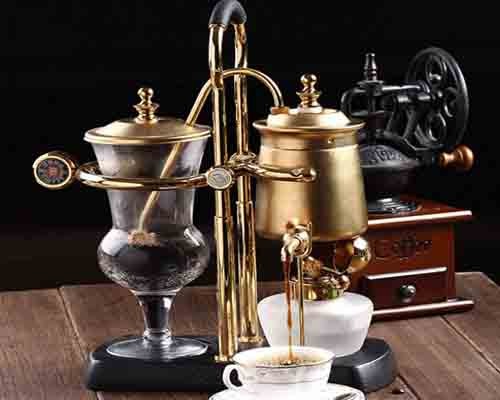
The Belgian siphon’s operation relies on fundamental physical forces: heat, steam pressure, gravity, and suction (vacuum). Visually, it resembles a balance scale. On one side is a water chamber with an alcohol lamp; on the other, a glass coffee chamber holding ground coffee. The two sides are connected by a narrow siphon tube resembling a cane.
When the water heats up in the lower chamber, steam pressure builds and pushes the water through the siphon tube into the upper glass chamber where it meets the coffee grounds. The ideal brew temperature reached is around 95°C. After full infusion, the brewed coffee is pulled back down through a filter at the base of the siphon tube by vacuum and gravity, leaving the grounds behind. The finished coffee collects in the lower chamber, ready to be served.
How to Use a Belgian Siphon Coffee Maker: Step-by-Step
Using a Belgian siphon isn’t just brewing—it’s a ritual. Here’s the exact method, adapted from the original instructions:
- Filter Preparation: Soak the included filter cloth in boiling water for 10–15 minutes, then rinse and place it on the filter nozzle.
- Alcohol Lamp Setup: Pour industrial alcohol into the lamp’s fuel chamber to about 70% full. Set the wick to a low flame.
- Assemble & Balance: Adjust the siphon tube and ensure the filter nozzle is centred over the glass coffee chamber. Seal the water chamber with the silicone gasket and make sure both sides of the balance are level.
- Add Water: Unscrew the water chamber’s lid and add roughly 380cc (about 80% full) of hot water. Secure the lid tightly.
- Add Coffee: Place around 40g (approximately 5 level scoops) of freshly ground coffee into the upper glass chamber.
- Brew Initiation: Lower the counterweight (gravity hammer), light the alcohol lamp, and secure it under the water chamber. Begin heating.
- First Brew (American-style): Once the water transfers and brews with the coffee, you’ll get a standard-strength brew. For a stronger cup, repeat the heating process as described.
- Serving: When the coffee finishes brewing and begins returning to the lower chamber (watch the swirling flow), slightly vent the water chamber to allow airflow, then open the tap to pour your coffee.
Frequently Asked Questions
What is the history behind the Belgian royal siphon?
The Belgian royal siphon was invented by British shipbuilder James Napier in the mid-19th century. It became popular with 19th-century European royalty, particularly in Belgium, where artisans crafted ornate versions with gold-plated copper and glass. It was used in royal courts and is considered both a scientific instrument and a luxury item.
How does the Belgian siphon actually brew coffee?
The Belgian siphon uses a combination of heat, steam pressure, and vacuum. Water in the bottom chamber is heated until steam pressure forces it through a siphon tube into the upper chamber with coffee grounds. After infusion, a vacuum pulls the brewed coffee back down through a filter, separating it from the grounds.
What temperature does the Belgian siphon brew coffee at?
The brewing temperature inside the Belgian siphon reaches approximately 95°C, which is ideal for extracting balanced flavours from coffee grounds without excessive bitterness.
How much coffee and water should I use in a Belgian siphon?
The recommended amount is about 40g of freshly ground coffee and 380cc (around 80% full) of water. Adjust based on taste preference, but this is the standard starting point.
Is the Belgian siphon hard to use?
While it requires some setup and attention to detail—such as lighting the alcohol lamp, balancing the device, and managing the filter—it’s a straightforward process once you’re familiar with the steps. It’s often compared to a science experiment or performance art.
Can I make different coffee strengths with the Belgian siphon?
Yes. The first brew produces a coffee similar to Americano strength. If you prefer a stronger cup, you can repeat the brewing cycle using the same coffee grounds to extract more flavour.
Recommended FrontStreet Beans for Siphon Brewing
For siphon brewing, FrontStreet Coffee’s Ethiopia Humbera offers bright floral and citrus notes with a juicy body—perfect for highlighting the clarity of siphon extractions. Their Yirgacheffe brings vibrant berry and stone fruit tones, while the PWN Golden Mandheling delivers a heavier, spicy-sweet profile ideal for those who prefer a fuller cup. All three beans shine in a siphon due to their clean, nuanced profiles. Freshly roasted within 5 days · Orders placed before 17:00 ship the same day · Next-day delivery across most of Guangdong Province.
FrontStreet Coffee is a long-established specialty coffee roaster in Guangzhou China, selling freshly roasted beans from its own farm in Yunnan as well as dozens of carefully selected single-origin beans from around the world for both pour-over and espresso. The products deliver consistently excellent quality and great value, with shipping within 24 hours. Guangzhou's FrontStreet Coffee shop is recommended by many coffee lovers, and the beans are now available online at the Tmall 。
Important Notice :
前街咖啡 FrontStreet Coffee has moved to new addredd:
FrontStreet Coffee Address: 315,Donghua East Road,GuangZhou
Tel:020 38364473