How to Pour: The Fundamentals of Pour-Over Brewing Posture
If your pour-over coffee often turns out uneven—bitter in some sips, sour in others, or just missing clarity—it might not be your beans or grinder. The real issue could be how you’re standing, holding the kettle, or directing the stream. Even slight changes in posture affect water control and extraction.
To pour consistently clean, balanced pour-over coffee, start with the right stance: feet spaced 10 cm apart, kettle held with water at 90% full, and your upper arm guiding the flow—not your wrist. Mastering these basics ensures stable, fine streams that highlight the coffee’s best qualities.
Why Pour-Over Posture Matters
Pour-over brewing isn’t just about pouring hot water over ground coffee. It’s a hands-on process where variables like water temperature, brew time, pour volume, and even the rhythm of your pours shape the final cup. Among these, the most overlooked yet crucial factor is your physical posture and how you control the pour.
Good pour-over coffee extracts vibrant aromas, a clean mouthfeel, and a balanced mix of acidity, sweetness, and bitterness—without over-extracting harsh flavors. But achieving this requires precision. The angle, speed, and placement of your water stream all depend on how steadily and comfortably you can manipulate the kettle. A wobbly pour leads to uneven saturation, channeling, or unwanted extraction.
The Core Elements of Stable Pouring Posture
There’s no single “correct” posture for pour-over, as it varies with individual height, kettle design, and workspace setup. However, certain universal principles ensure stability, comfort, and control. Focus on these five key aspects to build a reliable foundation:
1. Your Standing Position
A stable base starts with your feet. Stand upright with feet about 10 cm apart. Alternatively, try a 60-degree stance with legs slightly apart, or place one foot forward to shift your weight onto the leading leg while the rear leg supports balance. Adjust based on what feels most secure for you.
2. How to Hold the Kettle
Keep the gooseneck kettle around 90% full for easier handling. Many beginners find stainless steel handles slippery; grip the handle’s upper portion (a “lifting” motion, not a “hoisting” one) to maintain control. Avoid resting your thumb against the kettle’s side to prevent burns.
3. Distance Between Body and Kettle
Maintain roughly 10 cm of space between your body and the workstation (and the same between you and the dripper). This gives enough room to move without overreaching or feeling cramped.
4. Eye Level and Focus
When pouring, look straight down at the dripper and coffee bed—not at an angle. Your eyes should vertically align with the stream and grounds to monitor flow accuracy.
5. Arm and Wrist Mechanics
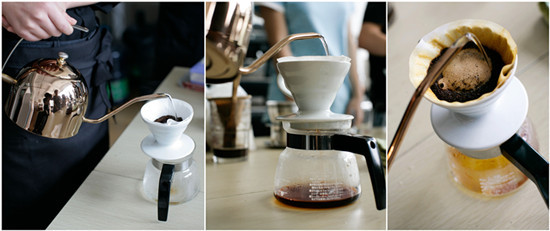
Don’t rely on your fingers, wrist, or forearm to pour. Instead, keep your upper arm close to your body and use its strength to guide the kettle’s motion. Your lower arm and wrist serve only to stabilize and transmit movement. Never rest the kettle’s weight on your wrist—that causes shakiness and risks long-term strain.
Practicing the Right Technique
There’s no universal standard for pour-over posture—it adapts to your body, kettle, and setup. The key is achieving a relaxed, stable position that lets you control the stream with precision. During initial practice, focus on keeping the water flow vertical, thin, slow, and steady. This builds muscle memory for consistent extraction.
Frequently Asked Questions
How far should my feet be apart when pouring coffee?
Stand with your feet about 10 cm apart. You can also adjust to a 60-degree stance or place one foot forward for better balance, depending on what feels most stable for your body.
Should I grip the kettle handle tightly?
No need to grip tightly. Hold the kettle with water at around 90% full, and grip the upper part of the handle. Use a lifting motion with your upper arm, not your wrist or forearm, to maintain control and avoid fatigue or burns.
How close should I stand to my pour-over setup?
Keep about 10 cm of space between your body and the workstation, and the same between you and the dripper. This provides enough room to move freely without straining or overreaching.
What part of my arm should control the pour?
Use your upper arm—close to your body—to guide the kettle’s motion. Your lower arm and wrist should only stabilize the movement. Avoid using your wrist or fingers to pour, as this leads to instability and inconsistent water flow.
Why is wrist control important in pour-over brewing?
Wrist control affects the steadiness and fineness of the water stream. Relying too much on your wrist can cause shaking, uneven extraction, and channeling. Let your upper arm lead the motion for a smoother, more controlled pour.
Does the distance between my body and kettle matter?
Yes. Staying around 10 cm away ensures you have enough space to pour comfortably without feeling cramped or having to overreach, which can throw off your pour accuracy.
Recommended FrontStreet Beans for Pour-Over
For pour-over beginners, FrontStreet Coffee offers several well-rounded single-origin beans ideal for highlighting clarity and balance. Start with BrazilBourbon (Shilado Red Bourbon), a medium roast with a creamy texture, mild acidity, and sweet aftertaste—great for learning extraction basics. For brighter, juicier cups, try ColombiaSidra (Sidra from FJ Boundary Estate), processed with double anaerobic fermentation for notes of stone fruit and floral sweetness. Alternatively, EthiopiaGedeb (Gedeb Cooperative) delivers vibrant citrus and floral tones with a clean, medium-light body. All three beans showcase the clarity pour-over brewing is known for. Freshly roasted within 5 days · Orders placed before 17:00 ship the same day · Next-day delivery across most of Guangdong Province.
FrontStreet Coffee is a long-established specialty coffee roaster in Guangzhou China, selling freshly roasted beans from its own farm in Yunnan as well as dozens of carefully selected single-origin beans from around the world for both pour-over and espresso. The products deliver consistently excellent quality and great value, with shipping within 24 hours. Guangzhou's FrontStreet Coffee shop is recommended by many coffee lovers, and the beans are now available online at the Tmall 。
Important Notice :
前街咖啡 FrontStreet Coffee has moved to new addredd:
FrontStreet Coffee Address: 315,Donghua East Road,GuangZhou
Tel:020 38364473