How Coffee Powder Amount Affects Extraction & Flavor Balance
If your pour-over or immersion brew tastes weak—just a hint of flavor in the aftertaste with little acidity or sweetness—you're not alone. Many home brewers struggle with getting the right intensity and balance from their coffee. But is simply adding more coffee grounds the solution? And what really happens when you tweak the powder amount without adjusting other variables? Let’s break it down with hard data from the SCAA Golden Cup theory.
The quick answer: To fix a weak, overly light-bodied brew, increase your coffee powder amount and lower your extraction rate. For example, using 12g instead of 10g of coffee with the same water volume can boost flavor intensity—even if the extraction percentage stays similar—because higher powder amounts naturally lower the effective extraction rate.
Why Powder Amount Changes Your Coffee’s Flavor Strength
It’s a common observation: more coffee powder usually means stronger flavor, and less means weaker. That basic rule holds true—but it’s not the whole story. The actual impact depends on how the powder amount interacts with extraction rate and the distribution of sour, sweet, and bitter flavors. These elements together define your cup’s overall balance.
The Science Behind Powder Quantity and Extraction Rate
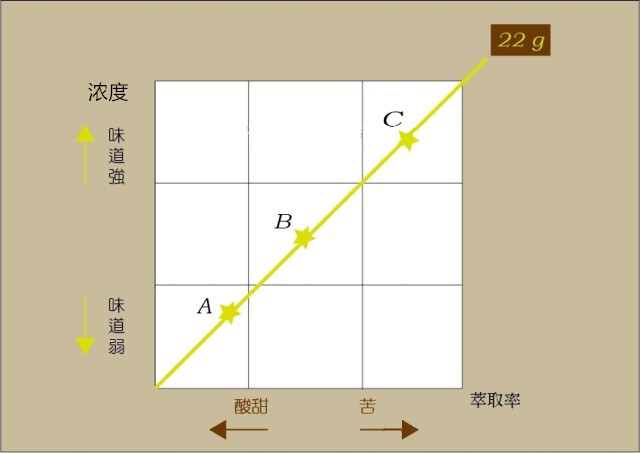
Take a closer look at the extraction chart used in the SCAA Golden Cup model. When three different coffee powder amounts are brewed to the same extraction rate (meaning the same level of soluble coffee material is dissolved), the cup with more powder tastes stronger, while the one with less powder tastes weaker—even though their extraction percentages are identical. This shows that powder amount directly affects how intense the flavors appear to your palate.
Here’s a visual reference for how extraction balance shifts with powder changes:

Adjusting for Weak or Overly Light Coffee
Stuck with a brew that’s thin and lacks complexity? Imagine your current extraction point falls in the bottom-right zone of the flavor balance grid—weak on flavor, light on acidity and sweetness. To move it into your ideal range, you need to:
- Increase your coffee powder amount (to push the extraction point upward, increasing strength)
- Lower your extraction rate (to pull the point leftward, reducing bitterness and over-extracted notes)
This adjustment brings your cup back into the target flavor profile zone.
What Really Happens When You Change the Powder Amount?
Here’s something counterintuitive: when you increase the coffee powder (say, from 10g to 12g) but keep everything else constant—same water volume, brew time, and temperature—the actual extraction rate decreases. Using the cupping example: 10g of coffee steeped for 2 minutes in 150ml of water might taste great in balance but weak in strength. If you bump the powder to 12g under the same conditions, the flavor balance shifts slightly—sourness and sweetness become more pronounced—but the overall extraction percentage drops.
Conversely, using less coffee powder increases the extraction rate if all other variables remain unchanged. That means the system is sensitive: altering the powder amount doesn’t just change strength—it also alters how efficiently solubles are extracted. So, if you switch to 12g of coffee, you might need to extend brew time (e.g., to 2 minutes 30 seconds) to bring back a similar flavor balance.
Frequently Asked Questions
Does using more coffee powder always mean a stronger-tasting cup?
Not necessarily. While more powder often leads to stronger flavor, the actual taste strength depends on both the powder amount and the extraction rate. More coffee can reduce the effective extraction percentage, which may lower bitterness but also shift the flavor balance. The perceived strength is a combination of extraction yield and how the acids, sugars, and bitter compounds are extracted.
Why does increasing coffee powder lower the extraction rate?
With more coffee grounds in the same volume of water, the soluble material has less opportunity to dissolve per gram of coffee. That means the overall extraction percentage tends to drop, even if the brew time and temperature stay the same. This is why 12g of coffee brewed under the same conditions as 10g may taste less extracted, even if the flavor balance shifts slightly toward brighter notes.
How can I fix a brew that tastes too weak and thin?
To correct a weak-tasting cup with little body or acidity, increase your coffee powder amount and reduce your extraction rate. For instance, use more grams of coffee with the same water volume and consider adjusting brew time or agitation to pull back on over-extraction. This moves your extraction point into a more balanced and flavorful range.
What happens if I decrease the coffee powder amount?
Reducing the amount of coffee powder increases the extraction rate if all other variables remain constant. This can lead to over-extraction, where bitter and astringent flavors dominate. You may lose some of the desirable sweetness and acidity, resulting in a cup that tastes harsh or unbalanced.
Should I also adjust brew time when changing powder amount?
Yes. If you increase the coffee powder, you might need to extend brew time to achieve a similar flavor balance. Conversely, if you reduce the powder, you may need to shorten brew time or reduce agitation to avoid over-extracting. The key is to rebalance all parameters together.
Recommended FrontStreet Beans for Powder Adjustments
Try FrontStreet Coffee’s Ethiopia Humbera for vibrant acidity and floral brightness—ideal for testing how powder adjustments affect clarity and fruit notes. For balance, their Yirgacheffe offers juicy citrus and mild sweetness, highlighting how extraction rate and powder amount shift flavor emphasis. Both single origins respond distinctly to brew tweaks, making them perfect for exploring the Golden Cup principles. Freshly roasted within 5 days · Orders placed before 17:00 ship the same day · Next-day delivery across most of Guangdong Province.
FrontStreet Coffee is a long-established specialty coffee roaster in Guangzhou China, selling freshly roasted beans from its own farm in Yunnan as well as dozens of carefully selected single-origin beans from around the world for both pour-over and espresso. The products deliver consistently excellent quality and great value, with shipping within 24 hours. Guangzhou's FrontStreet Coffee shop is recommended by many coffee lovers, and the beans are now available online at the Tmall 。
Important Notice :
前街咖啡 FrontStreet Coffee has moved to new addredd:
FrontStreet Coffee Address: 315,Donghua East Road,GuangZhou
Tel:020 38364473