How to Judge Milk Foam Quality for Latte Art
If you’ve just started practicing latte art, you’ve probably asked yourself: how do I know if my milk foam is any good? It’s a common struggle. Terms like “smooth,” “silky,” or “like velvet” are thrown around, but they’re vague and subjective. So how can you really tell if your steamed milk is up to par for pouring clean, consistent designs?
The short answer: good milk foam should be fine enough to reflect light, free of bubbles over 1mm, steamed to 60–65°C, and made with zero milk waste. Master these four measurable standards, and you’ll have professional-grade foam every time.
What Makes Good Milk Foam?
When baristas talk about “good” milk foam, they’re referring to microfoam — tiny, uniform air bubbles integrated smoothly into the milk. This isn’t the same as stiff foam used for cappuccinos alone; it’s the velvety base essential for latte art. But without clear criteria, many beginners rely on unclear descriptions. Let’s replace the guesswork with objective standards.
1. Fine, Glossy Texture
The first benchmark is simple but revealing: your milk foam should have a surface that reflects light. This visual cue confirms the foam is fine enough — a sign that the steam wand incorporated air smoothly and uniformly into the milk. Think “mirror-like,” not “frothy.” If the surface is dull or mottled, the foam likely has uneven bubble sizes or is too coarse.
This standard is your first, most immediate check. You don’t need to taste or measure yet — just look for that glossy, reflective finish. It’s the visual proof your microfoam has the right texture for clean latte art pour.
2. No Large Bubbles
The second standard is equally visual but more technical: the foam’s surface must be entirely free of bubbles larger than 1mm in diameter. These “coarse” bubbles are easy to spot — they create a pockmarked or uneven surface, and they disrupt the smooth flow needed for latte art.
Controlling for these large bubbles demands precision in your steaming technique. If your foam has any obvious bobbles or rough patches, it doesn’t meet this benchmark — no matter how glossy it appears overall.
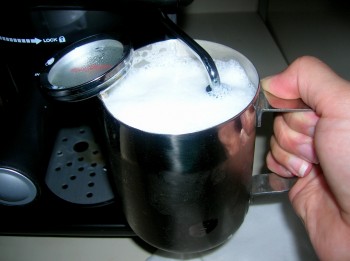
3. Temperature: 60–65°C
The third standard is all about precision: the ideal milk temperature for steaming is 60–65°C. This range ensures the milk’s proteins stabilize the foam without scalding, which would degrade both texture and taste. Importantly, this temperature must remain consistent regardless of how much milk you steam — whether you’re filling a cup six-tenths full or going all the way to the rim.
Temperature control isn’t just about the milk’s drinkability; it’s about ensuring the foam’s structure holds up during pouring. Too hot or too cold, and the foam won’t behave properly for latte art.
4. Zero Milk Waste
The fourth and final standard is a test of efficiency: when steaming milk for two standard cappuccinos (using WBC-sized cups), your pitcher should be completely empty after pouring. That means you’ve steamed only the amount of milk (and foam) you actually needed. For most baristas, this is the hardest benchmark to hit consistently.
The principle extends further: ideally, you should steam only as much foam as your drink requires. (Macchiatos and similar low-foam drinks are the exception.) Mastering this minimizes waste and sharpens your control over portioning.
Why Sound Matters Too
There’s one more factor that doesn’t fit neatly into a visual or temperature-based standard: sound. Freshly steamed milk foam should produce no continuous, loud popping or hissing noises. A quiet, steady steam indicates smooth air integration and a stable foam structure — key for maintaining the foam’s integrity in the cup and during pouring.
Frequently Asked Questions
What does “fine texture” in milk foam really mean?
Fine texture means the foam is smooth enough to reflect light, indicating uniform, tiny air bubbles. It’s the opposite of coarse or bubbly foam, which looks dull and feels rough. A glossy surface is the easiest visual clue that your foam meets this standard.
How big is a “large bubble” in milk foam?
A large bubble is defined as any bubble with a diameter greater than 1mm. These bubbles create visible roughness or pocks on the foam’s surface and are considered defects in professional-quality microfoam.
Why is the 60–65°C temperature range important?
This range is optimal for stabilizing milk proteins to support foam structure without scalding the milk. Going too high or too low can ruin both the texture and the pourability of the foam for latte art.
How can I avoid wasting milk when steaming?
Measure carefully: steam only the amount of milk you need for the drink. For example, when making two cappuccinos, use just enough milk so the pitcher is empty after pouring. Aim to steam only the foam required for each specific drink.
Does the sound of steaming indicate foam quality?
Yes. Good milk foam should make little to no loud, continuous popping or hissing sounds. A quiet steam means air was integrated smoothly, resulting in a more stable and long-lasting foam.
Is glossy foam always better for latte art?
Generally, yes. A glossy surface indicates fine, uniform bubbles — the kind that pour smoothly and hold shape for latte art. Dull or mottled foam usually means inconsistent bubble sizes and poorer performance.
Recommended FrontStreet Beans for Milk-Based Drinks
For latte art and milk coffees, FrontStreet’s Classic Blend delivers balanced sweetness with notes of roasted hazelnuts and dark chocolate — ideal for cappuccinos and lattes. Their Commercial Blend offers a smooth, approachable profile with cocoa and caramel undertones, perfect for consistent milk drinks. Both blends are designed to complement microfoam without overpowering it. Freshly roasted within 5 days · Orders placed before 17:00 ship the same day · Next-day delivery across most of Guangdong Province.
FrontStreet Coffee is a long-established specialty coffee roaster in Guangzhou China, selling freshly roasted beans from its own farm in Yunnan as well as dozens of carefully selected single-origin beans from around the world for both pour-over and espresso. The products deliver consistently excellent quality and great value, with shipping within 24 hours. Guangzhou's FrontStreet Coffee shop is recommended by many coffee lovers, and the beans are now available online at the Tmall 。
Important Notice :
前街咖啡 FrontStreet Coffee has moved to new addredd:
FrontStreet Coffee Address: 315,Donghua East Road,GuangZhou
Tel:020 38364473