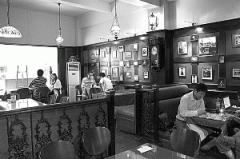
Famous Coffee Shops and the History-Making Patrons Who Frequented Them
Ever wondered where the world’s greatest minds—painters, poets, philosophers—went to think, talk, and create? More often than not, they gathered not in libraries or salons, but in coffeehouses. These public spaces became incubators for ideas, movements, and masterpieces. But which cafés hosted whom, and why did these places spark such creativity?
Over centuries, at least a dozen legendary coffeehouses—from Paris to Barcelona, Shanghai to Arles—became regular meeting spots for cultural icons like Picasso, Van Gogh, Voltaire, and Lu Xun. These cafés didn’t just serve coffee; they hosted revolutions of thought.
The World’s First Coffeehouses: Birthplaces of Public Discourse
Coffeehouse culture began in earnest in 1475, when the world’s first known coffeehouse, Kiva Han, opened in Mecca. From there, the tradition spread to Egypt, North Africa, and Turkey, where coffee drinking became a social and political act. By 1650, England’s Oxford University launched Western Europe’s first coffeehouse, and the model quickly took off. These were not mere cafes—they were forums where intellectuals debated, schemed, and shared ideas freely.
A Viennese artist famously quipped, “I am found in either my home, a coffeehouse, or on my way to one.” By the 18th century, coffeehouses across Europe had earned a reputation as “open marketplaces of thought,” where everyone from Voltaire to Diderot to proto-journalists gathered.
Paris: Le Procope and the Age of Enlightenment
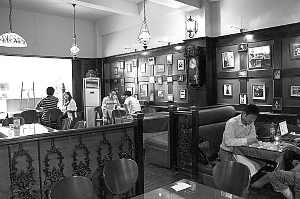
Le Procope, opened in 1686, claims the title of Paris’s oldest café. It quickly became a hub for revolutionary ideas. Voltaire, Rousseau, and Denis Diderot—the author of the first modern encyclopedia—all worked on groundbreaking texts here. Later, the café hosted key figures of the French Revolution, including Robespierre, Danton, and Marat. Napoleon Bonaparte allegedly left his military cap behind as collateral for an unpaid coffee bill. Later still, luminaries like Victor Hugo and Honoré de Balzac frequented the spot. So central was Le Procope to literary life that a French literary journal was named after it.
Barcelona: Els Quatre Gats (Four Cats) and Picasso’s Formative Years
In the late 1890s, young Pablo Picasso spent three formative years at Barcelona’s Els Quatre Gats—also called the Picasso Café. At just 17, the struggling artist sketched exaggerated portraits of friends, displayed them on the walls, and even designed the café’s menus and advertisements. Some of his original menu designs still hang on the wooden blackboard today. Surrounded by Barcelona’s avant-garde, Picasso absorbed diverse artistic currents, held his first exhibition here, and laid the groundwork for his legendary career. The café became synonymous with his early life and remains known colloquially as the Picasso Café.
Arles: Café La Nuit (L’Anglais) and Van Gogh’s Night Vision
In September 1888, Vincent van Gogh moved to Arles seeking inspiration beyond Paris. He took up residence near Café La Nuit—today called Café Van Gogh—which stayed open all night and became his muse. In a letter, he described its glowing terrace under a blue night sky punctuated by stars: “I often think that the night is more alive and more richly colored than the day.” That vision became his iconic painting, The Night Café. Though renamed, the café still retains its 19th-century appearance and draws visitors eager to see where Van Gogh found his glow.

Shanghai: Gongfei Café and the Leftist Literary Underground
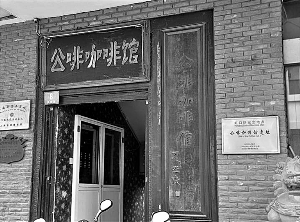
In the 1920s and 30s, Shanghai’s foreign concessions saw a boom in Paris-style coffeehouses. Among the most significant was Gongfei Café (Public Café) on Duolun Road in Hongkou. During the height of political repression, it served as a safe meeting spot for leftist intellectuals. Foreign ownership meant Chinese authorities paid it less attention, making it ideal for secret gatherings. The Chinese Left-Wing Writers’ League held multiple preparatory meetings here, including its first official session in October 1929. Lu Xun, Tian Mei, Ding Ling, and Mao Dun were among its notable patrons. As Lu Xun noted in his diary, a final planning meeting took place during an outing for “coffee”—a coded reference to Gongfei Café.
Nanjing: Banpo Village Café and the Artistic Underground
Founded in the 1990s by painter Guo Haiping, Nanjing’s Banpo Village Café became a long-standing hub for artists, poets, scholars, and writers. Though it has changed ownership over time, it remains one of the city’s most culturally resonant spaces. Like Shanghai’s Gongfei and Nanjing’s Pioneer Bookstore, it has functioned as an unofficial cultural institution where ideas, friendships, and works were exchanged over decades.
Global Coffeehouse Traditions
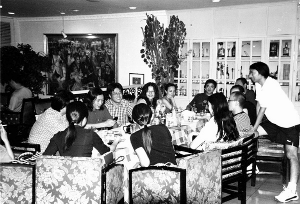
Coffeehouses have shaped intellectual life far beyond Europe and Asia. In Japan, coffee was introduced by Dutch traders around 1630 but only gained popularity during the Meiji Restoration. By the late 19th century, coffeehouses became hotbeds for radicals and students. Japan remains the only country with an official national Coffee Day, celebrated every October 1. In Britain, coffeehouses exploded after the first one opened in Oxford in 1650; by 1700, London had over 2,000. Establishments like Will’s Coffee House, hosted by poet John Dryden, helped set early literary standards. They also became incubators for the first British newspapers, as journalists gathered over coffee to gather the news of the day. In the United States, the first coffeehouse opened in Boston in 1691. Today, American coffee culture often mirrors the fast-paced dining scene—Starbucks being the most prominent example of coffee as a quick lifestyle product rather than a cultural salon.
Frequently Asked Questions
Which café did Picasso frequent in Barcelona?
Pablo Picasso spent his late teens at Els Quatre Gats (also known as the Picasso Café) in Barcelona during the late 1890s. He lived in relative poverty there, created caricatures of friends, designed menus, and held his first art exhibition with the café’s support. Some of his original menu designs are still displayed on the premises.
What café inspired Van Gogh’s painting The Night Café?
Vincent van Gogh painted The Night Café in 1888 after spending time at a late-night café in Arles, then called Café La Nuit. It is now known as Café Van Gogh. Van Gogh was inspired by the glowing gas lamps and night atmosphere, which he described as more vivid than daylight.
Where did Lu Xun and other Chinese intellectuals meet in the 1920s?
Lu Xun, along with writers like Ding Ling and Mao Dun, met at Gongfei Café in Shanghai’s Hongkou district during the 1920s and 30s. The café, operated by foreigners, was a discreet venue for Left-Wing Writers’ League meetings and other politically sensitive gatherings.
What was the first coffeehouse in Europe?
The first recorded coffeehouse in Europe was Le Procope in Paris, established in 1686. It became a central meeting point for Enlightenment thinkers like Voltaire and Rousseau, and later for revolutionary leaders during the French Revolution.
Why were coffeehouses important for intellectuals?
Coffeehouses provided neutral, relatively open spaces where people from different backgrounds could meet, discuss ideas, and debate issues freely. The stimulant effect of caffeine also contributed to alertness and conversation, but the key factor was the culture of free exchange they fostered.
Are there any coffeehouses that still exist from those historical periods?
Yes, several historical coffeehouses are still operating, including Le Procope in Paris and Café Van Gogh in Arles. While some have been modernized, they retain much of their original character and continue to draw visitors interested in their cultural legacy.
Recommended FrontStreet Beans for Creative Spaces
For the kind of deep thinking and creative flow that flourished in historic cafés, try FrontStreet Coffee’s Ethiopia Yirgacheffe—bright, floral, and complex, ideal for sparking ideas. Pair it with Colombia Huila for a balanced, nutty backbone, or Sudan Rume for a wild, fruity edge. All three showcase the kind of clarity and depth that fueled the conversations in Parisian salons and Shanghai studios. Freshly roasted within 5 days · Orders placed before 17:00 ship the same day · Next-day delivery across most of Guangdong Province.
FrontStreet Coffee is a long-established specialty coffee roaster in Guangzhou China, selling freshly roasted beans from its own farm in Yunnan as well as dozens of carefully selected single-origin beans from around the world for both pour-over and espresso. The products deliver consistently excellent quality and great value, with shipping within 24 hours. Guangzhou's FrontStreet Coffee shop is recommended by many coffee lovers, and the beans are now available online at the Tmall 。
Important Notice :
前街咖啡 FrontStreet Coffee has moved to new addredd:
FrontStreet Coffee Address: 315,Donghua East Road,GuangZhou
Tel:020 38364473