
"mesocarp"
470 article(s) found

A brief introduction to the processing process of Coffee beans
There are three main methods for processing coffee: dry, semi-dry and non-dry. The purpose of processing is to peel the coffee beans, reduce the water content of the coffee beans to a level suitable for preservation, and then deal with the coffee beans according to the market demand. Recently, the harvest of coffee has been fully spread out in Yunnan. I think it's time to pick out some of the blog posts I've posted. this

Colombian coffee species morphology coffee varieties boutique coffee beans China Coffee Network
The main varieties of Colombian coffee are small grains of coffee. Plants are small trees or large shrubs, 5-8 m tall, usually much branched at base; old branches gray-white, nodes dilated, young branches glabrous, compressed. Leaves thinly leathery, ovate-lanceolate or lanceolate, 6-14 cm long and 3.5-5 cm wide, tip long acuminate, acuminate part 10-15 mm long, base cuneate or slightly obtuse, rarely rounded, entire or
Colombian coffee bean Colombian species morphology Central and South American coffee beans
Species morphology the main varieties of Colombian coffee are small grain coffee. Plants are small trees or large shrubs, 5-8 m tall, usually much branched at base; old branches gray-white, nodes dilated, young branches glabrous, compressed. Leaves thinly leathery, ovate-lanceolate or lanceolate, 6-14 cm long and 3.5-5 cm wide, tip long acuminate, acuminate part 10-15 mm long, base cuneate or slightly obtuse, rarely round

A brief introduction to the initial processing of coffee beans
Recently, the harvest of coffee has been fully spread out in Yunnan. I think it's time to pick out some of the blog posts I've posted. I've been planning this for a long time. Almost a year ago, I posted a blog called "Harvest Rewards". It's about several ways to harvest coffee in this area. The coffee fruit should be peeled within 8 hours after picking, otherwise
Coffee berry picking-berry treatment-drying
The coffee beans we are talking about are actually the seeds of a fruit similar to cherries.

What is coffee cherry cherry fruit the whole ripening process takes about how long
Do you know where the boutique coffee comes from? what are coffee beans? coffee beans actually come from ripe coffee fruits, which are also called coffee cherries. What is coffee cherries? Coffee cherries are the fruits or berries of coffee trees that grow in clusters along the short stems of the plant. Coffee cherries are usually about 6 inch (1.5 cm) long and start out light green.
Coffee bean picking-berry treatment-drying
The coffee beans we are talking about are actually the seeds of a fruit similar to cherries.

Introduction to the treatment process of raw coffee beans Coffee trees bear fruit several times a year
When the coffee berries are ripe, they are usually harvested by manual picking. In some places, only the fully ripe berries are picked, while others are all picked from a single branch. The former is called handpicked and the latter is called strip-picking. Because the ripening time of coffee berries is not consistent, the harvest is likely to be divided into several stages.
Small coffee Coffea arabica Linn Arabica coffee
Small coffee Coffea arabica L. Coffea arabica Linn. Sp. Pl. one hundred and seventy two。 1753; A. Cheval. Op. Cit. 196; A. E. Haarer, op. Cit. 13; Flora of Hainan 3: 349. 1974; Atlas of higher plants in China 4: 285, figure 5929. 1975; Tree Map of Yunnan, Volume 2: 1151. 1991. Small trees or large shrubs, 5-8 m tall

A brief introduction to the processing process of High-quality Coffee beans
There are three main methods for processing coffee: dry, semi-dry and non-dry. The purpose of processing is to peel the coffee beans, reduce the water content of the coffee beans to a level suitable for preservation, and then deal with the coffee beans according to the market demand. Recently, the harvest of coffee has been fully spread out in Yunnan. I think it's time to pick out some of the blog posts I've posted. This
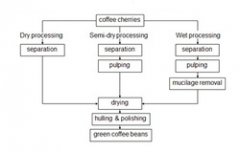
A brief introduction to the general knowledge of fine coffee the processing process of coffee beans
Recently, the harvest of coffee has been fully spread out in Yunnan. I think it's time to pick out some of the blog posts I've posted. I've been planning this for a long time. Almost a year ago, I posted a blog called "Harvest Rewards". It's about several ways to harvest coffee in this area. The coffee fruit should be peeled within 8 hours after picking, otherwise

A brief introduction to the processing process of coffee beans the transformation process of a bean
Recently, the harvest of coffee has been fully spread out in Yunnan. I think it's time to pick out some of the blog posts I've posted. I've been planning this for a long time. Almost a year ago, I posted a blog called "Harvest Rewards". It's about several ways to harvest coffee in this area. The coffee fruit should be peeled within 8 hours after picking, otherwise
Yunnan coffee
Yunnan is a subtropical mountain climate zone south of the Tropic of Cancer, with unique plateau red soil, rich and loose soil and mild climate, which is especially suitable for growing small-grain coffee, which can grow the best coffee in the world.

Morphology of quality species in Colombian coffee producing area
In terms of yield or texture, Colombian coffee is first produced by Medellin, which is characterized by full granules, rich nutrition, moderate acidity, good balance, rich aroma and soft taste. In addition to Medellin, the provincial capitals of two neighboring provinces in the south, Armenia and Manizales, are also famous coffee producers.

The growth process of Coffee Tree introduction to the method of flavor description in planting environment and region
The growth process of the coffee tree is described by the flavor description of the planting environment and the region. The taste treatment method introduces that the immature coffee is actually green. After a mature period of 6 to 7 months, the mature skin is red, because its shape is similar to that of cherries. Therefore, foreigners call the mature coffee a cherry (Cherry). Under the bright red skin, it is an ugly skin.

What is the fermentation of coffee beans? What is fermentation?
Professional coffee knowledge exchange more coffee bean information please follow the coffee workshop (Wechat official account cafe_style) what is fermentation? To put it simply, fermentation is the process by which sugar and starch are decomposed into acid or alcohol. Let's explore more deeply that yeast and bacteria are very important for fermentation. Yeast fermentation, called Saccharomyces cerevisiae, which is a natural wild yeast, is also found in

Sweet Colombia Arabica Flavor Description Grind Variety Description
Colombia coffee varieties are mainly small coffee. Plants are small trees or large shrubs, 5-8 meters high, usually multi-branched at the base; old branches are gray, nodes expand, young branches glabrous, compressed. Leaves thinly leathery, ovate-lanceolate or lanceolate, 6-14 cm long, 3. 5 -5 cm wide, apex long acuminate, acuminate part 10-15 mm long, base cuneate or slightly obtuse, rarely rounded, entire or rounded
Steps of wet treatment of coffee after picking
As the harvest season is almost over, I would like to add an overview of the coffee processing process. In this blog post, I will introduce to you the steps of wet treatment in Yunnan after coffee picking. After harvest, the berries are either sent directly to the pulp collector (if the harvest is done well), or concentrated in a siphon tank filled with water. The berries are here.
Explain the steps of wet treatment after coffee picking
As the harvest season is almost over, I would like to add an overview of the coffee processing process. In this blog post, I will introduce to you the steps of wet treatment in Yunnan after coffee picking. After harvest, the berries are either sent directly to the pulp collector (if the harvest is done well), or concentrated in a siphon tank filled with water. The berries are here.
Species morphology of Colombian coffee-flavored coffee
The main varieties of Colombian coffee are small grains of coffee. Plants are small trees or large shrubs, 5-8 m tall, usually much branched at base; old branches gray-white, nodes dilated, young branches glabrous, compressed. Leaves thinly leathery, ovate-lanceolate or lanceolate, 6-14 cm long and 3.5-5 cm wide, tip long acuminate, acuminate part 10-15 mm long, base cuneate or slightly obtuse, rarely rounded, entire or