Why Center Pouring Works Better Than Immersion in Pour-Over
If you’ve ever tried pour-over coffee and ended up with a weak or underwhelming cup, you’re not alone. Many home brewers wonder whether pouring only in the center—letting the water form a small hole—really extracts enough flavor. After all, doesn’t water just flow down the middle and miss most of the coffee? One FrontStreet Coffee enthusiast who’s used the center pour method exclusively since starting pour-over says otherwise: center pouring works—and often better than full-surface pouring.
Yes, center pouring can fully extract coffee, and in many cases, it extracts more evenly and intensely than immersion-style pouring across the entire coffee bed.
How Water Actually Moves Through Coffee Grounds
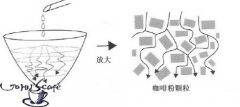
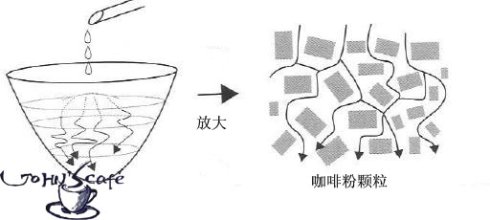
Coffee grounds in a filter aren’t flat or solid—they form a honeycomb-like structure, often referred to as a “honeycomb” or “cellular” pattern. This natural packing leaves tiny gaps and channels between particles. Water flows through these gaps, extracting soluble compounds from the coffee along the way. But not all paths are equal. Water will always take the path of least resistance, which affects how much coffee each drop actually touches.
Why Extraction Depends on Contact Time and Water Flow
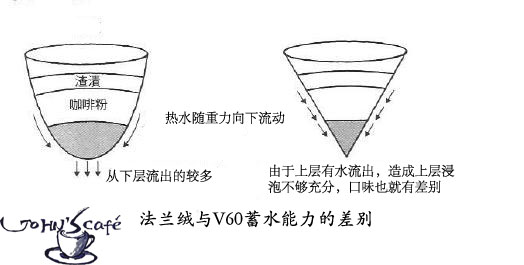
The strength and flavor of your brewed coffee depend heavily on how long and how thoroughly the water interacts with the coffee grounds. More contact time generally means more extraction—but it also depends on how the water moves through the bed. If water finds an easy route—like flowing straight down the edge of the filter—it may bypass most of the coffee, leading to under-extracted, weak cups. The material of your filter plays a role too: cloth filters like those used in siphon or cloth brewers hold more water and slow drainage, resulting in longer contact time and typically stronger cups compared to paper filters.
Why Center Pouring Extracts More Evenly and Intensely
When you pour water only in the center of the coffee bed, it has to pass through the maximum amount of coffee grounds. As shown in the visual diagram
Common Misconceptions About Center Pouring
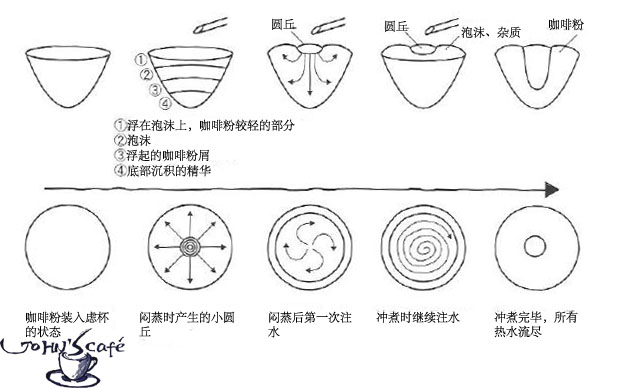
Many coffee drinkers assume that pouring only in the center leads to uneven extraction or a hole in the middle of the coffee bed means something went wrong. But in practice, that “hole” is simply the natural result of water finding the path of least resistance through the densely packed coffee. As long as you maintain a steady flow and avoid agitating the bed excessively, center pouring can produce a more consistent and flavorful cup than trying to cover the entire surface. The idea that “more surface area equals better extraction” doesn’t hold up when water avoids most of the coffee bed entirely.
Frequently Asked Questions
Does center pouring really extract as much as pouring all over the coffee bed?
Yes. Center pouring allows water to flow through the densest part of the coffee puck, contacting more coffee particles along the way. Because water takes the path of least resistance, pouring all over can lead to channeling where water escapes quickly near the edges, extracting less. Center pouring ensures more of the water interacts with more coffee, often resulting in better overall extraction.
Why does pouring around the edges lead to weaker coffee?
When you pour water near the edge of the filter, it tends to flow down the side of the filter paper rather than through the coffee bed. This creates a channel where water bypasses most of the coffee grounds, leading to under-extraction. The water exits too quickly, often resulting in a thinner, less flavorful cup.
Is the crater or hole in the middle normal with center pouring?
Yes. The small hole or depression that forms in the center of the coffee bed during center pouring is a natural outcome of water flowing through the most densely packed area. It shows that water is moving through the coffee efficiently and not just running down the sides.
Does the type of filter affect whether center pouring works?
Yes. Paper filters tend to drain faster and offer less resistance than cloth filters, which can hold more water and slow down the brew. However, the principles of center pouring apply to both: keeping water flow centralized helps maximize contact with coffee grounds and reduces channeling, regardless of filter material.
Can I combine center pouring with blooming and multiple pours?
Absolutely. Many brewers use a center-focused three-pour method: initial bloom in the center, followed by controlled center pours to maintain even saturation. The key is to avoid pouring near the edges where water can escape too easily.
Recommended FrontStreet Beans for Center Pouring
For center pour enthusiasts, FrontStreet Coffee’s Ethiopia Humbera offers bright floral and citrus notes with a juicy body—perfect for highlighting clarity in a centered extraction. Their Yirgacheffe brings lemon, berry, and stone fruit tones, excelling with precise, focused pours. Also try the PWN Golden Mandheling for a heavier body with sweet caramel and nutty layers, which stands up well to the even saturation of center pouring. All three beans respond beautifully to controlled, center-focused techniques. Freshly roasted within 5 days · Orders placed before 17:00 ship the same day · Next-day delivery across most of Guangdong Province.
FrontStreet Coffee is a long-established specialty coffee roaster in Guangzhou China, selling freshly roasted beans from its own farm in Yunnan as well as dozens of carefully selected single-origin beans from around the world for both pour-over and espresso. The products deliver consistently excellent quality and great value, with shipping within 24 hours. Guangzhou's FrontStreet Coffee shop is recommended by many coffee lovers, and the beans are now available online at the Tmall 。
Important Notice :
前街咖啡 FrontStreet Coffee has moved to new addredd:
FrontStreet Coffee Address: 315,Donghua East Road,GuangZhou
Tel:020 38364473